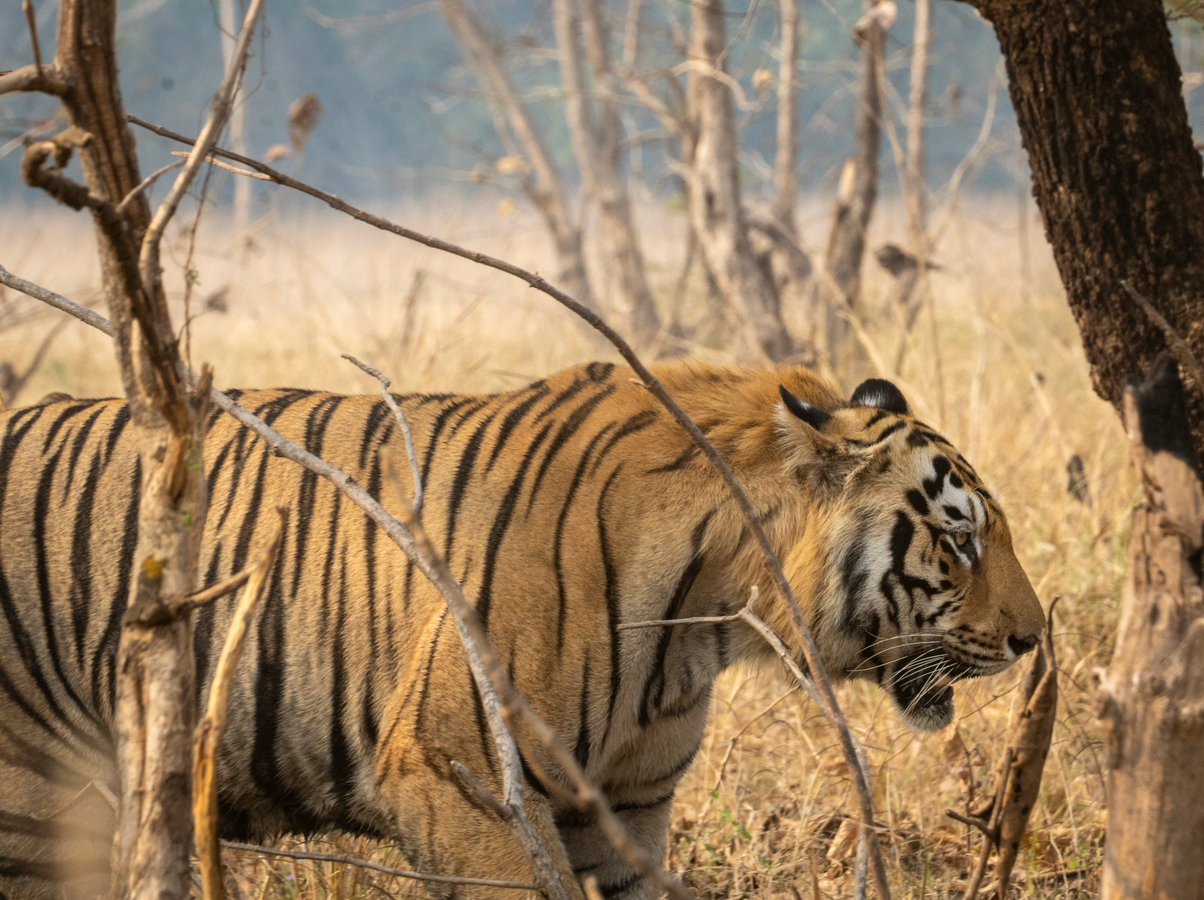
Tadoba National Park (Maharashtra), March 8 The evening air, thick with anticipation, was broken by what sounded like a bark. To our untrained ears, it was just another jungle sound.
But to our guide Santosh, who was in the front seat of our open-top Gypsy, it was a signal he had been waiting for all afternoon. "Shhh, it's here! I'm telling you, the tiger is nearby," Santosh said calmly and confidently.
We had been driving through the jungle for the last two hours in the Gypsy, but each attempt to spot a tiger had been unsuccessful. As the sun began to set, we stopped at a waterhole where other Gypsies, carrying hopeful tourists, had already parked. We moved towards the waterhole, expecting to see the tiger emerge from a raised embankment on the opposite side.
That's when Santosh heard the bark of a spotted deer – the sound the animal makes to warn other herds when it senses a tiger nearby. The bark rang out again, but this time from a different direction.
"Quick, quick, turn around!" Santosh motioned to our driver Atul, telling him to reverse and head back to the road we had passed earlier. We had to be the first to arrive before the other Gypsies did. Atul was a skilled driver. So were the other drivers. Without any traffic, the five Gypsies reversed, turned, and parked at the dirt road fork surrounded by tall grass, trees, and shrubs. We waited, cameras ready. Not for long.
Suddenly, a magnificent cub emerged from the foliage, her gait confident and unafraid of the humans waiting to photograph her – with long lenses. Behind her, followed her sister. Both walked together, their large, furry, striped heads occasionally nuzzling playfully.
This was the moment all safari-goers had been waiting for all afternoon. To witness the majesty of a tiger is indescribable. To see it so close that you could discern every strand of its hair was a truly awe-inspiring experience.
Seconds passed and the cubs – about two or three years old, which is the age of a pony for a tiger cub – approached the waiting Gypsys. A hushed silence filled the warm jungle air. The only sound was the clicking of DSLR camera shutters.
Santosh told us that the tigers of Tadoba are so used to seeing safaris that they see humans and their vehicles as part of the jungle.
But he gave us a tip: "If the tiger looks at you, make eye contact, keep your gaze steady, and don't crouch. That way, it will know you are not a prey."
He said the two cubs were born to Chhoti Madhu, one of the many named tigers of Tadoba. The cubs don't get names until they are adults. Chhoti Madhu has a third cub, a male. We didn't see him. But we did catch a glimpse of Chhoti Madhu a few hundred metres away. She remained hidden while her girls played with each other in front of the Gypsies before making their way to the waterhole to quench their thirst.
The forest officer of the area, Santosh Thipe (not the same Santosh as the guide), later told us that the other tigers that roam the area are Shambu, Vaiman, Chhota Dadiyal (named after his luxurious cheek hair), W (named after a W pattern on his forehead), and Collar Wali (fitted with a tracking collar by the forest authorities).
"Of all the animals in the jungle, the tiger is the most regal. Its demeanour is that of a king. It is aloof, dignified, and above all, powerful," said Thipe.
He pointed out that a tiger will never attack anyone unless it is hungry.
"Unlike humans, wild animals are not greedy. They kill only when they want to eat," said Thipe, who is a native of the neighbouring Chandrapur, the district headquarters.
Tadoba is one of 58 tiger reserves in the country, and arguably the most popular because of its relatively easy tiger spotting. It is a three and a half hour drive from Nagpur, and has several lodging options around the national park in the buffer zone.
Safari times are limited to four hours in the morning and four in the afternoon, with tourists required to leave the core area by 6 pm in the winter, a deadline enforced very strictly. Tadoba gives tourists the option to enter from 23 safari gates.
No mobile phones are allowed in Tadoba and many other national parks following a Supreme Court directive last year.
The national park is home to about 90 tigers, with neighbouring areas which make up the Tadoba Andhari Tiger Reserve accounting for another 100 tigers. Just a decade ago there were only 30 in the area.
The Andhari river forms the lifeline of the abundant wildlife in the reserve, comprising spotted deer, sambar deer, sloth bear, Indian gaur, wild dogs, leopards, crocodiles, storks, egrets, owls, spiders, and many more.
A safari is a great opportunity to learn about the other life forms that we share our planet with, and to pick up interesting vignettes about the national animal. For example, jungle cats use tree trunks, bushes, and boulders to urinate and scent-mark their territories.
Every tiger has a unique pattern of stripes, and is best identified by the stripes on its flanks drawn by nature in perfect symmetry. As the English poet William Blake noted:
"Tyger Tyger, burning bright,
In the forests of the night:
What immortal hand or eye,
Dare frame thy fearful symmetry?"