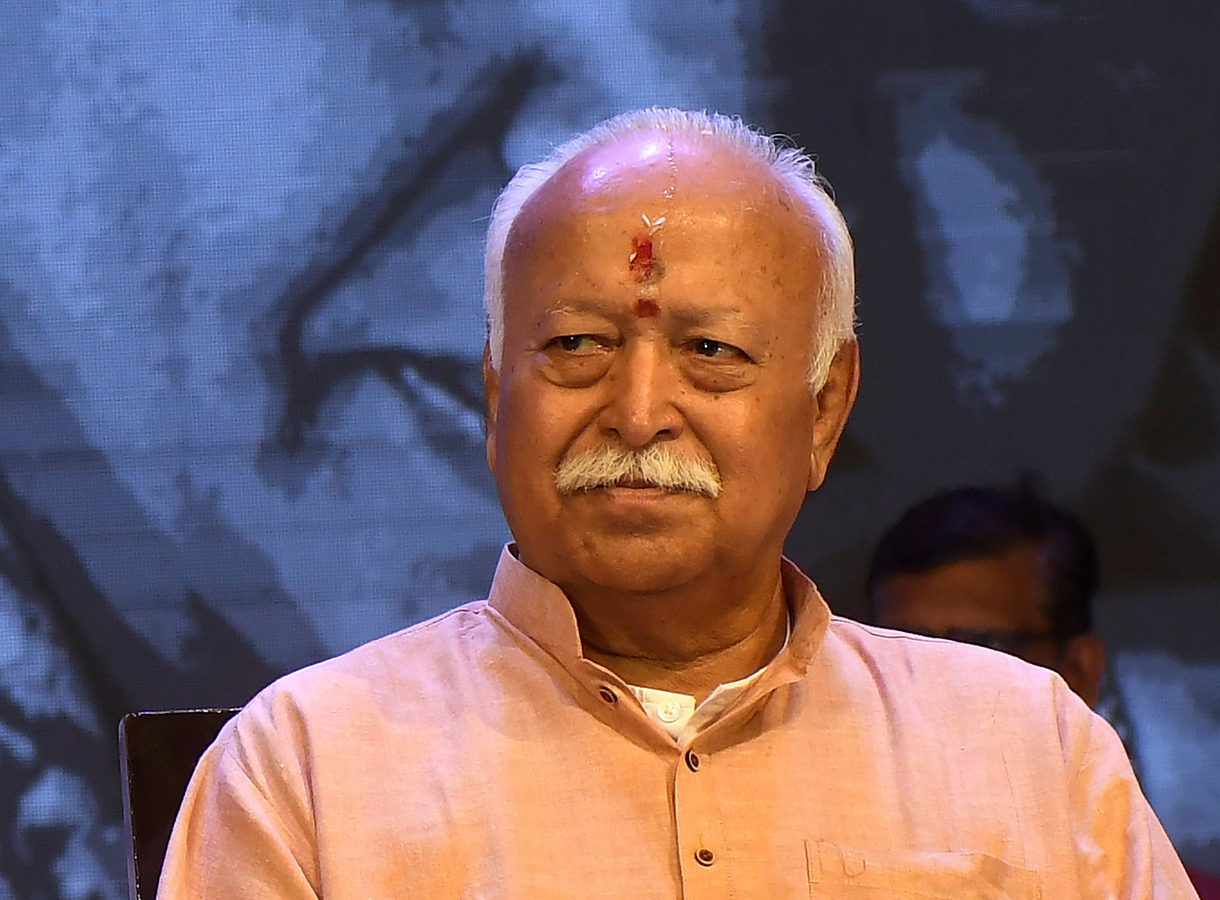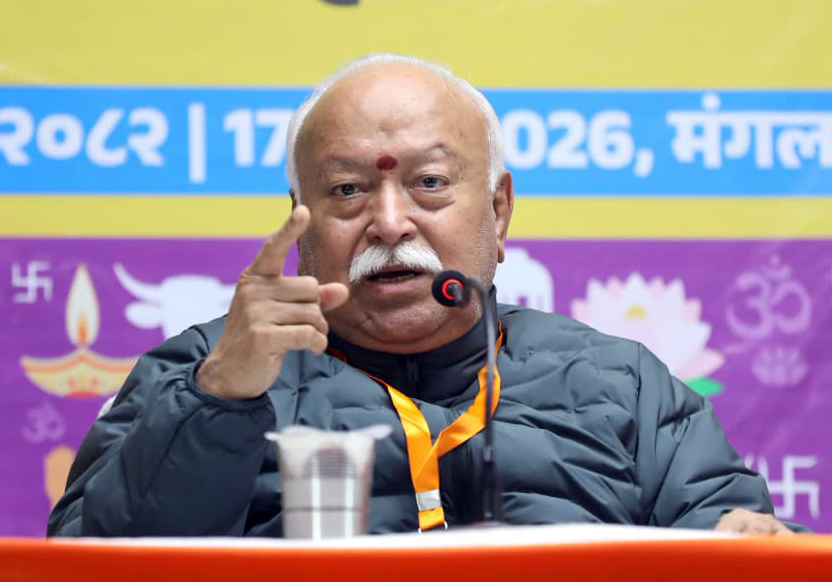
Lucknow, February 17 – RSS chief Mohan Bhagwat called on Hindu society to unite, strengthen itself, and take decisive steps to reverse population decline, halt forced or inducement-based conversions, and accelerate "Ghar Wapsi" efforts, while remaining alert to external and internal challenges.
Addressing a gathering on social harmony at Saraswati Shishu Mandir in Nirala Nagar, Lucknow, Bhagwat said that Hindus are not currently under immediate threat from others, but must remain cautious and proactive. He expressed serious concern over the declining Hindu population and emphasized that families should aim for at least three children, which he described as essential for the community's long-term survival.
"Scientists have pointed out that any society where the average number of children per family falls below three faces the risk of extinction in the coming generations," he said, urging newly married couples to understand this responsibility.
He added that the true purpose of marriage is to carry forward the world with a sense of duty, not merely to fulfill personal desires. Bhagwat demanded an immediate end to conversions driven by greed, inducement, or coercion, and called for speeding up the "Ghar Wapsi" programme to welcome back those who wish to return to Hinduism.
He emphasized that returnees must be properly supported and integrated. Regarding illegal infiltration, the RSS chief was unequivocal; infiltrators should be identified without delay, excluded from society, deported, and barred from any form of employment.
He reiterated that Hindu society needs to be organized and empowered to safeguard its identity and future, while simultaneously promoting harmony and ending all forms of discrimination within the larger Indian family.
The address drew representatives from various spiritual and social organizations, underscoring the call for unity and collective responsibility.
Bhagwat advised Hindu families to have at least three children, citing scientific views that societies with an average of fewer than three children per family risk extinction in the future. This message, he suggested, should be conveyed to newly married couples.
The RSS chief described the purpose of marriage as advancing the world through a sense of duty rather than merely satisfying desires. Highlighting the importance of harmony, he said that its absence breeds discrimination. All people are children of one motherland, and as humans, are fundamentally one. Discrimination emerged over time as a habit that must be eliminated.
Sanatan ideology, he noted, promotes harmony, and the same truth exists everywhere. Opponents need not be destroyed; understanding this philosophy removes divisions.
Bhagwat emphasised women's power as the foundation of family and home. In tradition, men earned while mothers managed spending. Women embrace new families after marriage and should not be seen as weak but as powerful figures, akin to demons and warriors in cultural imagination.
He called for training women in self-protection. In contrast to Western views of women as wives, Indian tradition regards them as mothers whose affection matters more than beauty.
Responding to a question on UGC (University Grants Commission) guidelines, Bhagwat said that everyone must follow the law. If a law is flawed, constitutional means exist to amend it. Castes should never fuel conflict; a strong sense of belonging prevents such issues. Those who have strayed should be respectfully brought back, fostering unity through coordination instead of suppression or elevation of one over another.
He asserted that India will soon guide the world, offering solutions to global problems.
Bhagwat urged regular locality-level meetings on social harmony to clear misunderstandings, challenge stereotypes, resolve issues, and support the weak. He warned against plots by some elements in countries like the US and China aimed at undermining goodwill, calling for caution, ending internal distrust, and sharing each other's joys and sorrows.
Representatives from diverse groups, including Sikh, Buddhist, and Jain communities, along with organizations such as Ramakrishna Mission, ISKCON, Art of Living, Sant Nirankari Ashram, Arya Samaj, and others, attended the event.