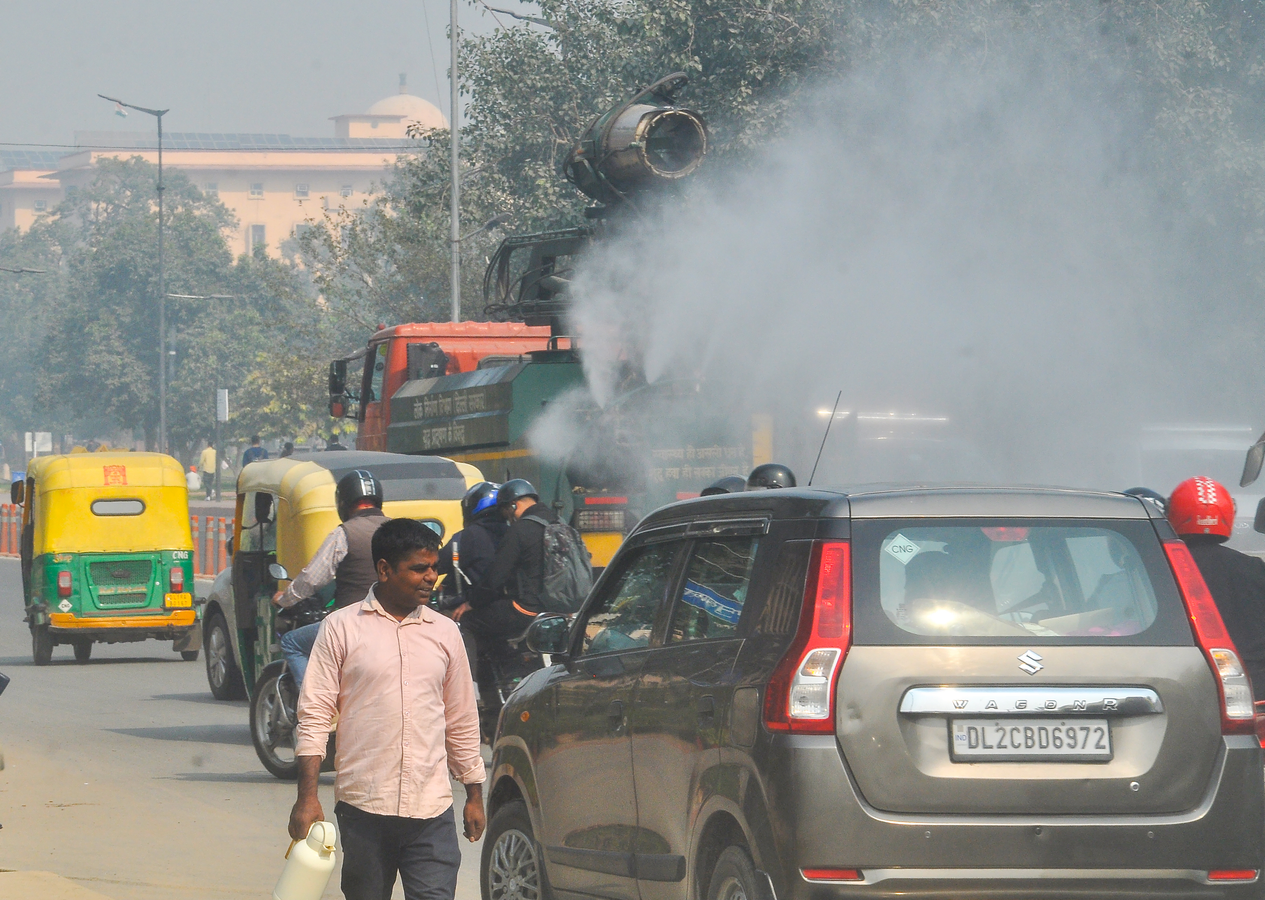
New Delhi, February 25 – Air quality in Delhi remained "poor" on Wednesday, with Anand Vihar registering "very poor" conditions, as indicated by an AQI of 342. The Delhi-NCR region is experiencing a gradual increase in temperatures, although mornings and evenings remain relatively cooler.
According to the Central Pollution Control Board (CPCB), several monitoring stations across the national capital reported varying air quality levels. Anand Vihar recorded an AQI of 342 (very poor), Ashok Vihar 258, Burari Crossing 265, Chandni Chowk 275, DTU 229, Dwarka Sector-8 254, IIT Delhi 173, ITO 284, Jahangirpuri 292, Lodhi Road 159, Mandir Marg 165, North Campus 241, Punjabi Bagh 261, Pusa 192, R.K. Puram 262, Rohini 282, Sonia Vihar 260, and Wazirpur 299. Most of these areas fell into the "poor" category, with a few registering "moderate" levels.
To improve air quality monitoring, Delhi has activated six new Continuous Ambient Air Quality Monitoring Stations (CAAQMS), bringing the total number of such stations in the city to 46 – the highest in the country. This initiative aims to enhance real-time air pollution tracking and enable more data-driven policy interventions.
The newly operational stations are located at Jawaharlal Nehru University (JNU), Indira Gandhi National Open University (IGNOU), the ISRO Earth Station near Malcha Mahal (Central Ridge), Delhi Cantonment, Commonwealth Sports Complex, and Netaji Subhash University of Technology (West Campus). These stations are now transmitting live air quality data to the Delhi Pollution Control Committee (DPCC) website, enhancing transparency and accessibility of information for residents and authorities alike.
Meanwhile, temperatures in the national capital region are steadily rising. Reports suggest that temperatures are likely to peak around Holi, with intense sunshine expected to make conditions uncomfortable during the day. This warming trend is not limited to the NCR but is also likely to be observed across most parts of North India, including Haryana, Punjab, Uttar Pradesh, and Rajasthan.
Currently, Delhi's maximum temperature is around 30 degrees Celsius, while the minimum is approximately 13 degrees Celsius. However, a gradual increase is expected in the coming days. By Saturday, the maximum temperature is expected to reach 32 degrees Celsius, with the minimum climbing to around 16 degrees Celsius. By March 4, the maximum temperature may reach 33 degrees Celsius, while the minimum could settle near 17 degrees Celsius.
On Wednesday, the minimum temperature is likely to remain near normal, while the maximum temperature may be significantly above normal – approximately 3.1 to 5.0 degrees Celsius higher. On February 26, the sky is likely to remain mostly clear. The maximum temperature is expected to range between 30 and 32 degrees Celsius, while the minimum may hover between 13 and 15 degrees Celsius.
Delhi appears set to end February with unusually warm temperatures, with maximum temperatures running significantly above seasonal norms and winter retreating earlier than usual. Daytime temperatures repeatedly remained several degrees above the long-period average throughout the month. A peak of 31.6 degrees Celsius was recorded on February 16 at Safdarjung – the city’s base weather station – about 7.2 degrees Celsius above normal and marking the earliest breach of the 30-degree Celsius mark in five years.
Delhi's all-time February high is 34.1 degrees Celsius (recorded on February 26, 2006), while recent highs include 33.6 degrees Celsius (February 21, 2023) and 32.4 degrees Celsius (February 26, 2025). Whether 2026 sets a new record will depend on late-month temperature spikes; so far, 31.6 degrees Celsius remains the month's peak.
After beginning the month with a mean temperature of 18.35 degrees Celsius on February 1 – already about 3 degrees above normal – the city experienced only brief dips. For example, on February 2, the mean temperature fell to 13.95 degrees Celsius, slightly below the climatological average. Thereafter, temperatures rose steadily, with several days recording mean values 2-4 degrees Celsius above normal. Following a brief cooldown due to light rain and gusty winds around February 18, heat levels climbed again under clear skies. Observations from Safdarjung, Palam, Ridge, Lodhi Road, and Ayanagar confirmed that above-normal temperatures were widespread across the city.