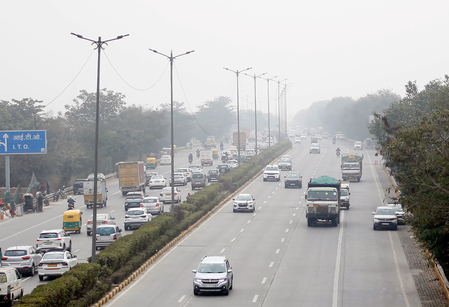
New Delhi, March 17 – Delhi experienced a notable improvement in air quality on Tuesday, with the Air Quality Index (AQI) falling into the 'satisfactory' and 'moderate' categories at several monitoring stations. In light of this significant improvement, all restrictions under the Graded Response Action Plan (GRAP) have been lifted in the Delhi-NCR region, officials confirmed on Monday.
According to official data, AQI levels across key areas showed considerable improvement. Ashok Vihar recorded 144, Aya Nagar 132, Bawana 165, Burari Crossing 120, CRRI Mathura Road 121, Delhi Cantonment 122, Chandni Chowk 134, and the Commonwealth Sports Complex 133. Other areas such as DTU reported 93, Dwarka Sector-8 157, IGI Airport (T3) 129, IIT Delhi 127, JNU 113, and Narela 140. However, a few locations like Mundka (170), Patparganj (164), Rohini (174), Shadipur (185), and Wazirpur (197) remained in the moderate range.
The Commission for Air Quality Management (CAQM) attributed the improvement to favourable meteorological conditions. Delhi's overall AQI was recorded at 119 on Monday. "Forecasts by the India Meteorological Department (IMD) and IITM indicate that the AQI is likely to remain in the moderate category in the coming days," an official stated.
With the lifting of GRAP measures, several restrictions have been lifted. These include the ban on the use of coal and firewood in tandoors at hotels, restaurants, and open eateries, as well as limitations on the use of diesel generators, which are now permitted beyond emergency situations.
GRAP comprises four stages, each triggered by AQI levels. GRAP-1 is implemented when AQI ranges from 201 to 300, GRAP-2 from 301 to 400, GRAP-3 from 401 to 500, and GRAP-4 when AQI exceeds 450.
This year, GRAP-4 restrictions were enforced on January 17 amid severe pollution levels. As air quality gradually improved, these measures were rolled back in phases. GRAP-4 was lifted on January 20, followed by GRAP-3 two days later, and GRAP-2 restrictions were lifted on February 18.