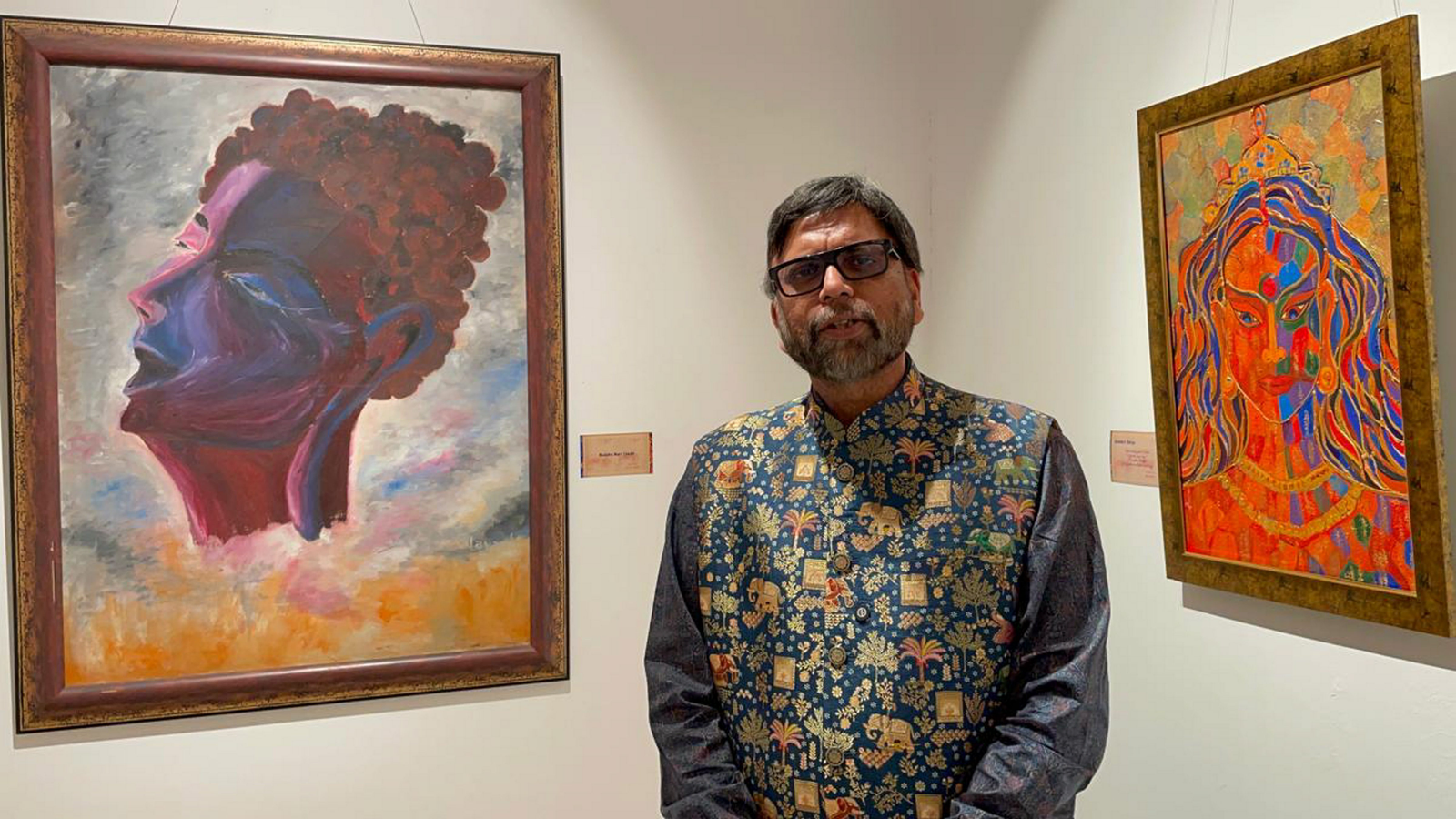
New Delhi, April 4 A diplomat's job largely involves conducting bilateral engagements and signing agreements, but Ambassador Jayant Khobragade, India's envoy to Spain, seamlessly combines his professional duties with his artistic pursuits.
The officer, who joined the IFS in 1995, is currently hosting an exhibition of his artworks, created over the last nearly 30 years, at the Travancore House here. The exhibition includes paintings of nature, depictions of Lord Ram and Lord Krishna, as well as works inspired by flamenco dance and Spanish music.
One of the artworks on display is "Buddha Must Laugh," an oil painting created in 1997, which Khobragade calls his "only political work" in the exhibition.
"Art is very important to me. Diplomacy is my profession, music is my passion, but painting is simply a way of life. I have been painting for three and a half decades. This is my 15th exhibition, and the second one in Delhi," Khobragade told
The diplomat, who was appointed India's envoy to Spain last year, had previously served as the country's ambassador to ASEAN (Association of Southeast Asian Nations), headquartered in Jakarta, and Kyrgyzstan, in addition to diplomatic assignments at Indian embassies in Moscow, Madrid, Almaty, and Bishkek.
Asked about how his career in diplomacy and art intersect, Khobragade said he sees no contradiction.
The diplomat, who also has a passion for music and photography, shared how many of his artworks were inspired by the surroundings and cultures of the host country where he was posted.
"Any artist perceives their surroundings. When I was in Spain, I got ideas for painting. In Moscow, I held an exhibition titled 'The Russian Soul', which was about Russian poetry."
"As the Indian ambassador to ASEAN, I had the opportunity to visit the greatest temples of the region, such as Angkor Wat and the Borobudur temple, which left a deep impression on me," Khobragade said.
One key aspect of diplomacy is fostering people-to-people connections between two countries, and Khobragade said art helped him establish those connections.
"Diplomacy itself is an art. For a diplomat, it is very important to connect with people," he said.
One artwork, "Leela: A Duel in Mind," stands out due to its impressive scale – 2 m x 1.5 m – and vibrant use of colors.
Khobragade said he painted it two years ago when he was posted in Jakarta, and it took him almost nine months to complete.
"I wanted to depict the connection between India and Southeast Asia, the cultural and civilizational connection between the two sides. I portrayed the more standard image of Lord Ram from our culture, but I depicted Ravan from Southeast Asia. Sometimes, they don't depict Ravan with 10 heads in one row, but in a 5-3-2 tiered fashion," he said.
The vivid canvas also depicts the battlefield and fire in Lanka, Ravan’s kingdom, in the background.
Asked about his work based on the culture of Spain, Khobragade said he did it from 2008 to 2011, when he was posted as a counsellor in Madrid.
These works are titled "Flamenco," "Daughters of Spring," "Daughters of Autumn," "Dance," and "Knot in the Threads."
"I picked up not only flamenco dancing, but also visited different museums and saw classical European paintings. One needs visual literacy, as I call it, for art," he said.
On his second stint in Spain, Khobragade said, "As soon as I reached Madrid, I purchased a canvas and paint and started painting. Some of those works are on display, such as 'Octo-Ganesha' and 'Holi', portraying Lord Krishna and Radha."
"We are celebrating 2026 as India-Spain Year of Culture, Tourism and Artificial Intelligence. So, as part of culture, this exhibition becomes my personal contribution," the ambassador said.
The year 2026 marks 70 years of diplomatic relations between the two countries.
Asked if art can be a tool of diplomacy for peace when conflicts are taking place in various parts of the world, Khobragade said art in any form can be a facilitator to achieve peace.
Knowing a country's culture and civilisational roots helps one to better understand people, and that can aid in dialogues between two sides, he said.
Sharing the story behind the theme and caption for his 1997 artwork "Buddha Must Laugh," Khobragade said, "When India conducted its first nuclear test in 1974, the prime minister had described it as 'Buddha Smiled'. In the 1990s, the negotiations on the Comprehensive Test Ban Treaty (CTBT) were not going anywhere. So, I thought that now 'Buddha Must Laugh'. I displayed this painting in August 1997 at the Lalit Kala Academy. In May 1998, we went for another round of (nuclear) tests."
While Khobragade has travelled to many countries and exhibited his works on varied subjects, his colour palette remains “very Indian.”
"I absorb cultural elements wherever I stay, but the core remains Indian," he said.