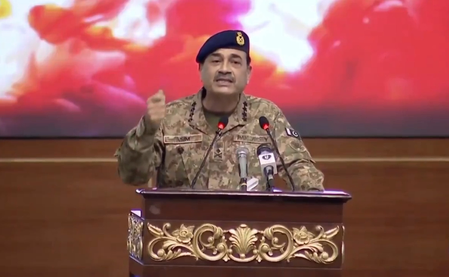
New Delhi, April 7 – Pakistan has been engaged in a disinformation campaign against India. While Pakistan is known to support terrorist groups to target India, in recent months, it has also been spreading false information about its neighboring country.
This sudden increase in the spread of false information in India is attributed to the failure of Field Marshal Asim Munir and his efforts to establish his own legacy. A key turning point was Operation Sindoor, during which the Indian armed forces effectively neutralized the terrorist infrastructure.
According to a senior Intelligence Bureau official, Munir's biggest setback came from Pakistan's own proxies, particularly the Jaish-e-Mohammad (JeM). The JeM questioned the ability of the Pakistan Army and the ISI to protect the group, especially after the Indian forces targeted their headquarters in Bahawalpur.
Masood Azhar, the chief of JeM, is reportedly dissatisfied with the establishment, and since Operation Sindoor, he has largely remained out of the public eye. Another official stated that, given the questions being raised about the capabilities of the Pakistan Army, Munir felt compelled to launch a disinformation campaign against India.
While this strategy initially proved somewhat effective, it ultimately failed when Pakistan faced diplomatic setbacks while dealing with other countries. Analysts suggest that Pakistan's foreign policy, which it had hoped to build a reputation on, has been undermined.
The conflict in Afghanistan also proved detrimental to Munir's efforts. He had anticipated easily controlling the Afghan Taliban, but this plan backfired. Since the Taliban's return to power, Pakistan had hoped to exert influence in Afghanistan, but this effort was unsuccessful. Afghanistan has clearly stated that it will not allow any foreign influence in its own foreign policy.
A significant factor was the reconciliation between the Afghan Taliban and India. This led the Pakistan Army to falsely claim that the Tehreek-e-Taliban Pakistan (TTP) was given space to launch attacks.
The Afghan Taliban has vehemently denied these claims, but Pakistan decided to launch a military operation against Afghanistan. Disnfo Lab, a research group investigating information warfare and psychological operations, took to X and stated that, following Operation Sindoor, Munir has been actively working to establish his leadership.
Pakistan has been facing a cold reception from the UAE, Saudi Arabia, Iran, and Afghanistan. Munir is desperately trying to create a positive narrative to counter this, as it is now a matter of his survival. The global media is not buying Pakistan's narrative, and therefore, it is actively developing its own global media network to promote its preferred narratives.
Disnfo Lab points to the creation of the Himalayan Institute of Research and Policy Studies (HIRPS) at the Minhaj Institute in Lahore. This institute claims to study geopolitics, security, and climate across the Himalayan region, encompassing Pakistan, China, India, and Central Asia. Founded in November 2025, the institute is headed by Professor Dr. Hussain Mohi-ud-Din Qadri, a prominent critic of India. Under his leadership, the institute includes academics, retired military officers, and other individuals who also engage in anti-India campaigns.
An official stated that the HIRPS's purpose is to facilitate discussions and conduct research. While the institute claims to be studying geopolitics, its actual goal is to host global conferences and then disseminate a false narrative against India.
The institute would portray India as an aggressor in the region to allow the global media to pick up the information, the official added.
Furthermore, Pakistan also formulated the Strategic Communication Master Plan 2025 (STRATCOM 2025), which aims to establish English-language media platforms to project Pakistan's false narratives globally. As part of Munir's strategy to gain international recognition, he also facilitated the creation of media platforms such as AsiaOne News (Karachi, July 2025), Pakistan TV Digital (August 2025), DM News English (Manchester, UK, August 2025), FP92TV (Paris, active from 2024), and Afrik1 TV.
AsiaOne is headquartered in Karachi and was launched just two months after Operation Sindoor. The channel has recruited presenters from Turkey, Nigeria, the UK, and Australia. The hiring process is designed to give the platform an international appearance. The channel is owned by 365 Digital Media Company and was founded by Naveed Qamar Baloch, a former TRT World journalist, who has close ties with the ISI.
TRT, a state-funded media group in Turkey, has been assisting Pakistan in spreading a false narrative against India. It has repeatedly promoted the false claims made by the DG ISPR against India. For instance, during Operation Sindoor, the media outlet disseminated false news about Indian jets being taken down by the Pakistan armed forces.
Another media outlet that the Pakistan establishment launched was DM News English, founded by a Manchester-based British Pakistani, Dr. Liaqat Malik. The media outlet presents itself as British and has studios in Manchester, Birmingham, London, and Lahore. The founder is a known peddler of fake news and has frequently promoted criminal activities on air.
To ensure that Pakistan's false narrative reaches a wider audience, it also launched FP92TV, a French-Urdu digital channel.
These developments clearly indicate that Pakistan is losing the global narrative. The global media is not buying Pakistan's stories.
Pakistan had touted its role in brokering a ceasefire between Iran and the United States. However, Iran has expressed serious concerns about a lack of trust. This was Asim Munir's best opportunity to establish himself as a global leader, but this effort ultimately failed. Pakistan's military alliance with Saudi Arabia ultimately proved insufficient in the face of Iran.
Even the UAE, which has been a target of the ongoing conflict, has significant concerns about Pakistan, as the country appears to be shifting its allegiance based on external pressures. An official explained that questions are being raised about Asim Munir both domestically and internationally. This explains why he has established so many media outlets. He is desperate for global attention and hopes that these outlets, which he has established, will help him gain attention in the global media.
Munir has also successfully suppressed local media while promoting these new outlets, which are presenting themselves as global brands.
Another official explained that Pakistan's misadventure in Pahalgam cost them the narrative and lost face. The Narendra Modi government responded forcefully with Operation Sindoor, which Asim Munir is still struggling to accept, the official said.