New Delhi, February 18 – The resurgent Bangladesh Jamaat-e-Islami is asserting itself politically, as evidenced by its firm stance on immediate constitutional reforms, directing its criticism at the newly formed government led by BNP's Tarique Rahman.
In June last year, the registration of Bangladesh's largest Islamic party was restored more than a decade after it was banned by the Awami League government led by Prime Minister Sheikh Hasina.
Its re-emergence follows a turbulent past, during which the party faced legal restrictions and political isolation due to its opposition to Bangladesh's 1971 independence and the wartime activities of some of its leaders.
Some commentators have framed Jamaat's return to parliamentary politics as a rehabilitation into mainstream politics, while others view it as a concerning normalization of a party with a controversial past.
The Islamist party sought the formation of a new parliament as a constituent assembly to amend Bangladesh's constitution and introduce wide-ranging changes as outlined in the "July Charter," a package of constitutional reforms proposed and promoted by the interim administration led by Muhammad Yunus following the 2024 uprising in Bangladesh. This aims to reshape key institutions, strengthen checks and balances, and redefine the rules governing executive power, the judiciary, and electoral arrangements.
A Constitutional Reform Council was envisioned to oversee and implement the Charter's amendments and the broader reform roadmap.
However, Rahman's Bangladesh Nationalist Party (BNP), which was reluctant to sign the Charter, wants to adhere to the existing rules. Party leaders emphasized that there is no constitutional provision for a "Constitutional Reform Council."
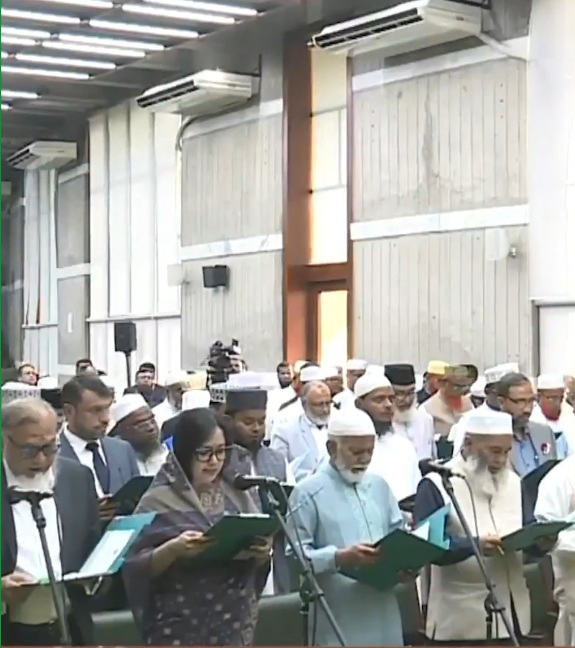
Furthermore, Bangladesh's Chief Election Commissioner (CEC) does not have the authority to administer an oath to such a body. The CEC administered the oath of office to MPs on Tuesday.
While Jamaat may not have been able to form a government, it achieved significant gains in vote share and the number of seats in last week's election. Its assertive posture and renewed outreach to student politics have left analysts and rivals warning that the party will be a disruptive and influential actor in Bangladesh's politics in the future.
Its performance in the 13th national election marked a historic comeback from the margins. Official figures and party statements show that it secured its best-ever vote share and seat count, obtaining 31.76% of the mandate and winning 68 seats.
These figures transformed Jamaat from a peripheral actor into the main opposition force in parliament.
"The Jamaat had successfully spread its influence in regions bordering India among the population settled there who moved out of India after partition. The BNP was comparatively weaker in these areas. However, neither could post any gains here earlier due to the Awami League’s dominance," contended Soumya Bandopadhyay, Consulting Editor to Bangladesh’s Prothom Alo newspaper.
"Now the political space lies open for the Jamaat in Khulna, Rajshahi, and Rangpur divisions," added the veteran journalist.
Citing statistics, the Delhi-based scribe pointed out that the Jamaat, when contesting on its own, earlier got its "best results" in 1991.
"They had then won 18 seats, with 12 per cent of the total mandate. In 1996, their seat tally fell to three, and their vote percentage to nine," he recounted.
"In 2001 and 2008, when the Jamaat contested in alliance with the BNP, it won 17 seats, with a four per cent share in the first, and two wins and a vote share of five in the next," he said, adding: "That has jumped to about 32 per cent now."
Overall, the BNP-led alliance won 212 seats, followed by 77 for the Jamaat-led alliance, out of the 297 parliamentary seats for which results were announced. Out of the 300 seats in the Bangladesh Parliament, elections were held for 299 seats following the death of a candidate. Later, a court barred the publication of results for Chattogram‑3 and Chattogram‑8 constituencies, thus the latest results reflect the outcome of voting for 297 seats.
The National Citizen Party (NCP), founded by a section of the 2024 youth protestors, aligned with the Jamaat and came in third, winning six of the 30 seats it contested. Fifty other members are nominated to Parliament, based on the votes secured by the political parties in 300 constituencies. NCP leader Nahid Islam, 27, also won, becoming one of the youngest MPs in the new parliament.