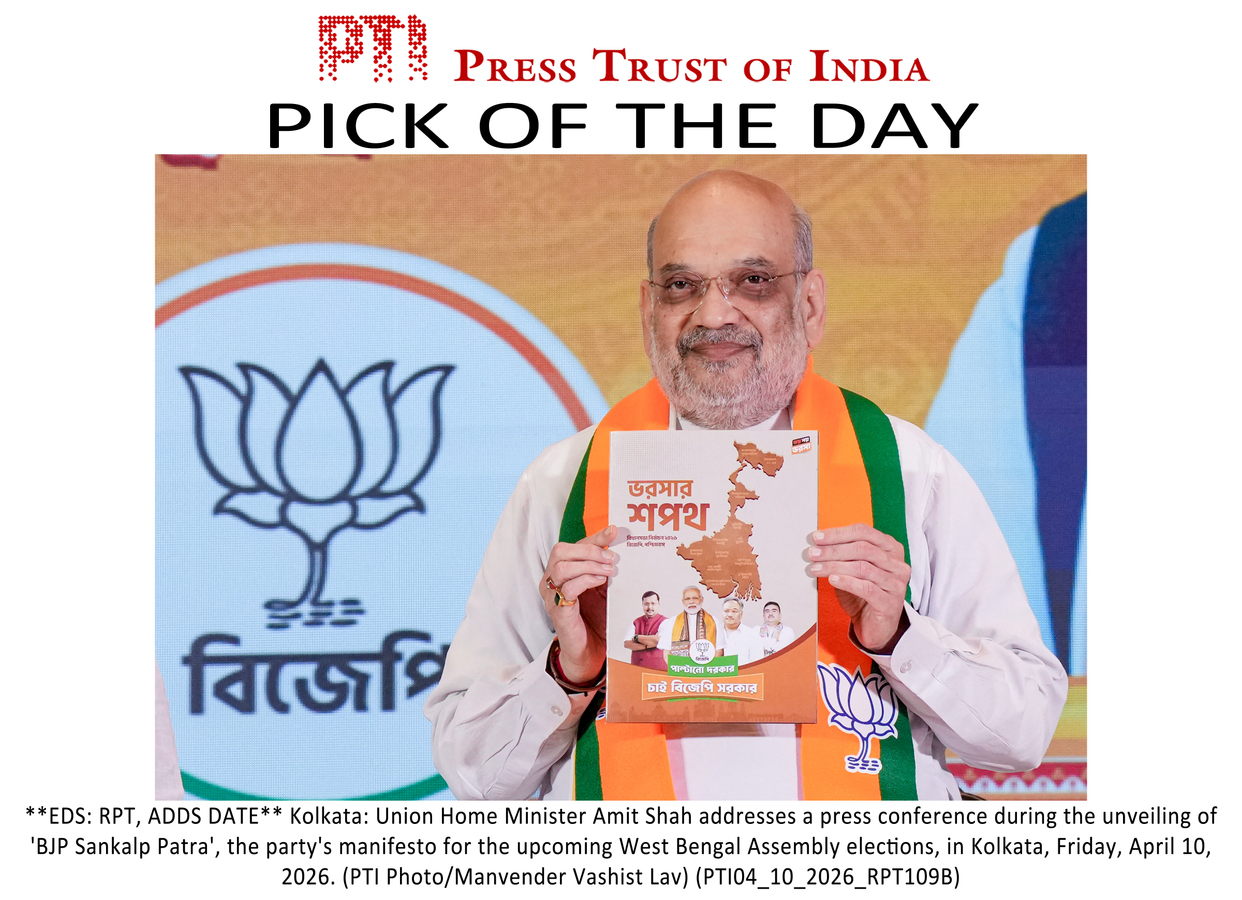
Kolkata, April 10 By combining firm promises on infiltration, a Uniform Civil Code, and the concept of "Ram Rajya" with a comprehensive welfare package for women, unemployed youth, and farmers, the BJP unveiled its West Bengal election manifesto on Friday. This move appeared to be its most aggressive attempt yet to win over the social coalition that has kept the TMC in power since 2011.
Union Home Minister Amit Shah transformed the release of the manifesto into a platform centered on welfare promises, Bengali symbolism, and a strong attack on Chief Minister Mamata Banerjee, framing the election as a direct contest over identity and welfare.
He promised that if the BJP were voted into power, it would implement the Uniform Civil Code in Bengal within six months, appoint a "son of Bengal" as chief minister, and establish what he called "Ram Rajya" in the state.
In response to TMC accusations that the UCC was divisive, Shah said the proposal did not originate with the BJP.
"It was the Constituent Assembly that recommended it. Is having the same law for every citizen appeasement? Or is it appeasement when one citizen is allowed four marriages and another only one?" he asked.
The manifesto also promised strict laws against "love jihad" and "land jihad," and a law guaranteeing every citizen the freedom to practice religion and faith.
Shah also declared that a BJP government would adopt a "detect, delete, and deport" policy for infiltrators.
"We will take a zero-tolerance approach towards infiltration," he said, promising to seal Bengal's borders, stop cattle smuggling, and clear government land of "encroachers and infiltrators."
The manifesto promised "citizenship and rehabilitation for all Hindu refugees," many of whom allege large-scale deletions from voter rolls in the voter verification process.
The BJP said that within 45 days of coming to power, it would provide all the land needed for border fencing and introduce modern scientific patrolling in rivers and canals with the help of the Centre.
The manifesto promised three white papers detailing 15 years of alleged TMC corruption, deterioration of law and order, and political violence in the state.
It also promised a commission headed by a retired Supreme Court judge to investigate political violence and ensure that every case is "resolved to its logical conclusion," regardless of which party is involved.
The BJP also sought to win over TMC's strongest base – women voters.
The party promised Rs 3,000 a month for every woman in Bengal, free travel on all state-run buses, 33 per cent reservation for women in all government jobs, including the police, and one women's police station in every block.
Pregnant women would receive Rs 21,000 and six nutrition kits, while two women battalions of the State Reserve Police Force, named after Matangini Hazra and Rani Rashmoni, would be created.
A special police unit called the "Durga Suraksha Squad" and a self-defense training force for women were also promised.
The BJP's promise of Rs 3,000 is widely seen as a direct counter to the TMC's flagship Lakshmir Bhandar scheme. The TMC, in its own manifesto, has promised to raise Lakshmir Bhandar to Rs 1,500 for women from the general category and Rs 1,700 for SC and ST women.
The BJP also sought to address the discontent among unemployed youth, promising them Rs 3,000 a month and an additional Rs 15,000 to prepare for competitive examinations.
The party aims to outbid the TMC, which has offered Rs 1,500 a month to unemployed youth.
Those who lost jobs due to the school recruitment scam and other corruption-related cases would be given age relaxation of up to five years, while the BJP also promised "transparent, merit-based" recruitment and permanent jobs for deserving candidates.
Shah also attempted to exploit the long-standing resentment among state government employees over pending Dearness Allowance, promising DA parity with the Centre and the implementation of the Seventh Pay Commission within 45 days.
For farmers, the BJP promised to raise annual assistance under PM-Kisan to Rs 9,000 by adding Rs 3,000 from the state government.
It also promised one crore jobs and self-employment opportunities, a startup network, and 75 lakh "Lakhpati Didis."
The BJP also wrapped its Hindutva plank in the language of Bengali pride and culture, seeking to counter the TMC's long-standing charge that the saffron party is "anti-Bengali" and culturally alien to the state.
Shah assured Bengalis that a BJP government would not interfere with their food habits and that no one would stop people from eating fish and eggs.
Seeking to consolidate its hold over North Bengal, which accounts for 54 assembly seats, the manifesto promised constitutional recognition for Rajbanshi and Kurmali languages, an AIIMS, IIT, IIM, sports university, and a fashion designing institute in the region.
A cancer hospital, a special development plan for Haldia port, deep-sea ports at Tajpur and Kulpi, four townships, and a 10-year plan to turn Kolkata into a globally recognized "living city" were also included in the document.
Darjeeling would be developed as a heritage tourism destination, while the hills would be developed "keeping Bengal united."
The BJP also addressed the issue of a CM candidate.
"Bengal's chief minister will be someone born in Bengal, who speaks Bengali and is capable. If the state is run from Delhi, that is still better than being run from Bangladesh."