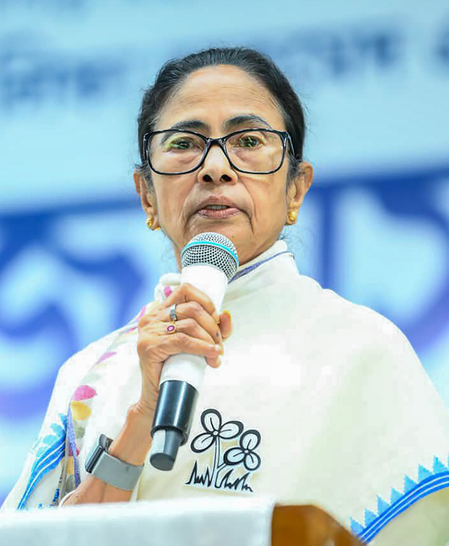
Kolkata, April 9 The Bharatiya Janata Party (BJP) approached the Election Commission of India (ECI) with a plea to immediately ban and impose campaign restrictions on West Bengal Chief Minister Mamata Banerjee for a specific period, amid the crucial two-phase state assembly elections later this month.
In a letter to Chief Election Commissioner Gyanesh Kumar on Wednesday, the BJP accused the Chief Minister of inciting violence against the central armed police force (CAPF) personnel deployed in the state to ensure free, fair, and violence-free elections.
The BJP pointed to an instance where the Chief Minister allegedly made a "inflammatory and seditious statement" at a public gathering on April 7, where she said, "200 CRPF vehicles are coming to attack you, people."
"At a separate election rally in Harirampur, Dakshin Dinajpur district on April 3, Mamata Banerjee further alleged that "money is being brought in using CRPF vehicles," casting aspersions on the constitutional conduct and integrity of central forces deployed under the authority of the Election Commission," the letter stated.
According to the BJP, these statements constituted a deliberate and orchestrated attempt to portray lawfully deployed security forces as aggressors and enemies of the civilian population, with the direct intent of inciting violence, creating terror among voters, and undermining the free and fair electoral process.
"These statements were made by the sitting Chief Minister, the highest constitutional authority in the State, before thousands of voters/citizens, and have been widely reported in the national media and social media," the letter added.
In light of these public statements from Mamata Banerjee, the BJP requested the ECI to immediately ban and impose campaign restrictions on the Chief Minister for a specific period.
The BJP also requested the CEC to direct the West Bengal Chief Electoral Officer (CEO) Manoj Kumar Agarwal to register an FIR or cause the registration against the Chief Minister under various sections of the Bharatiya Nyaya Sanhita, 2023, and the Representation of the People Act, 1951.