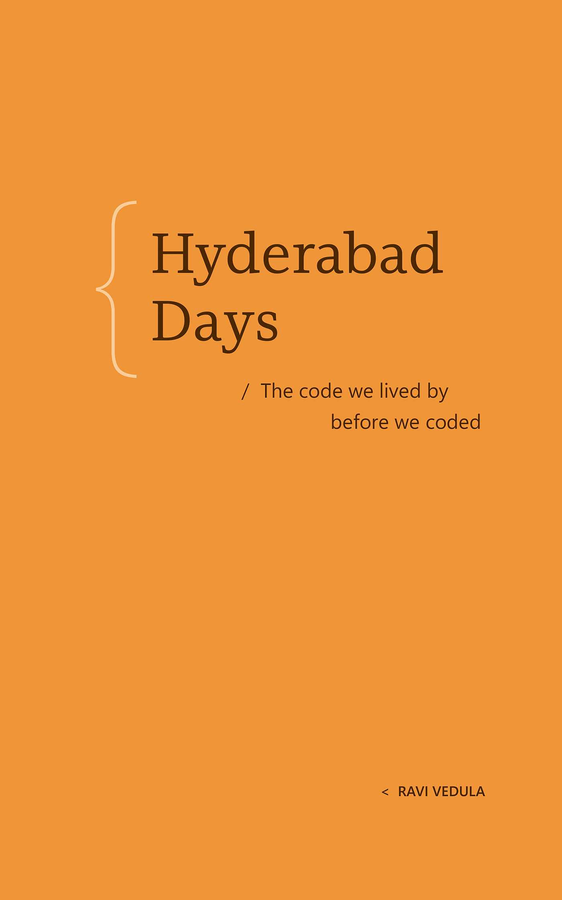
In his new memoir, "Hyderabad Days," a senior Indian-American executive at Microsoft explores the importance of memory and meaning in leadership, arguing that leadership development begins long before one writes a single line of code.
Ravi Vedula, a Corporate Vice President at Microsoft, says his book draws on "memories and vignettes from the 80s and 90s," adding that those years were "highly formative" and continue to influence his thinking in engineering and leadership.
Vedula says these childhood memories are "the foundation of my values and principles," which guide his thinking about leadership and engineering.
The book, which will be released on March 31, focuses on growing up in a Hyderabad neighborhood and frames these experiences as a "reflection of the experiences of anyone who grew up in a similar neighborhood." He emphasizes that "this is not just my story; it's also yours."
Vedula says each chapter ends with a reflective "postscript" that connects childhood incidents to present-day lessons. Simple experiences, such as pooling money to buy a cricket ball or resolving disputes in a local cricket game, become "a story of teamwork and resourcefulness."
He explains that this structure allows him to move beyond "ordinary life vignettes" and connect them to a broader leadership framework based on storytelling, rather than formal frameworks.
A recurring theme is community. "I felt like I was raised by everyone in the neighborhood," he says, recalling a chapter titled "Everybody's Child."
He also emphasizes "resourcefulness," which is often described in India as "jugaad," and teamwork as defining traits. His mother's quiet sacrifices also play a significant role. "It was about service and leadership," he says.
Vedula, who moved to the United States in 1993 to pursue higher studies and joined Microsoft in 2000, says the book deliberately focuses on the "pre-immigrant story."
"No one ever tells the pre-immigrant story," he says, adding that his life has been shaped by "India, America, and India," where America provided him with opportunities and India provided him with a sense of belonging.
Reflecting on the rise of Indian professionals in the US technology sector, he says that these early influences may have played a role. "We tend to be resourceful and work within constraints," he says. "I believe that all of this is part of our journey."
On artificial intelligence, Vedula argues that technological shifts only reinforce the importance of human values. "Our humanity, ethics, and values are essential for shaping AI for the future," he says.
He adds that while AI may take over routine tasks, "the judgment and values that have shaped your job will remain central."
Vedula says the memoir is not just about nostalgia but also about "what we cannot afford to lose as we shape the future."
The proceeds from the book, he says, will go towards funding heart surgeries for children in India.
Vedula, who now leads a global data and analytics organization at Microsoft, has worked across major product transitions, including Exchange, Office 365, and the company's cloud evolution. His career reflects the broader trajectory of Indian-origin leaders in global technology firms, particularly in Silicon Valley and the US corporate ecosystem.
Vedula's reflections also intersect with a wider shift in how the Indian diaspora is documenting its journey. Unlike earlier narratives that focused primarily on migration and professional success, "Hyderabad Days" emphasizes formative environments – neighborhoods, families, and shared cultural experiences – that shaped individuals before they entered global systems.
He suggests that the rapid pace of technological and social change risks eroding these foundational experiences.
"We don't have enough shared moments anymore because of these distractions," he says, referring to the shift from collective family experiences, such as watching a single television program together, to highly individualised, screen-driven lives.
The contrast, he notes, is stark across generations. "We cannot imagine a life without digital media and social media and mobile phones," he says, adding that children today are "living a completely different" reality from those who grew up in the pre-digital era.
However, he cautions against viewing the past through a purely nostalgic lens. Instead, he frames these experiences as a repository of enduring principles. "The book isn't really about the past," he says. "The book is about what is non-negotiable as we shape the future."
Vedula also addresses the pressures facing younger generations, particularly those growing up in the United States.
"It is hard to be a kid in this generation," he says, citing the combined impact of social media, constant information flow, and evolving career landscapes shaped by artificial intelligence.
He emphasizes the importance of maintaining human connection and social grounding.
"Having friends, having people who care about you, and having people that you care about… interacting with a person in conversation" remains an essential anchor amid rapid change, he says.
The book also reflects Vedula's long career arc across technological transformation – from early enterprise software to cloud computing and now artificial intelligence. He describes witnessing these shifts firsthand, noting that "software isn't built in perfect conditions" and often requires adaptability and resilience – traits he links back to his upbringing in India.
On India's evolution as a technology hub, Vedula calls its progress "quite remarkable," pointing to its talent pool and expanding ecosystem. However, he says the next phase will require breakthroughs at a global scale. "Nothing has emerged on the global stage in a way that I think India still has to figure out," he says, adding that AI could act as "a real great equaliser."
Looking ahead, Vedula plans a series of book engagements across technology hubs in the United States, including Seattle and Silicon Valley, with a subsequent outreach in India once the print edition becomes available there.
He says the memoir is aimed not only at readers who share similar childhoods but also at younger members of the diaspora seeking to understand their roots.
"Perhaps the next generation… will finally figure out how their parents lived and how their parents grew," he says.
Vedula reiterates that the narrative is intentionally universal. "This is not unique to me… this is everyone's story," he says, positioning the book as both a personal account and a collective memory of a generation shaped by community, constraint, and aspiration.