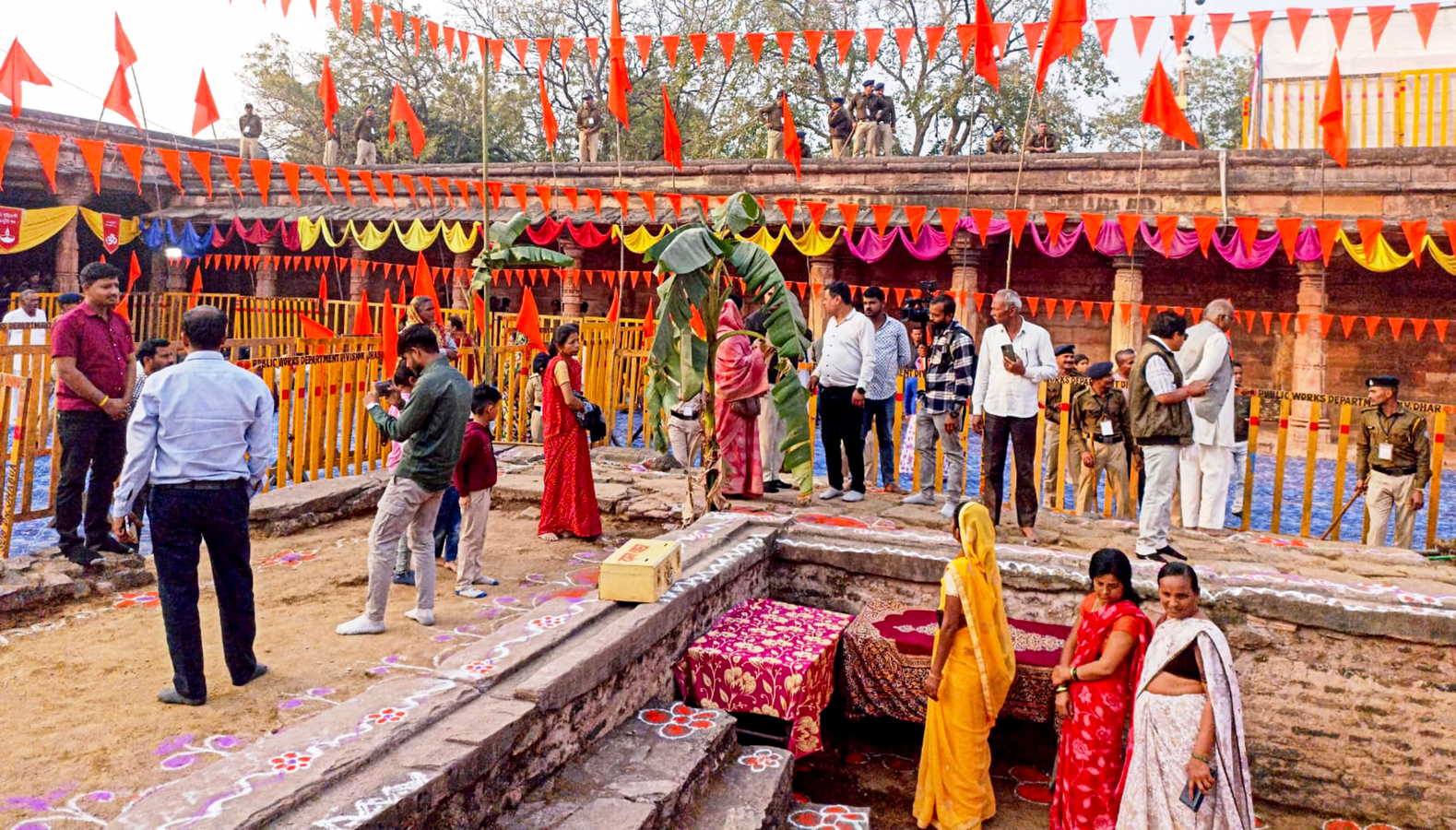
New Delhi, April 1 The Supreme Court on Wednesday said the Madhya Pradesh High Court will consider the objections raised by the Muslim side regarding the ongoing Archaeological Survey of India’s survey, including videography and color photographs of the disputed Bhojshala Temple-Kamal Maula Mosque premises in the state.
While the apex court did not interfere with the high court’s proceedings, it emphasized that all objections regarding the scientific survey must be heard in accordance with the principles of natural justice.
A bench comprising Chief Justice Surya Kant and justices Joymalya Bagchi and Vipul M Pancholi heard senior advocate Salman Khurshid, appearing for the Maulana Kamaluddin Welfare Society, and advocates Barun Sinha and Vishnu Shankar Jain for the Hindu parties.
Khurshid, at the outset, raised concerns regarding the accessibility of evidence.
“We have raised several objections. We request that the videography be handed over and color photographs of the survey be provided so we can properly frame our objections,” he said.
The bench noted that the high court had already addressed the procedural timeline for these objections.
Justice Bagchi observed that while some objections were listed in the survey report, others remained to be addressed.
He noted that the videography would be played in court, allowing all parties to contest its correctness.
The CJI referred to the apex court’s earlier directions and said the high court had passed the interim order and said it will hear the objections at the stage of final hearing.
“The high court has passed an order in deference to our earlier directions. We have no doubt that the high court, after perusing the videography, will take up the objections in accordance with the principles of natural justice,” the CJI said.
The bench further clarified that it has not expressed any opinion on the merits of the case and that parties remain free to approach the high court for any grievances.
Earlier, the high court had said it will inspect the Bhojshala Temple-Kamal Maula Mosque complex at Dhar before April 2 in light of the "numerous disputes" pertaining to the ASI-protected structure.
On March 16, a high court bench of Justices Vijay Kumar Shukla and Alok Awasthi had set April 2 for the regular hearing of the petitions related to the disputed complex and said it will inspect the site.
On March 28, the two high court judges inspected the complex in Dhar. Justices Shukla and Awasthi of the Indore bench of high court had reached the site at around 1:50 pm and left at 2:45 pm.
The Hindu community considers Bhojshala to be a temple dedicated to Goddess Saraswati, while the Muslim side claims the 11th-century monument is the Kamal Maula Mosque.
As per an ASI order of April 7, 2003, Hindus are allowed to worship at the complex every Tuesday, while Muslims are permitted to offer namaz every Friday.
The high court, in its oral remarks, had said, "In view of the numerous disputes, we would like to visit the complex and inspect it. We will visit the complex before the next date (April 2)."
It, however, had clarified that no party involved in the case will be allowed to be present at the disputed site during this visit.
The disputed complex in Dhar is protected by the ASI, which, following high court orders, conducted a scientific survey of it and submitted a detailed report.
The ASI's more than 2,000-page report has indicated that a large structure dating back to the reign of the Parmar kings of Dhar predated the mosque and that the current disputed structure was built by reusing parts of ancient temples.
Retrieved architectural remains, sculptural fragments, large slabs of inscriptions with literary texts, Nagakarnika inscriptions on pillars, etc., suggest that a large structure associated with literary and educational activities existed at the site, according to the report.
Based on scientific investigations and archaeological remains recovered during the investigations, this pre-existing structure can be dated to the Paramara period, the report emphasised.
"Based on scientific investigations, survey and archaeological excavations conducted, study and analysis of retrieved finds, study of architectural remains, sculptures, and inscriptions, art and sculptures, it can be said the existing structure was made from the parts of earlier temples," the report stated.
From the art and architecture of the decorated pillars and pilasters, it can be said that they were part of earlier temples and were reused, while making colonnades of the mosque over a high platform of basalt, the ASI said in the report.
The Hindu community, which approached the court with the primary plea of determining the religious nature of the entire disputed complex, claims that coins, sculptures, and inscriptions found by the ASI during its scientific survey prove the structure was originally an ancient temple.
The Muslim side, however, has disputed the claim and questioned the survey, alleging the ASI ignored its earlier objections and included "objects placed in the disputed complex" in the survey.