In a significant shift in political messaging, the BJP's rally in Kolkata on Saturday showcased a unique combination of Hindutva and Bengali cultural identity, signaling the party's attempt to adjust its strategy for the 2026 assembly elections.
The rally featured chants of "Jai Shri Ram" alongside "Jai Ma Kali" and "Jai Ma Durga," and repeated references to "Bengali Hindus" in speeches. This reflected an effort by the BJP to integrate its core ideology with Bengal's linguistic and cultural identity.
Even the symbolism surrounding the event was carefully chosen.
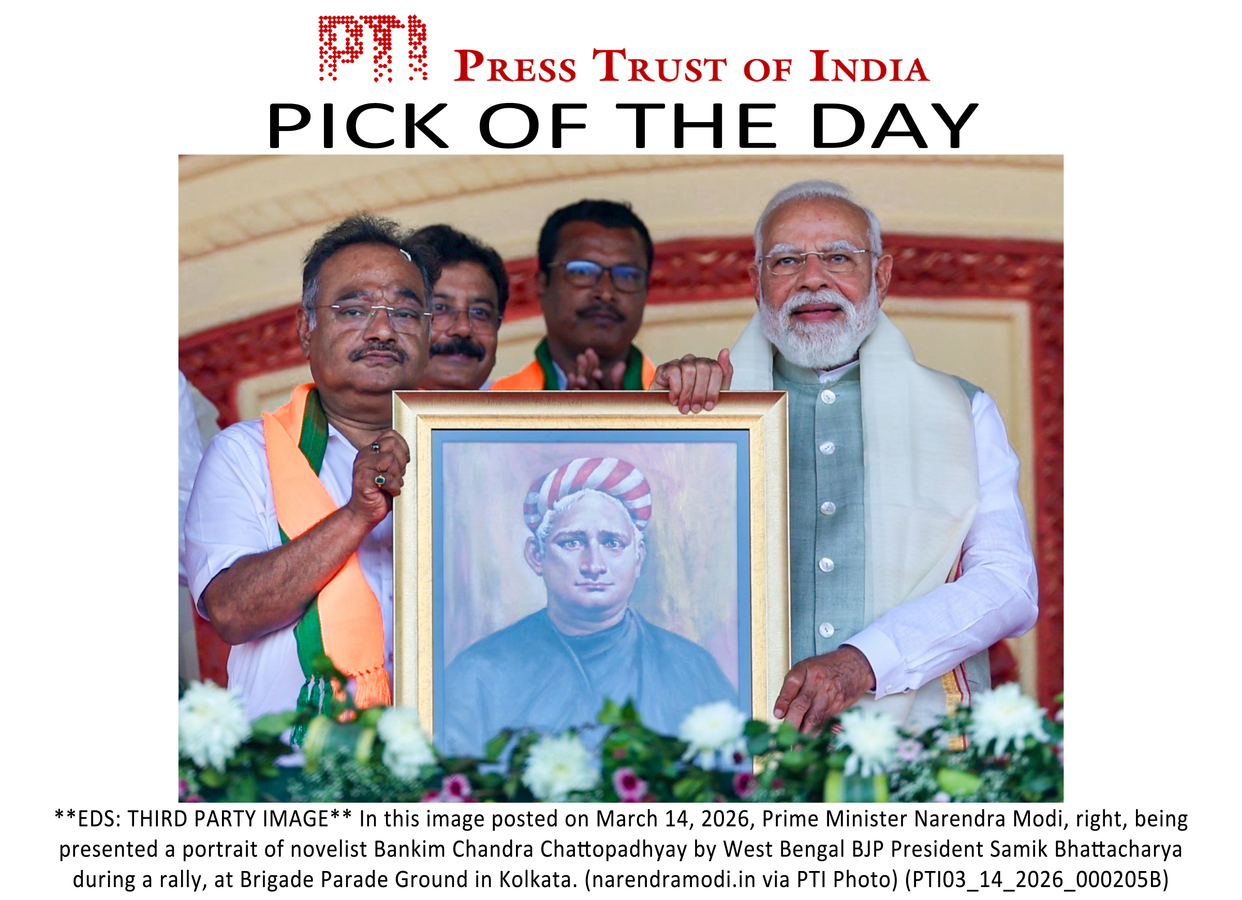
State BJP president Samik Bhattacharya presented Prime Minister Narendra Modi with a portrait of Bankim Chandra Chattopadhyay, painted by Subrata Gangopadhyay, while Leader of the Opposition Suvendu Adhikari presented him with an idol of Goddess Durga.
The stage itself reflected this blend of religion and regional identity, with a large depiction of the Dakshineswar temple at the center, flanked by panels representing Bankura's terracotta tradition on one side and the tea garden culture of north Bengal on the other.
Modi's speech made the political intent clear.
He alleged that West Bengal's demographic profile was changing due to infiltration under the Trinamool Congress government, claiming that Bengali Hindus were increasingly feeling threatened.
"The demographics of West Bengal are being altered. Because of this, the number of Bengali Hindus is declining," Modi said, linking the issue to the state's history of Partition, refugee influx, and illegal immigration.
This formulation was politically loaded, invoking not only religion but a layered identity combining faith and ethnicity.
For the BJP, which has traditionally emphasized Hindutva in its Bengal campaign, the focus on the "Bengali Hindu" identity represents an attempt to adapt to the political dynamics of a state where linguistic and cultural identity has historically shaped electoral narratives.
The ruling TMC decisively asserted this political grammar in the 2021 assembly elections.
After the BJP's significant surge in the 2019 Lok Sabha polls, where it won 18 of the state's 42 seats with a vote share of around 41 per cent, the TMC countered the saffron expansion by aggressively promoting Bengali sub-nationalism.
Chief Minister Mamata Banerjee's campaign slogan, "Bangla Nijer Meyekei Chai" (Bengal wants its own daughter), and the broader narrative portraying the BJP as a "party of outsiders" helped the ruling party consolidate the Bengali pride plank.
This strategy proved successful as the TMC swept the 2021 assembly elections with 213 seats in the 294-member House.
Since then, the debate over insiders versus outsiders has remained a central theme in Bengal politics, with the TMC continuing to portray the BJP as culturally alien to the state's political ethos.
Saturday's Brigade rally suggested that the BJP may now be attempting to break this perception by repositioning its narrative rather than abandoning its ideological core.
Speakers at the rally repeatedly blended cultural and religious symbolism, invoking historical figures, Partition memories, and refugee politics alongside criticisms of the Mamata Banerjee government.
Several leaders also sought to tap into sentiments among refugee-origin communities, particularly the Matua population in south Bengal, by linking the question of citizenship for Hindu refugees with Bengal's historical experience of displacement after Partition.
Beyond the rhetoric, observers also noted the presence of supporters from rural Bengal at the rally.
In recent electoral cycles, the BJP has performed relatively better in urban and semi-urban constituencies, while the TMC has maintained its advantage in rural areas through welfare networks and organizational strength.
The crowd composition at Brigade, with a noticeable influx from districts, suggested that the BJP is attempting to expand its rural presence as it prepares for the next assembly battle.
However, seasoned Bengal observers cautioned against over-interpreting Brigade gatherings.
The historic Kolkata Brigade Parade ground has often hosted massive political rallies that failed to translate into electoral gains, a pattern experienced by parties across the spectrum, from the Left Front in its later years to Mamata Banerjee during the '90s and early 2000s.
Still, the messaging emerging from Saturday's rally appeared clear.
After years of projecting Hindutva as its primary political axis in the state, the BJP now seems to be testing a hybrid narrative, one that seeks to merge religious identity with Bengali cultural pride.
In Bengal's layered political landscape, where religion, language, and regional identity intersect in complex ways, the party appears to be betting on a new formulation: the narrative of the "Bengali Hindu."
Whether this recalibrated pitch can dent the TMC's hold over Bengali sub-nationalism, a factor that proved decisive in 2021, will likely determine the contours of the 2026 electoral contest.