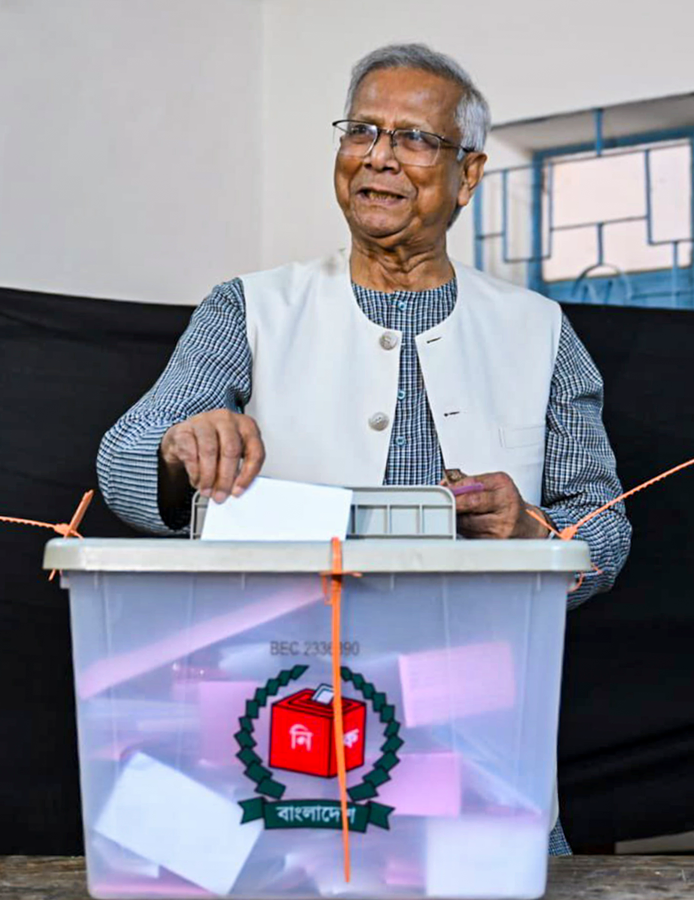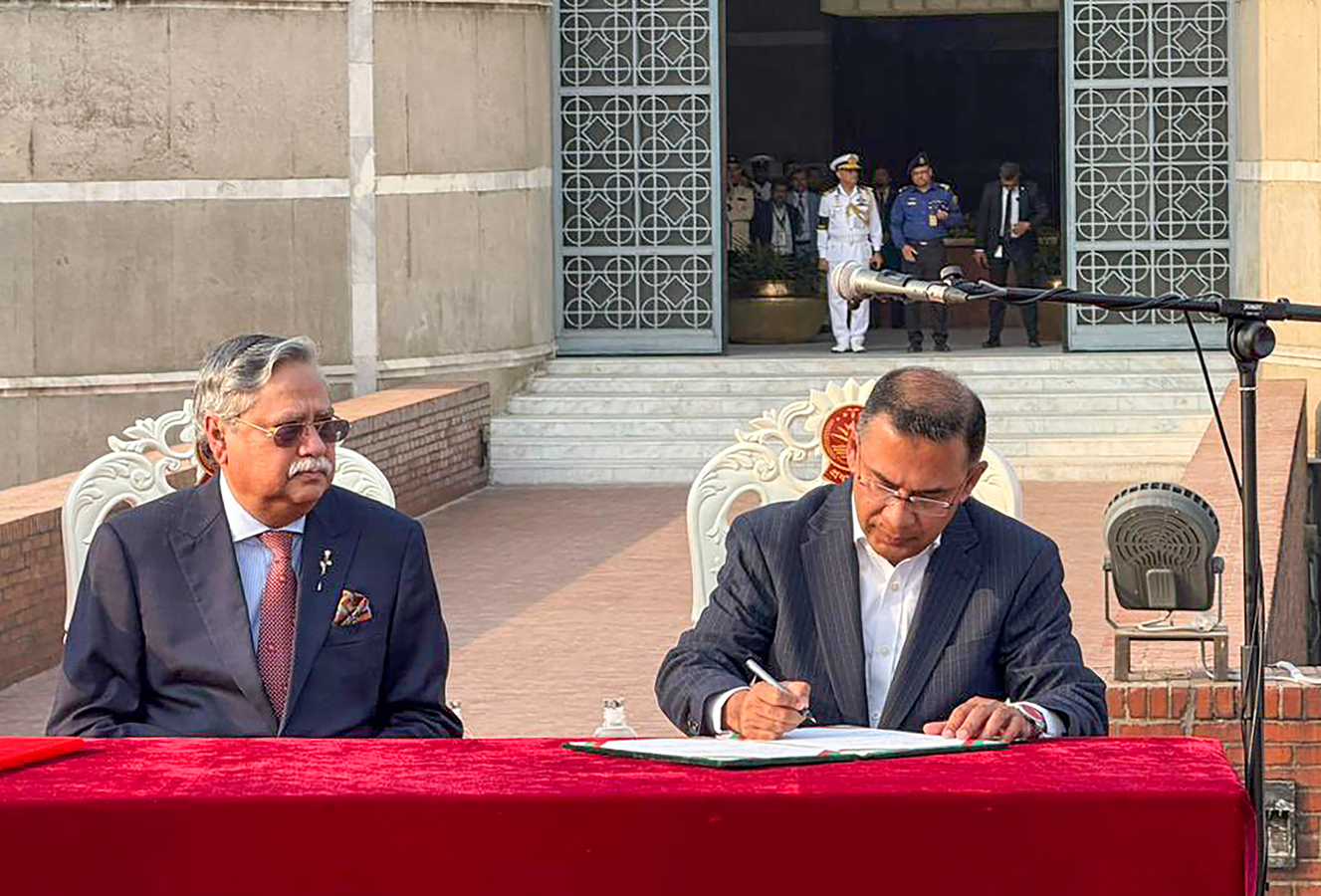
New Delhi, February 17 – A heated debate on Tuesday over a proposed Constitutional Reform Council reflected how, even before Bangladesh's newly elected cabinet could assume office, it was facing legal challenges regarding changes adopted by the interim government led by Muhammad Yunus, according to Bangladeshi media reports.
While members of the Bangladesh Nationalist Party (BNP) took oath as parliamentarians on Tuesday, they did not take an oath as members of the proposed Constitution Reform Council, "as there is no such provision in the Constitution," reported Dhaka's Business Standard.
BNP Standing Committee Member and MP Salahuddin Ahmed told the news outlet that, to reflect the will of the people as expressed in the referendum, it is first necessary to enter Parliament and enact the required laws and constitutional reforms.
Emphasizing that "all actions must be conducted constitutionally," the BNP leader claimed that their oath of office was administered in accordance with constitutional provisions.
He claimed that under Article 148(2A) of Bangladesh's Constitution, if the Speaker and Deputy Speaker are unable to administer the oath, the Chief Election Commissioner (CEC) is empowered to do so within three days.
Following this provision, the CEC administered the oath to the MPs, he said.
However, as reported by the news site, he added that there is no constitutional provision for a "Constitutional Reform Council," nor does Bangladesh's CEC have the authority to administer any oath for such a body.
Thus, they argued, the interim government bypassed established legal frameworks, undermining legitimacy. Once the Constitution is amended, the person administering the oath and the form of the oath will be included in the Third Schedule of the Constitution, added Salahuddin Ahmed.
Meanwhile, the Opposition Bangladesh Jamaat-e-Islami party strongly objected to BNP's stance, and, along with its ally, the National Citizen Party (NCP), announced that they would not attend the cabinet swearing-in ceremony that was held later the same day.
This stance reflects the support that the interim government enjoyed during its tenure since the fall of the Sheikh Hasina-led Awami League government in August 2024.
The controversy now underscores decisions that were pushed to be granted political legitimacy, but not legal recognition.
The Jamaat has been subject to legal bans over its alleged pro-Pakistan stance during Bangladesh's liberation war of 1971 and its hardline religious dogma. The ban was lifted during the term of the interim government.
The NCP, established in February 2025, emerged from the 2024 student-led uprising. Recognized as Bangladesh's first student-led political party, it claims to be built on reformist and anti-corruption ideals. However, it has been a part of the 11 Party Alliance, a coalition led by the Jamaat that primarily follows the ideology of Islamism and conservatism, with parties positioning themselves from center to far-right in Bangladesh’s political spectrum.
The Muhammad Yunus-led interim government adopted the "July Charter" essentially as a political and moral framework, which was drafted by civil society leaders, student groups, and reformists during the uprising. It laid out demands for establishing transparent, accountable institutions; ensuring fair elections under neutral oversight; limiting the tenure of Prime Ministerial aspirants, as well as proposing a bicameral legislature, among other reforms.
The Constitution Reform Council was formed specifically to translate such principles into legal and constitutional reforms, as the institutional mechanism to implement the July Charter's vision. Out of the 300 seats in the Bangladesh Parliament, elections were held for 299 on February 12. According to media updates, counting has been completed for 297 constituencies, with the BNP alliance sweeping 212, while the Jamaat and its allies won 77, and the rest went to others.