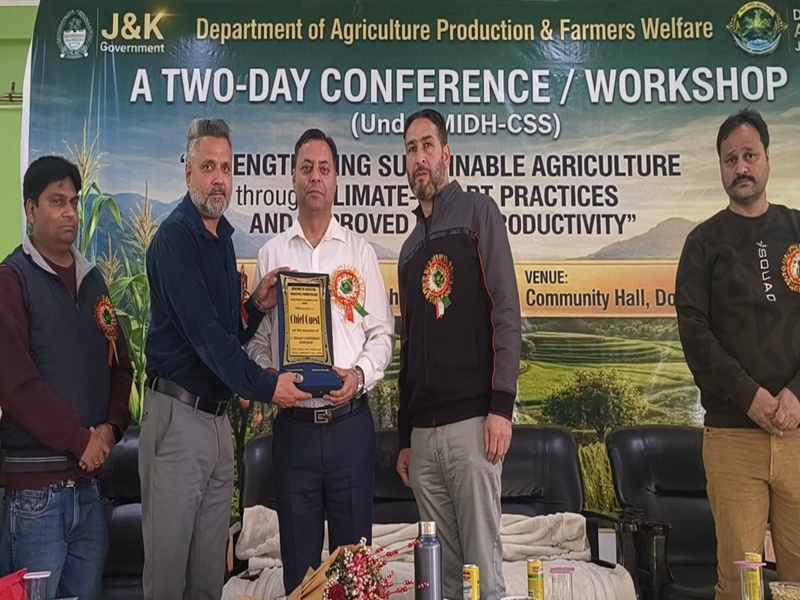
Doda (J&K), March 23 In the tranquil hills of Doda, where terraced fields cling to the mountains and life follows the rhythm of the seasons, a quiet transformation was taking place.
At the Community Hall, farmers from across the district gathered for a two-day conference-workshop organized by the Department of Agricultural Production and Farmers' Welfare under the Mission for Integrated Development of Horticulture.
The theme, "Strengthening Sustainable Agriculture through Climate-Smart Practices and Improved Farm Productivity," resonated throughout the hall.
Among the attendees was Basharat Ali Malik. Malik is a farmer whose journey began in 2006. Malik listened attentively as experts discussed various topics. They spoke about subsidies, polyhouses, and modern cultivation techniques.
He also shared his own thoughts. Malik said, "I earn between Rs 5 lakh and 6 lakh annually from farming," he shared. "These schemes have made a real difference. We are not just surviving – we are growing."
The room was filled with interest. For many younger farmers, Basharat was proof that agriculture, when supported and modernized, could be both sustainable and profitable.
On the stage, Mushroom Development Officer Susheel Rattan Sharma addressed the gathering.
His words were steady, but his message was urgent. "Our goal is simple," he said. "Every farmer in Doda must benefit from these schemes – whether they are from the Central Government or the Union Territory. No one should be left behind."
He spoke about the ongoing efforts to enroll farmers under MIDH, a scheme that offers up to 60 per cent subsidy – rising to 90 per cent in Himalayan regions – for projects such as nurseries, plantation expansion, and post-harvest management. For a region like Doda, where geography often limits opportunity, such support was a game-changer.
Farmers learned about cultivating fruits, vegetables, mushrooms, spices, and flowers during the sessions.
Climate-smart practices, efficient irrigation, and improved productivity methods were discussed in detail. What once seemed complex now felt within reach. The benefit of the seminar was that the farmers who attended sessions gained a lot of knowledge about cultivation in a different way.
By the end of the workshop, the farmers left not just with pamphlets and information, but with a renewed sense of purpose. In Doda, agriculture was no longer just a way of life – it was becoming a pathway to prosperity.