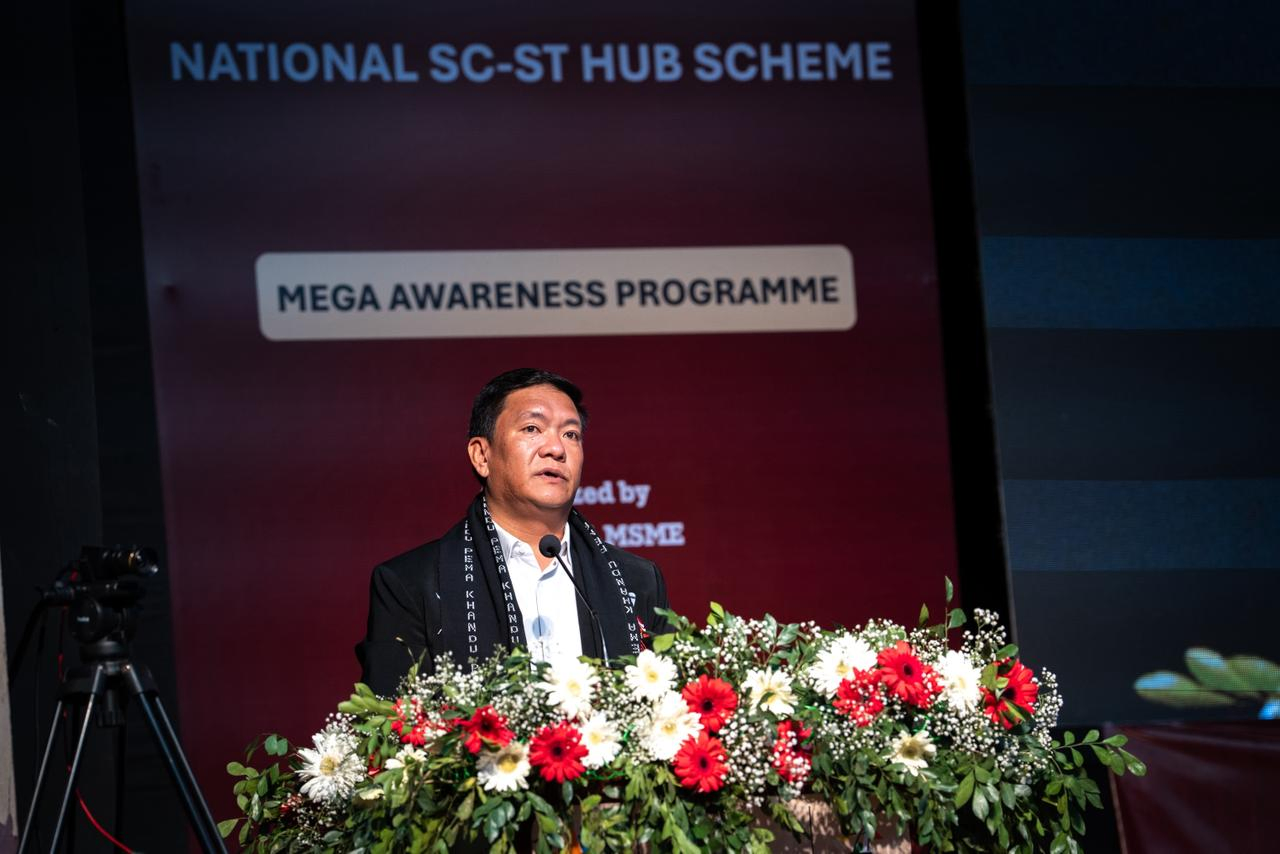
On Feb 23 in Itanagar, Arunachal Pradesh Chief Minister Pema Khandu emphasized the crucial role of Micro, Small, and Medium Enterprises (MSMEs) in driving India’s economic growth. He stated that since 2014, Prime Minister Narendra Modi has implemented various policies to strengthen the country's economy.
Khandu highlighted the special focus on uplifting Scheduled Castes and Scheduled Tribes through the National SC-ST Hub, which was established in 2016.
During the inauguration of a National-Level Mega Awareness Program organized by the National Small Industries Corporation Ltd. (NSIC) in coordination with the Arunachal Pradesh government, Khandu cited national data indicating that the MSME sector currently supports over 7 crore enterprises across the country, benefiting more than 31 crore people.
He stressed the need to accelerate this momentum, particularly in the Northeast and Arunachal Pradesh.
The program aims to ensure that SC and ST entrepreneurs benefit from various Government of India schemes and actively participate in the nation's economic progress.
Khandu urged youth to study government policies and budgets to fully utilize available schemes, emphasizing the importance of awareness and discipline.
He encouraged active participation in technical sessions and following up on shared information, noting that mere attendance without action would render such programs ineffective.
Khandu informed that 25% of total government procurement is mandated from MSMEs, with 4% reserved for SC/ST entrepreneurs and 3% specifically for women entrepreneurs. He described this as a progressive policy that opens significant opportunities for inclusive growth.
Expressing satisfaction at the strong participation of women, Khandu highlighted the state government's sustained focus on women empowerment through the Self Help Group (SHG) movement.
Over 1.5 lakh women across Arunachal Pradesh are actively engaged in SHGs, contributing to strengthening rural economies. Khandu also virtually inaugurated the Entrepreneurship Development Institute at Jote, which will provide structured training, mentoring, and capacity-building support to startups and MSMEs in the state.
Referring to the Union Budget 2026, Khandu outlined the Centre's three-pronged approach to strengthen MSMEs, equity support, risk capital access, and liquidity enhancement. He mentioned provisions of Rs 10,000 crore growth fund support for SMEs, Rs 2,000 crore under the Self-Reliant India Fund for micro enterprises, and over Rs 7 lakh crore liquidity support for the MSME sector.
He also noted that professional institutions such as ICAI, ICSI, and ICMAI will be supported to design short-term modular courses for strengthening corporate and financial capabilities of MSMEs, especially in Tier-II and Tier-III towns.
Speaking on state initiatives, Khandu highlighted the Arunachal Pradesh Entrepreneurship Development Programme launched in 2020, along with the Arunachal Pradesh Innovation & Investment Park, which provides mentoring in collaboration with premier institutions such as IIMs and seed funding support to startups.
He proudly noted that Arunachal Pradesh was recently recognized as one of the best-performing states in the Startup India ecosystem.
Currently, nearly 300 startups are actively operating in the state. He also referred to key state schemes such as the Deen Dayal Upadhyaya Swavalamban Yojana and the Chief Minister’s Tourism Development Scheme, which have boosted entrepreneurship across sectors.
Under the Arunachal Pradesh Industrial Investment Policy 2025, the state is offering power subsidy at Rs 2 per unit, 100% exemption on stamp duty and registration fees, 50% capital investment subsidy in government industrial areas, interest subsidies, GST reimbursement, transport and air freight subsidies, and export incentives to attract investors.
Encouraging youth to move beyond the conventional preference for government jobs, Khandu urged them to become job creators instead of job seekers.
He stated that "Government jobs are limited, but opportunities in entrepreneurship are limitless," stressing that dedication, discipline, and focus are key to success.
He further highlighted Arunachal Pradesh’s vast potential in hydropower, mining, agriculture, horticulture, and floriculture. Noting that the state has over 600 varieties of orchids, he encouraged entrepreneurs to explore floriculture and reduce the country’s dependence on orchid imports.
The Chief Minister also pointed to emerging export opportunities following recent trade agreements between India and major global partners, stating that MSMEs and startups from Arunachal can benefit from expanded market access through digital and online platforms.
Emphasising the need for wider outreach, Khandu proposed organising similar awareness camps in eastern, central, and western regions of Arunachal Pradesh to ensure that youth from remote districts equally benefit from central initiatives.
Welcoming the delegates from New Delhi and participants from across the state, the Chief Minister expressed satisfaction at the overwhelming presence of young entrepreneurs and aspirants at the convention centre.
He lauded them for recognizing the importance of the awareness programme and participating voluntarily.
The programme aims to promote awareness about the National SC–ST Hub and various central support mechanisms for entrepreneurship development.
The event was co-chaired by Industries Minister Nyato Dukam and Youth Affairs & Sports Minister Kento Jini. Also present were Joint Secretary, Ministry of MSME, Mercy Epao; CMD, NSIC, Dr. Shekhar Acharya; Secretary, Industries, Saugata Biswas; Khadi Board Chairman Maling Gambo; Itanagar Mayor Likha NarieTadar; senior officials from the Government of India and the State Government; representatives of financial institutions; and a large number of aspiring entrepreneurs.