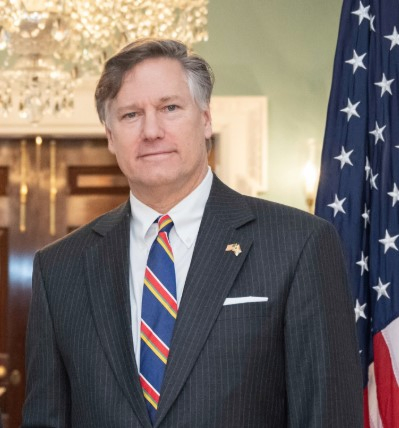
Washington, April 10 – The United States must deploy its private sector more aggressively across global markets to counter China’s expanding footprint, Deputy Secretary of State Christopher Landau said, calling commercial diplomacy a “key foundation” of American foreign policy.
Framing economic engagement as central to both geopolitical competition and long-term global stability, Landau argued that Washington must better mobilize its businesses to compete abroad.
“The one question that I think about every single day… is how do we… ensure that the U.S. private sector is… outperforming Chinese entities in every corner of the globe?” he said in his address at the Atlantic Council’s Global Prosperity Forum.
Landau acknowledged that many countries prefer US firms but often turn to China due to the latter’s consistent presence and financing. “You can’t beat something with nothing. The Chinese are here… Where is the American private sector?” he said.
He argued that Washington must address barriers such as perceived risk, lack of information, and regulatory complexity that deter US companies from investing abroad. “We may exaggerate some of the risks,” he said, adding that the government should help firms “assess risks correctly” and “mitigate those risks.”
At the core of his approach is what he described as a “three-legged stool” of commercial diplomacy: expanding export markets, encouraging US investment overseas, and attracting foreign direct investment into the United States.
“The overall objective is… we are trying to make our country more prosperous,” Landau said, stressing that economic engagement is not zero-sum. “The whole point… is that you find win-win situations that benefit both sides.”
He also pushed back against criticism that a stronger commercial focus makes US foreign policy overly transactional. “All relationships… are based on some sense of mutual benefit,” he said.
Landau said the Western Hemisphere remains a “natural focus” for US engagement, citing proximity and supply chain integration.
He pointed to Venezuela as a potential long-term opportunity, describing it as a “very, very rich country” whose economy has sharply deteriorated.
More broadly, he argued that economic development can help stabilize politically fragile regions. “Economic prosperity is the key element to almost all of these conflicts,” he said, citing examples where investment projects helped bridge political divisions.
On global conflicts, Landau said the US is working toward a “lasting and effective ceasefire” in the Middle East, adding that Washington has “effectively accomplished the military objectives” of degrading adversarial capabilities.
He also underscored the importance of access to capital in developing economies, calling it “the lifeblood of the whole system.”
He urged closer coordination between government and business. “What can I do for you to make your life easier?” he said, describing his message to corporate leaders.
The Atlantic Council forum highlighted growing consensus among policymakers and financial institutions that private capital will be critical to global growth. Speakers noted that most new jobs in emerging markets are expected to come from the private sector, not governments.
In recent years, the US has increasingly emphasised economic statecraft alongside traditional diplomacy, particularly in response to China’s Belt and Road Initiative. Washington has expanded tools such as the US International Development Finance Corporation to support overseas investment and manage risk.