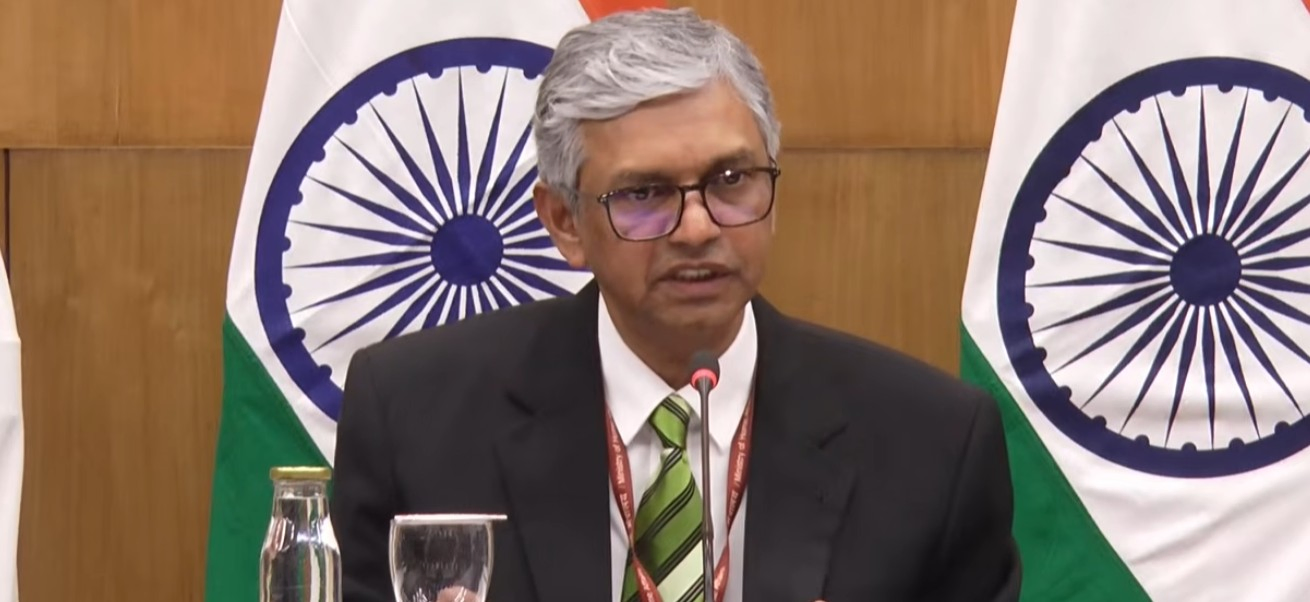
New Delhi, March 2 India reiterated its commitment to the judicial process on Monday, dismissing claims of any involvement in transnational organized crime as "baseless, politically motivated, and unsupported by credible evidence despite repeated requests."
Speaking at a special briefing on Canadian Prime Minister Mark Carney's visit to India, Secretary (East) in the Ministry of External Affairs (MEA), Periasamy Kumaran, said that India believes any such concerns must be addressed through law enforcement and judicial processes rather than through public narratives.
"Let me once again emphasize that India categorically rejects allegations of involvement in transnational violence or organized crime. These claims are baseless, politically motivated, and unsupported by credible evidence despite repeated requests. India believes that concerns of this nature must be addressed through credible law enforcement and judicial processes, not through public or publicized narratives," Kumaran said in response to a question about the killing of Khalistani terrorist Hardeep Singh Nijjar.
"Regarding the Nijjar case, we understand that the criminal investigation is proceeding according to established legal procedures... The Canadians have established legal procedures, and it will proceed accordingly. India has consistently maintained its commitment to the judicial process, and we believe that sensitive matters, once again, under judicial consideration, are best allowed to proceed through established legal processes without public commentary," he added.
Bilateral ties between India and Canada had soured after former Canadian Prime Minister Justin Trudeau had alleged in the Canadian Parliament that he had "credible allegations" of India's involvement in the killing of Nijjar. A major diplomatic row had erupted when Canada labeled India's High Commissioner and other diplomats as "persons of interest" in the investigation of Nijjar's death.
India denied all the allegations, calling them "absurd" and "motivated," accusing Ottawa of giving space to extremist and anti-India elements in the country.
During the briefing, Kumaran also spoke about the current security cooperation between India and Canada. He said that India and Canada have acknowledged progress on initiatives aimed at supporting the safety and security of the two nations and their citizens.
On criminals operating in Canada, Kumaran said, "let me try and give you some broader context on the current security cooperation between Canada and India. Based on the guidance provided by the leaders, we had a meeting between the National Security Advisors of the two countries in Delhi on September 18, 2025, and again on February 7, 2026, in Ottawa. Both sides have acknowledged progress on initiatives aimed at supporting the safety and security of their countries and citizens. It was also agreed to continue senior official-level discussions on security and law enforcement cooperation."
"Let me also highlight that we have a Joint Working Group (JWG) on counter-terrorism. We have a consular dialogue mechanism in place that addresses all issues, including extradition, lookout, and circular notices. We will be holding the next edition of the Consular Dialogue sometime in the coming months. At the meeting held on February 6, both sides agreed to a shared work plan to guide bilateral cooperation on national security and law enforcement issues, and to enable practical collaboration on their respective priorities," he added.
Kumaran mentioned that it was also agreed that each country would establish security and law enforcement liaison officers to build on working relationships, streamline bilateral communications, and enable timely information sharing on issues of mutual interest to Canada and India, including issues such as the illegal flow of drugs, particularly fentanyl precursors, and transnational organized criminal networks.