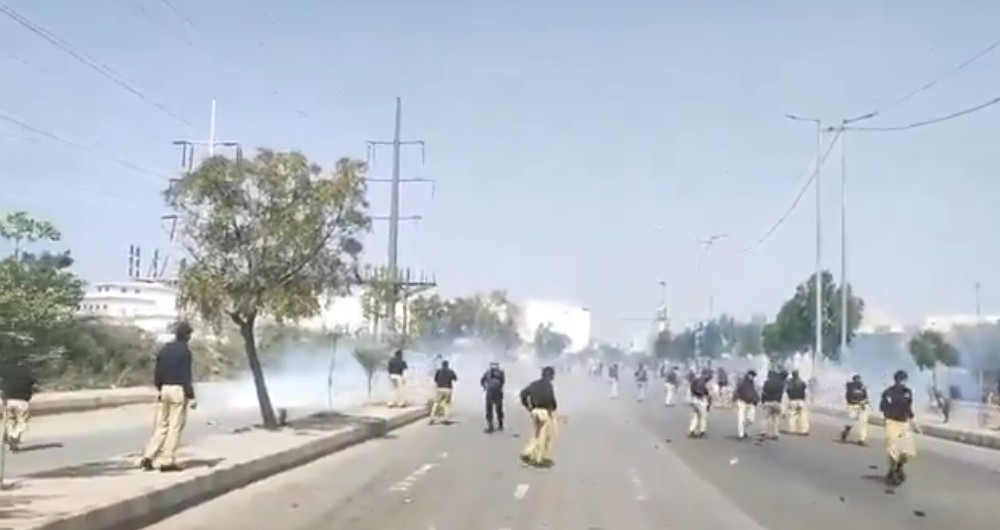
Islamabad/Karachi/Lahore, March 1 At least 10 people were killed in firing when protesters tried to storm the US Consulate in Karachi as violent clashes and arson rocked different cities of Pakistan on Sunday over the killing of Shia supreme leader Ayatollah Ali Khamenei.
Iran's Supreme Leader Khamenei was killed on Saturday in a coordinated US-Israeli airstrike on Tehran, with his death confirmed on Sunday, prompting an outburst of anger by Pakistan's Shia community, which comprises about 20% of the 240 million population.
The US Embassy in Islamabad said it is monitoring reports of ongoing demonstrations at the US Consulate General in Karachi and Lahore, as well as Pakistan's Interior Minister Mohsin Naqvi requested citizens to "peacefully express their grievances."
Besides Karachi and Lahore, protests were also held in major cities, including Islamabad, Peshawar, and Quetta, where protesters clashed with law enforcement officers, who on several occasions resorted to using tear gas and rubber bullets to disperse the crowds.
Violent clashes occurred in the coastal city of Karachi in Sindh province, where angry protesters tried to attack the US Consulate building on Mai Kolachi Road, and security personnel attempted to prevent them.
Dr. Mohammad Sabir Memon, the executive director of the Trauma Centre at Karachi's Civil Hospital (CHK), told Dawn that 10 people had died and 31 were injured in the protests near the Consulate.
Senior police official, SSP Asad Reza, said that after the crowd started attacking police officers, they used tear gas and rubber bullets to control the situation.
The Express Tribune newspaper quoted a statement from the Sindh government saying that demonstrators breached the external security perimeter of the Consulate, entered the premises, and caused damage.
A large number of demonstrators had gathered around the Consulate, and police fired at them while they were attempting to break into the US Consulate.
Dr. Sumaiya Syed, Police Surgeon, Sindh, said that 10 bodies were brought to the Civil Hospital, and some appeared to have bullet wounds.
Syed said that around 30 injured persons are receiving treatment at the hospital's trauma centre. "The injured include four police officers," she said.
Husain Mansoor, spokesperson for the Sindh's Information Minister, expressed "deep grief" over the loss of lives in the clash.
"The protesters entered after breaching the security cordon of the US Consulate and committed vandalism," he said in a statement.
Protests were also held in Gilgit and Skardu towns of Gilgit-Baltistan (GB) in Pakistan-occupied Kashmir (PoK), which has a sizable Shia population.
The situation in GB turned serious when protesters set fire to the offices of the United Nations Military Observer Group in India and Pakistan (UNMOGIP) in Gilgit and Skardu.
They also set fire to a school, the office of the Superintendent of Police, and the Agha Khan Rural Support Programme (AKRSP) office.
The authorities imposed curfew in the Skardu district, while the GB police in a statement said that the Pakistan Army had been called in under Section 245 of the Pakistan Penal Code (PPC).
Protesters also blocked the Karakoram Highway (KKH) at multiple locations.
In Lahore, hundreds of people surrounded the US Consulate, with some attempting to force their way into the consulate building.
However, a couple who reportedly managed to enter the building were caught by consulate security and later handed over to the police.
"A large number of activists of the Shia organization, Majlis Wahdat-i-Muslimeen (MWM), started gathering outside the US Consulate in Lahore following the confirmation of Khamenei's assassination," a senior Punjab police official said.
Later, a heavy contingent of police was rushed to secure the area, he said.
The protesters chanted slogans against America, and many were seen crying over the death of Iran's supreme leader while holding his portrait.
The area was cordoned off by the police, and protestors were allowed to have "a peaceful demonstration," but the situation around the consulate remained tense as the protesters did not leave despite senior police officers' requests.
In Islamabad, protestors were stopped from moving towards the US Embassy, as the city administration imposed Section 144 in the capital.
"Strict legal action will be taken in the case of any protest, demonstration or gathering," the administration warned.
Similarly, in Peshawar, police prevented demonstrators from marching towards the US Consulate, The News International reported.
The US Embassy said that it is monitoring reports of ongoing demonstrations at the US Consulates General in Karachi and Lahore, as well as calls for additional demonstrations at US Embassy Islamabad and Consulate General Peshawar.
"We advise US citizens in Pakistan to monitor local news and observe good personal security practices, including being aware of your surroundings, avoiding large crowds, and ensuring your STEP (Smart Traveller Enrollment Programme) registration is up to date," it said.
Interior Minister Mohsin Naqvi said that after the "martyrdom of Ayatollah Khamenei," every citizen of Pakistan is saddened in the same way as the people of Iran are grieving.
"We are all with the people of Iran. (But) we request the citizens not to take the law into their hands and record their protest peacefully," he said.
Separately, Naqvi met Prime Minister Shehbaz Sharif and briefed him about the law and order situation.
Meanwhile, in Sindh, the provincial government set up a high-level joint investigation team (JIT) to "impartially review all aspects of the incident" and also determine "who was responsible" for the incident.
The government also requested citizens to "express their emotions only in peaceful and legal ways."
Sindh Minister for Interior Ziaul Hasan Langar requested details from the Additional IG Karachi, stressing that "No one will be allowed to take the law into their own hands."
Langar called for enhanced security at sensitive installations. "Law enforcement agencies are fully alert and monitoring the situation closely," the minister said.
He said a judicial inquiry had been formed to ascertain the entire incident, but rebuked suggestions that those killed in Karachi protests were hit by US Marines guarding the Consulate.
"What we know is that protesters turned violent and tried to break through the security cordon around the consulate and clashed with the police, and some of them were very violent due to which police had to respond accordingly," he said.
The Express Tribune said that Pakistani Shia scholar, Allama Syed Shahenshah Hussain Naqvi appealed for calm in the country following Khamenei's killing.
"On the occasion of this assassination, express your devotion keeping in mind the sorrow of Karbala," Allam Naqvi said, in a video message, calling the protests outside the US Consulate in Karachi distressing.