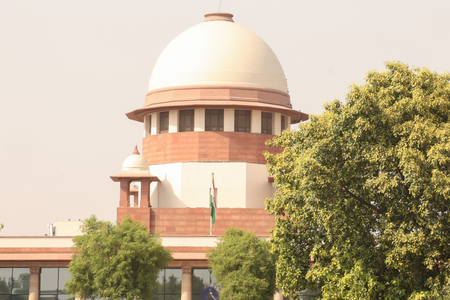
New Delhi, April 7 – A nine-judge Constitution Bench, headed by Chief Justice of India Surya Kant, is scheduled to hear the long-standing Sabarimala review matter on Tuesday. This case involves a batch of petitions that raise significant constitutional questions regarding religious freedom and gender equality.
According to the cause list published on the Supreme Court's official website, the Constitution Bench, which also includes Justices B.V. Nagarathna, M.M. Sundresh, Ahsanuddin Amanullah, Aravind Kumar, A.G. Masih, Prasanna B. Varale, R. Mahadevan, and Joymalya Bagchi, will take up the reference arising from review petitions filed against the court's September 2018 judgment, which allowed women of all ages to enter the Lord Ayyappa temple at Sabarimala.
The proceedings before the nine-judge Bench are scheduled to begin at 10:30 a.m. in the Chief Justice's court and will continue over multiple days, according to a pre-set schedule established by the top court. The apex court is expected not only to revisit the correctness of its 2018 verdict but also to examine broader constitutional questions related to the scope and ambit of Article 25 of the Constitution, including issues concerning the rights of women to access places of worship across religions.
In addition to the Sabarimala issue, the Constitution Bench will also consider related questions such as the entry of Muslim women into mosques and dargahs, the rights of Parsi women to access fire temples after interfaith marriages, the validity of excommunication practices, and the legality of female genital mutilation within the Dawoodi Bohra community.
Earlier, the CJI Surya Kant-led Bench had established a detailed schedule and clarified that the maintainability of the reference had been conclusively settled, while identifying seven substantial legal questions for adjudication.
According to the schedule, arguments from parties supporting the review petitions will be heard from April 7 to April 9, followed by submissions from those opposing the review between April 14 and April 16.
Rejoinder submissions, if any, will be taken up on April 21, with final arguments from the amicus curiae expected to conclude on April 22.
The top court had directed all parties to file written submissions in advance and emphasized strict adherence to timelines, noting that Constitution Bench matters are of paramount importance.
In the lead-up to the hearings, written submissions filed on behalf of the Travancore Devaswom Board urged the apex court to adopt a "community-centric" understanding of religion, arguing that courts should refrain from reinterpreting faith-based practices and questioning the continued application of the "essential religious practices" doctrine.
Meanwhile, Solicitor General Tushar Mehta informed the court that the Union government supports the review petitions. The Centre, in its submissions, has argued that the issue falls squarely within the domain of religious faith and denominational autonomy and lies beyond the scope of judicial review.
"An inquiry into whether a practice is rational, acceptable to judicial sensibilities, or aligned with transformative constitutional doctrines is not constitutional review," the Centre submitted, adding that judges are neither trained nor institutionally equipped to interpret religious texts or adjudicate theological questions.