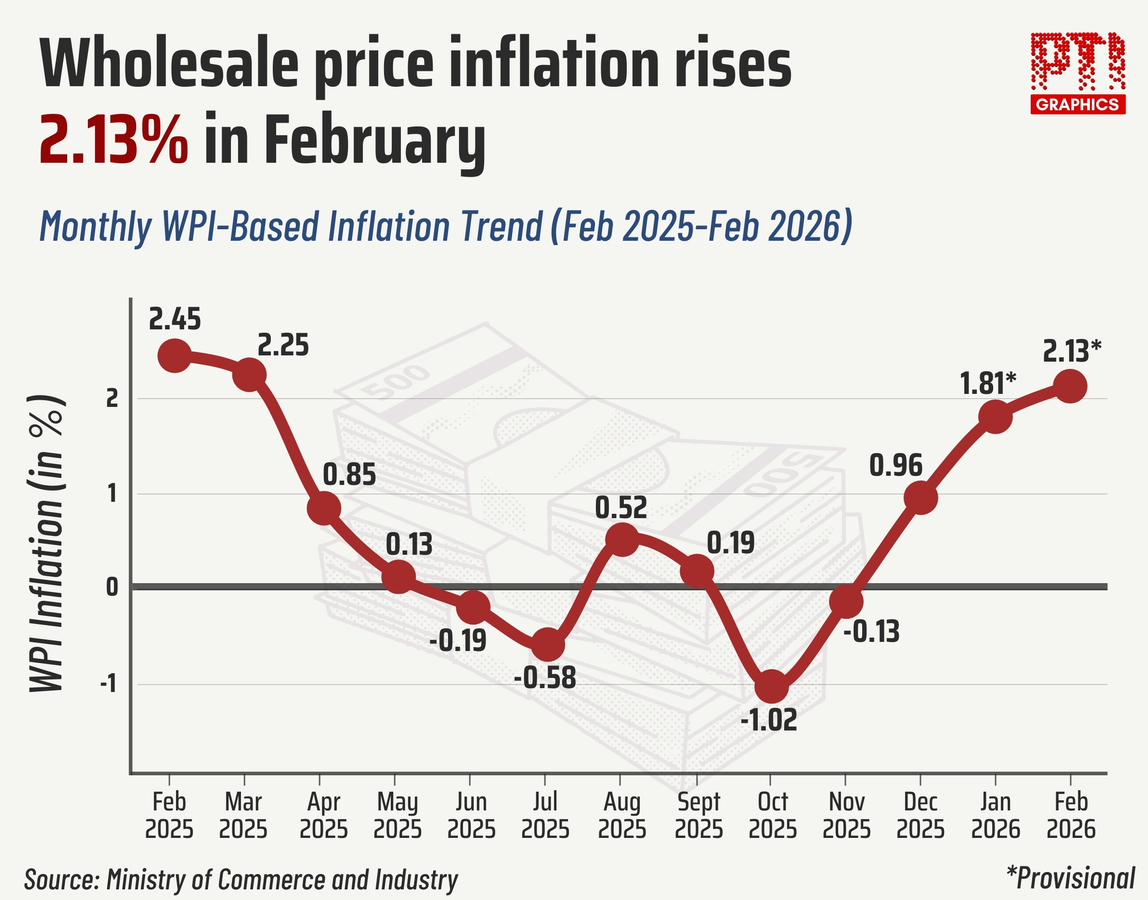
New Delhi, March 16 Wholesale price inflation rose to an 11-month high of 2.13 per cent in February, driven by an increase in the prices of food and non-food items, even though vegetable prices eased on a month-on-month basis, according to government data released on Monday.
This is the fourth consecutive month of rising wholesale price inflation, which stood at 1.81 per cent in January and 2.45 per cent in February last year.
Economists said that if oil prices continue to rise, this will likely further accelerate wholesale price inflation, especially given that the WPI more closely tracks international prices relative to the CPI basket (fertilizers, aluminum).
According to WPI data, inflation in food articles was 2.19 per cent in February, compared to 1.55 per cent in the previous month.
Although vegetable inflation eased to 4.73 per cent in February, compared to 6.78 per cent in January, inflation in pulses, potatoes, eggs, meat, and fish also increased in February.
"The positive inflation rate in February 2026 is primarily due to an increase in the prices of other manufactured goods, basic metals, non-food items, food items, and textiles, etc.," the Ministry of Industry said in a statement.
Negative inflation, or deflation, in the fuel and power basket narrowed to 3.78 per cent in February, compared to 4.01 per cent in January. Global oil prices averaged USD 68/bbl in February, compared to USD 63/bbl in January.
Barclays said in a research note that the impact of rising crude oil prices from the Middle East conflict will be more reflected in wholesale WPI inflation, rather than retail CPI inflation, since retail fuel prices remain unchanged.
"With a sharp jump in crude oil prices exceeding USD 100/bbl as of March 16, the corresponding WPI is likely to reflect this in the March print," Barclays said.
India Ratings and Research said that rising crude oil prices since the US-Iran war will have a strong impact on wholesale inflation from March 2026, until supply-side issues are resolved.
The average price of the Indian crude basket (up to March 12) reached a 44-month high of USD 101.25/bbl. Ind-Ra Chief Economist Devendra Pant expects wholesale inflation to remain high amidst the US-Iran war and a low base.
"Retail prices of petroleum products might remain stable for some time, which could offset any sharp increase in retail inflation. However, the increase in crude oil prices will push wholesale inflation higher. Ind-Ra expects wholesale inflation to jump to 3.7 per cent in March," Pant said.
According to WPI data for February, inflation in manufactured products edged up to 2.92 per cent in February, from 2.86 per cent in the previous month.
Inflation in the non-food articles category spiked to 8.80 per cent in February, from 7.58 per cent in January.
PHDCCI President Rajeev Juneja said, given the geopolitical risks, continued policy focus on improving supply-chain efficiencies, lowering logistics costs, supporting domestic manufacturing, and ensuring adequate availability of critical inputs for industry is crucial to contain cost-push pressures.
According to data released last week, India's retail inflation rose to 3.2 per cent in February, from 2.75 per cent in January.
The Reserve Bank of India (RBI) has reduced policy interest rates by 1.25 percentage points in the current fiscal year due to low inflation. The RBI mainly tracks retail inflation for deciding on benchmark interest rates.