Darjeeling, March 29 – In Darjeeling, the fading graffiti demanding "We Want Gorkhaland" now shares space with signs for roads, tourism, and welfare schemes – a reflection of how the politics of the hills is shifting from the aspiration for statehood to the demands of everyday governance.
For decades, politics in Darjeeling, Kalimpong, and Kurseong in North Bengal revolved around one key promise: a separate Gorkhaland state. While that aspiration remains, it is no longer the sole focus of political discourse in the hills.
Ahead of the West Bengal elections, the hills are witnessing a deeper shift. The long-standing demand for political recognition is now intertwined with other pressing issues: who will repair roads, revive tourism, ensure access to clean water, improve schools and hospitals, raise wages in tea gardens, and ensure welfare benefits reach the people.
This has led to the most complex election the hills have seen in years – a clash between the dream of Gorkhaland and the practical demands of governance.
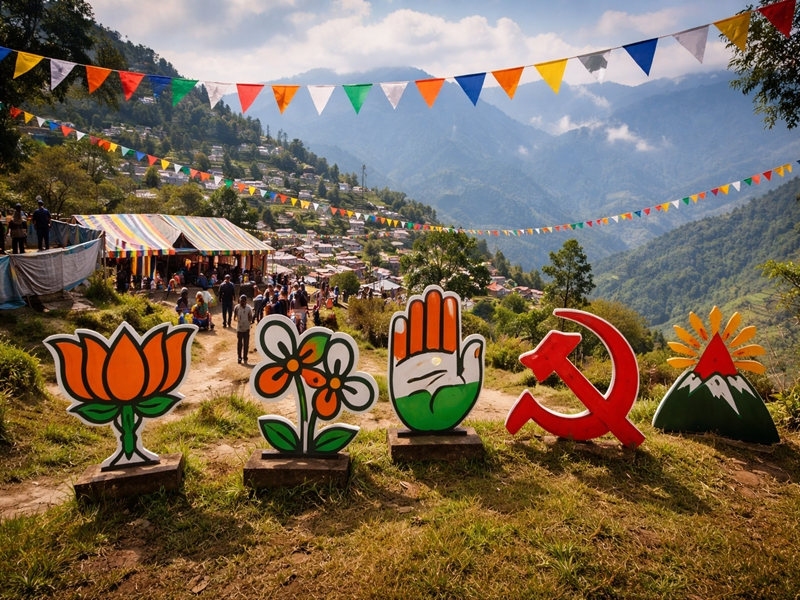
At the core of the election is a contest between the ruling TMC-Bharatiya Gorkha Prajatantrik Morcha (BGPM) alliance and the BJP-led National Democratic Alliance (NDA).
The Anit Thapa-led BGPM, backed by the TMC, is seeking to convince voters that the era of continuous agitation is over and that the hills now need development.
The BJP, on the other hand, is again emphasizing the importance of a "permanent political solution," arguing that infrastructure projects and welfare schemes cannot replace the unresolved issue of Gorkha identity.
"People used to vote for the Gorkhaland dream. Now, they also want to know who will repair the road to their village," said a tea garden worker in Kurseong.
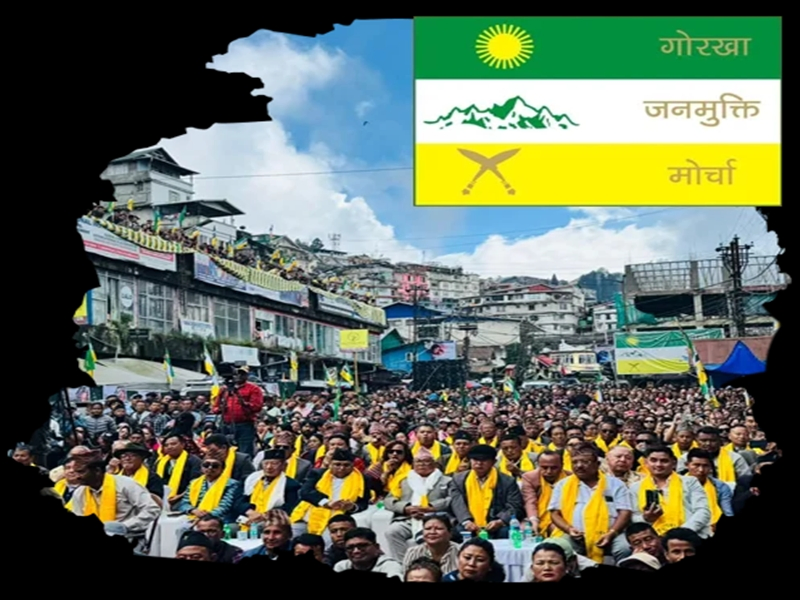
From the violent Gorkha National Liberation Front (GNLF) agitation in the 1980s to the rise of Bimal Gurung's Gorkha Janmukti Morcha (GJM), the politics of the hills has long been driven by the promise of statehood.
The BJP entered this landscape after 2009, forging an enduring, albeit transactional, alliance with hill parties. Despite repeatedly promising a "permanent political solution," it retained the Darjeeling Lok Sabha seat with the support of the GJM and later the GNLF.
However, repeated promises without delivery have led to disillusionment.
The voter list revision exercise has further complicated this situation.
In the Darjeeling district, the Systematic Repolarization (SIR) led to the deletion of around 1.22 lakh names across the five assembly constituencies, including nearly 25,000 in Darjeeling, 18,394 in Kurseong, and around 17,000 in Kalimpong.
These numbers are politically significant because they are close to or larger than the BJP's winning margins in 2021 – around 21,000 votes in Darjeeling and 15,000 in Kurseong, while Kalimpong was won by the TMC-backed Binay Tamang faction by 4,000 votes.
This has created a new level of uncertainty in the hills' electoral landscape, with the TMC-BGPM combine attempting to use the SIR to demonstrate that the BJP has allegedly failed to protect the political rights of the Gorkhas.
The 2017 agitation, which paralyzed the hills for over 100 days, left deep economic scars. Tourism collapsed, schools closed, and tea gardens suffered. What followed was not the disappearance of the Gorkhaland sentiment, but its fragmentation.
Bimal Gurung lost some of his influence. Binay Tamang faded. The GNLF declined sharply. Into this vacuum stepped Anit Thapa's BGPM, presenting itself as a force committed to development alongside the state government rather than remaining trapped in a cycle of protests.
"Our politics is about development with dignity," said Thapa. "People want roads, water, schools, and jobs. Agitation alone cannot feed families."
The TMC has carefully crafted its strategy to align with this. Unlike previous elections, when the TMC was perceived as a "plains" party with limited appeal to Gorkha voters, it is now leveraging both its alliance with the BGPM and the growing reach of its welfare schemes.
Schemes like 'Lakshmir Bhandar' have gained prominence due to a subtle demographic shift. Women now outnumber men in several parts of the Darjeeling district. There are more than 5.7 lakh women voters, while nearly 5 lakh women in the hills are beneficiaries of the scheme.
This demographic shift has encouraged the TMC to believe that Mamata Banerjee's "Banglar Meye" (Mother's Care) image can still resonate politically in the region.
However, the BJP believes that the TMC-BGPM combine is underestimating the depth of the Gorkhaland sentiment. That is why the party has once again turned to old allies, old symbols, and old promises.
The Bimal Gurung-led GJM faction has announced unconditional support to BJP candidates in all seven assembly constituencies in Darjeeling district, stating that only the BJP can deliver a permanent political solution.
The BJP's message is equally simple: development without identity is incomplete.
Its candidate choices reflect this calculation. In Darjeeling, it has fielded Noman Rai, associated with the GJM; in Kalimpong, former India hockey captain Bharat Chhetri; and in Kurseong, local BJP leader Sonam Lama. The BJP is increasingly reliant on the residual appeal of Bimal Gurung’s GJM and on tactical understandings with other anti-TMC forces. This includes Ajoy Edwards and the Indian Gorkha Janshakti Front (IGJF).
Unlike the BGPM, the IGJF has returned to the original Gorkhaland demand.
For the first time in decades, the hills are not merely voting on the dream of Gorkhaland, but on who can govern – a contest between the politics of a dream and the politics of delivery.