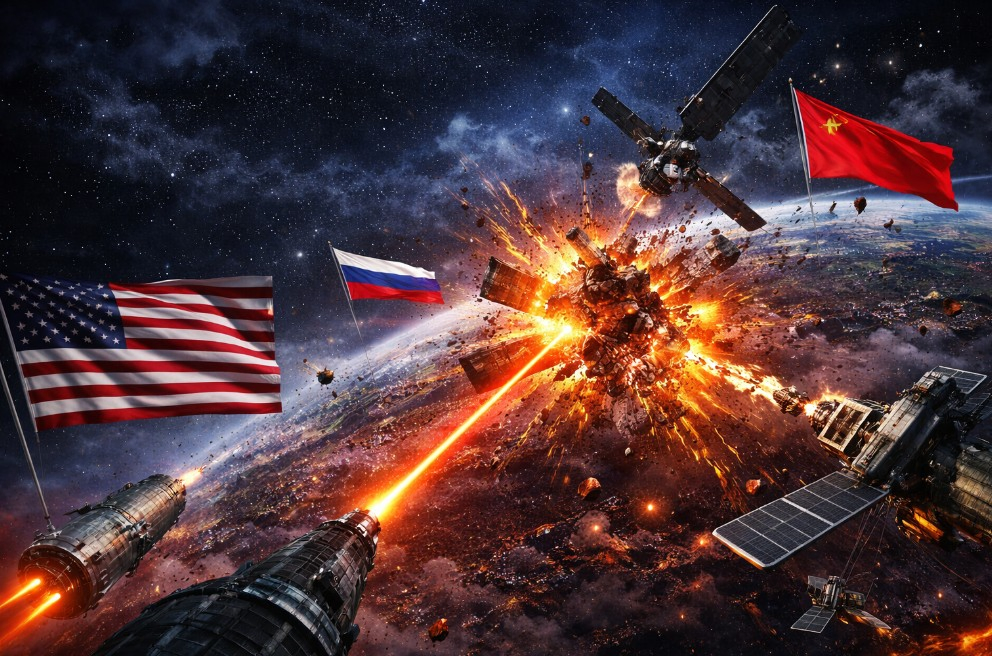
Washington, March 26 – The United States warned that space is now a contested domain for warfare, with China and Russia developing capabilities to threaten American satellites.
Senior defence and intelligence officials told lawmakers on Wednesday (local time) that modern warfare heavily relies on space systems. These include communications, navigation, and intelligence.
“Outer space is an increasingly complex and contested domain for warfare,” said Assistant Secretary of Defence for Space Policy, Marc Berkowitz.
He said adversaries are building systems to deny the US access to space and weaken its military advantage. He described China as the “pacing competitor” shaping US strategy.
Officials said recent conflicts have highlighted the growing role of space. They cited operations in the Middle East and lessons from Ukraine. Satellite-based systems helped track targets, support troops, and counter enemy actions.
Lt Gen Douglas Schiess of the US Space Force said space superiority is critical for military success. He said Guardians provide missile warning, communications, and electronic warfare support to forces in the field.
Officials warned that threats to space assets are rising rapidly. These include anti-satellite weapons, cyber attacks, and electronic jamming.
The National Geospatial-Intelligence Agency said adversaries are investing in systems to “disrupt, degrade, and deny access” in space.
The National Reconnaissance Office said it is expanding its satellite network. It now operates more than 200 satellites as part of a shift to more resilient systems.
US officials said they are working to accelerate space acquisitions. They are also relying more on private companies to deliver new technologies.
Thomas Ainsworth, the Air Force’s top space acquisition official, said the goal is to deliver capabilities faster and at a lower cost. He said the US must leverage innovation from the commercial space sector.
Lawmakers raised concerns about the defence industrial base. They said supply chains and workforce shortages could affect future space programmes.
The hearing comes as the Trump administration is pushing a new missile defence plan known as the Golden Dome. Officials said the system will rely on space-based sensors and interceptors to track and stop advanced threats.
Officials said control of space will shape future conflicts. Satellites now support nearly every military operation on land, sea, and air.
The United States has relied on space systems for decades. But the domain is becoming more crowded and competitive. China has rapidly expanded its satellite network. Russia continues to develop counterspace weapons.
The growing competition in space is expected to deepen cooperation with allies and partners, especially in the Indo-Pacific, where China’s capabilities remain a key concern.