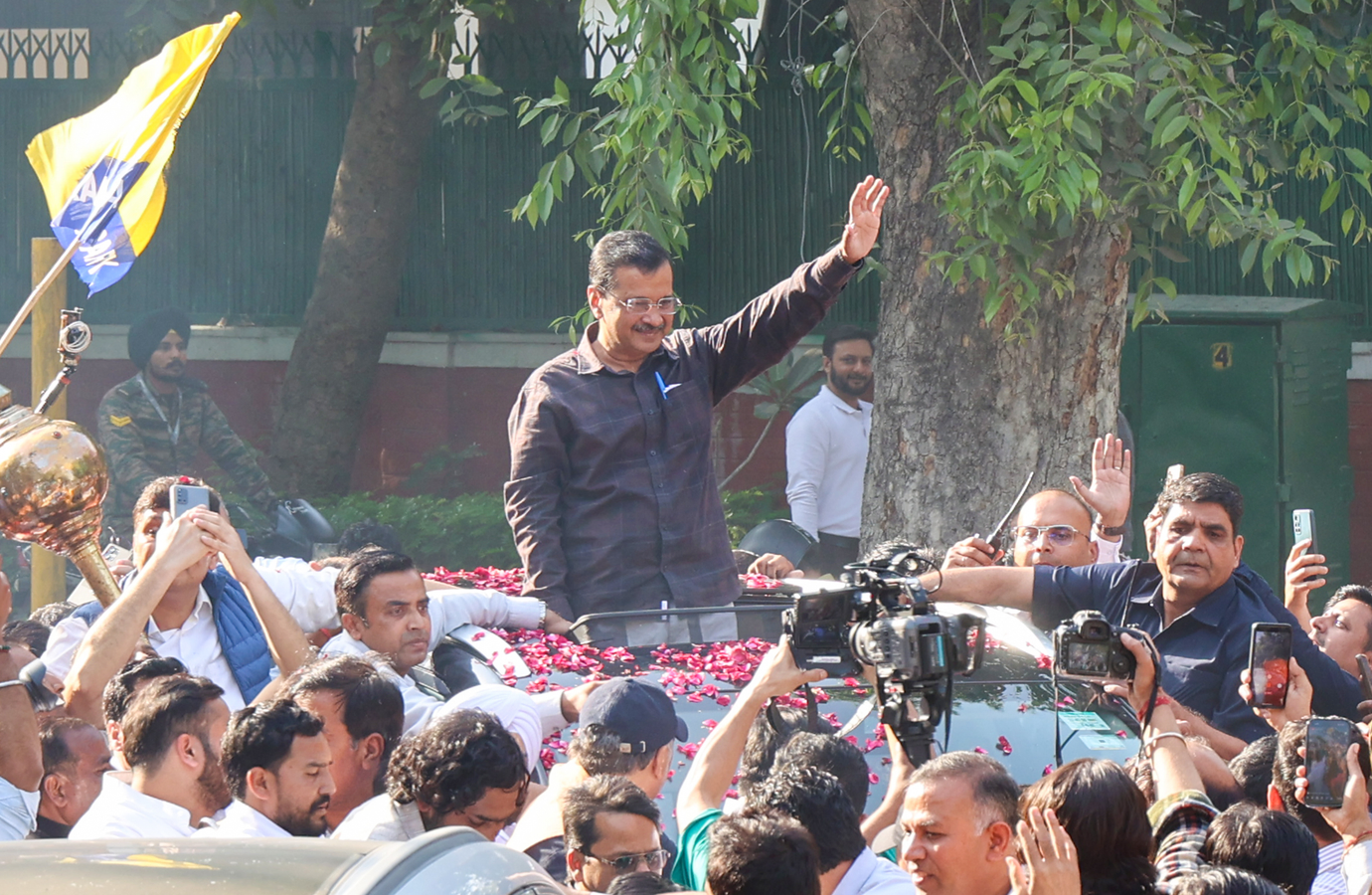
New Delhi, February 27 – A Delhi court on Friday acquitted all 23 accused, including AAP national convener Arvind Kejriwal and former Deputy Chief Minister Manish Sisodia, in the excise policy case being investigated by the Central Bureau of Investigation (CBI). The court ruled that the prosecution failed to establish even a prima facie case or raise a "grave suspicion" warranting charges.
In a detailed order exceeding 1,100 paragraphs, Special Judge (PC Act) Jitendra Singh of the Rouse Avenue Court stated that the CBI's case was "wholly unable to withstand judicial scrutiny" and was "completely discredited".
The court held that, after a thorough examination of all evidence, including voluminous documents and testimonies from nearly 300 prosecution witnesses, the prosecution's case did not even meet the threshold for a prima facie suspicion, let alone the "grave suspicion" required under criminal law.
The Special Judge observed that compelling the accused to undergo a full trial without legally admissible evidence would be a "manifest miscarriage of justice and an abuse of the criminal process".
The case involved the Delhi Excise Policy 2021-22, introduced by the AAP-led government in November 2021, which was later scrapped amid allegations of corruption, kickbacks, and policy manipulation.
The CBI alleged that the policy was designed to benefit certain private liquor entities, including the "South Group", in exchange for alleged upfront bribes intended for electoral purposes, including the Goa Assembly elections.
However, after a comprehensive examination of the evidence and testimonies from nearly 300 prosecution witnesses, the court concluded that the "theory of an overarching conspiracy" had been "completely dismantled".
The court also rejected allegations relating to the payment and recoupment of "upfront money", holding that the alleged payments were primarily based on "so-called pauti entries from Angadia firms, documents that are inadmissible in law", and on statements from approvers that were not corroborated.
The court also criticized the repeated use of the term "South Group" in the charge sheets, stating that such labels "serve no legitimate investigative or prosecutorial purpose" and could create a prejudicial impression.
The court also flagged broader constitutional concerns regarding prosecutions by the Enforcement Directorate (ED), noting that money laundering is inextricably linked to the survival of the underlying offence.
The court, relying on a Supreme Court ruling, reiterated that if the scheduled offence does not stand, the Prevention of Money Laundering Act (PMLA) proceedings cannot independently exist.
The court warned that prolonged pre-trial incarceration on provisional and untested allegations risks turning the process itself into punishment, contrary to Article 21 of the Constitution.
Finally, the court discharged all 23 accused, bringing unprecedented relief to the Aam Aadmi Party (AAP) leadership, as both Kejriwal and Sisodia had earlier been arrested in connection with the liquor policy investigation but were granted bail by the Supreme Court in 2024.