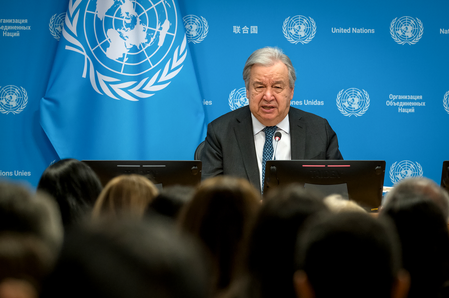

United Nations, March 3 – UN Secretary-General Antonio Guterres has engaged in diplomatic talks with leaders in the Gulf region as the global organization expressed concern over the global economic repercussions of the Iran war.
The UN is "concerned about the potential negative impacts that the military activities in the region could have on the global economy," Stephane Dujarric, Guterres' spokesperson, said on Monday.
"And these impacts, as they often do, hit the most vulnerable the hardest," he added.
Oil prices, which are highly sensitive to instability in the Gulf region, rose by 5.63% on Monday, and a closure of navigation in the Strait of Hormuz could further impact energy prices.
Guterres is "particularly concerned" about "the expansion of attacks to countries that were not involved in the initial attacks," Dujarric said, "whether we are talking about Gulf countries, Jordan, Syria, or Lebanon."
"What is needed in the region more than anything is a way out," Dujarric said.
"To that end, the Secretary-General again calls for de-escalation, an immediate cessation of hostilities, and genuine dialogue and negotiations," he said.
Dujarric said that Guterres spoke with Qatar's Emir Sheikh Tamim bin Hamad Al Thani, Oman's Foreign Minister Sayyid Badr bin Hamad bin Hamood Albusaidi, and the ambassadors of the six-member Gulf Cooperation Council.
Al-Thani and Guterres discussed "the situation in the region and the urgent need to end the current military escalation and return to dialogue in the interest of regional stability," Dujarric said.
During his conversation with Albusaidi, Guterres thanked Oman for its mediation efforts between Iran and the US, and reiterated his condemnation of the attacks against Iran and the Iranian attacks on Gulf countries," Dujarric said.
The US-Israel attacks on Iran came two days after the last session of negotiations between Iran and Israel in Geneva, facilitated by Oman.