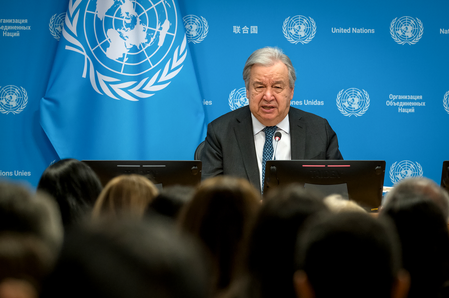
United Nations, April 7 UN Secretary-General Antonio Guterres is “deeply concerned” about US President Donald Trump’s warning to Iran that a “whole civilization will die tonight,” while also appealing for the re-establishment of freedom of navigation in the Strait of Hormuz.
“The Secretary-General is deeply concerned by statements suggesting that entire civilian populations or civilizations may be made to bear the consequences of political and military decisions,” a statement issued on Tuesday by his spokesperson Stéphane Dujarric said.
“There is no military objective that justifies the wholesale destruction of a society’s infrastructure or the deliberate infliction of suffering on civilian populations,” he added.
The statement, however, did not mention Trump or the US by name.
The statement came in response to a concerning Truth Social post by Trump, in which the US president declared, “A whole civilization will die tonight, and will never be brought back.”
“I don’t want that to happen, but it probably will. However, now that we have Complete and Total Regime Change, where different, smarter, and less radicalized minds prevail, maybe something revolutionary wonderful can happen, WHO KNOWS?
“We will find out tonight, one of the most important moments in the long and complex history of the World. 47 years of extortion, corruption, and death, will finally end. God Bless the Great People of Iran!” Trump said in the post early Tuesday.
Guterres reiterated that conflicts end when leaders choose dialogue over destruction. “That choice still exists. And it must be made -- now.”
The UN chief called for stepped-up diplomatic efforts to find a peaceful path forward. His personal envoy, Jean Arnault, is travelling to the region to support these efforts.
Guterres simultaneously also appealed for the re-establishment of freedom of navigation in the Strait of Hormuz, stressing that “when the Strait of Hormuz is strangled, the world’s poorest and most vulnerable cannot breathe”.
Just hours after Trump’s post, the UN Security Council failed to adopt a Bahrain-led resolution on re-opening the Strait of Hormuz after veto-wielding permanent members Russia and China voted against the resolution.
The resolution got 11 votes in favour and abstentions by Colombia and Pakistan.
The UAE expressed “profound regret” at the Security Council's inability to adopt the resolution that had called for an immediate halt to all attacks on vessels and attempts to obstruct freedom of navigation in the Strait of Hormuz.
“The Strait of Hormuz must remain open to all, and freedom of navigation in it must be safeguarded, as no state should possess the ability to obstruct the arteries of global trade or push the world to the brink of an economic crisis,” the Mission said in a post on X.
The UAE said it will continue to rally international efforts to reopen the Strait of Hormuz, and to work with its partners to ensure the security of navigation and restore the flow of global trade.
US Representative to the UN Ambassador Mike Waltz said in the Council that it is long known that Russia and China are capable of paralysing the Council through obstruction and manufactured confusion.
“Today's veto marks a new low, and it shows just how frightening a safer, more secure, more united Middle East can be…I will note today's result does not restrict the United States to continue to act in its own self-defence and in the collective defence of our allies and partners. And President Trump will continue the actions necessary to defend our people and the free world,” he said.