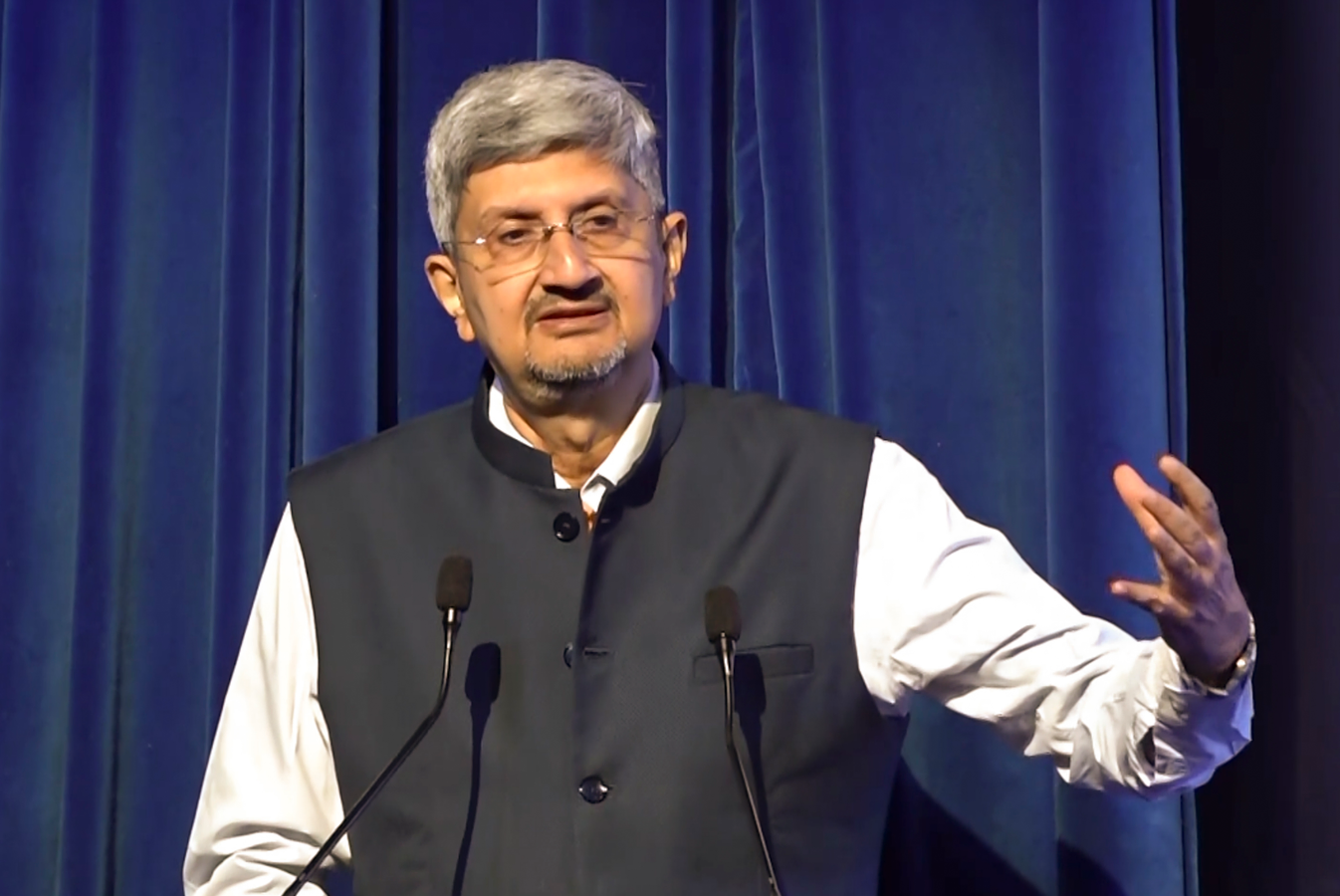
New Delhi, April 7 DRDO chief Samir V Kamat stated on Tuesday that the biggest challenge in materials development is its 10-15 year cycle, while system development cycles are "continuously shrinking."
Unless the materials development cycle "keeps pace" with the system development cycle, acquiring new materials will become "increasingly challenging," he said during a defense seminar hosted at Subroto Park.
"Materials are key enablers, whether for systems, weapons, or sensors. If you want capabilities beyond what you currently possess, you must develop materials that can provide that capability," the DRDO chairman said.
He cautioned India against relying on foreign countries for materials development technology.
"You won't get it. They will only provide the technology once they have used it in their systems. And, when they move to the next generation technologies... when they provide you with the various components needed to make your systems," Kamat said.
"Therefore, if you have any ambition of becoming 'Atmanirbhar' and a technology leader, this is one area – not the only one, but one area – that the country needs to focus on," he asserted. In his address, the DRDO chief highlighted various challenges the materials development sector faces, from investment to scalability.
"But the biggest challenge we face today is that the materials development cycle is 10 to 15 years. If you look at it, the system development cycle is continuously shrinking. Today, new systems arrive every five years, and in areas like drones, things change every couple of years or every year," he said. So, unless the materials development cycle keeps pace with the system development cycle, "acquiring new materials becomes increasingly challenging," the DRDO chief added.
Kamat, also Secretary, Department of Defence Research and Development, said the materials community has attempted to shorten the materials development cycle, using integrated computational materials engineering and AI/ML (artificial intelligence/machine learning) tools.
"I am very optimistic that in the next five to ten years, the materials community will also be able to shorten the materials cycle," he said. The next challenge, after producing materials, is converting them into the product form needed. This is where manufacturing comes in, Kamat emphasized.
He said that today, India is "self-sufficient" in naval hulls, including ship hulls and submarine hulls.
In his address, the DRDO chief also urged stakeholders to work in the area of critical raw materials used in making materials.
"See, today we have magnet technology, but we don't have rare earth metals," he emphasized. China controls 90% of the rare earth metals. And for the heavy rare earths needed in neodymium, iron, boron magnets, China has 99% dominance, the DRDO chief added.
"So, we need to look at tungsten. Today, we don't have any tungsten in the country to make tungsten heavy alloy. We have the technology to make tungsten heavy alloy, but our dependence on tungsten is still very high. It's not that these resources are unavailable in the country. We have tungsten and rare earth resources in the country. But we have not paid enough attention to the extraction technologies. We have not paid enough attention to exploring our country to see where these resources are," he said.
Kamat underlined that a holistic approach is needed to make a mark in the future. "I am sure that with the increased focus of the government on Atmanirbharta, all these issues will be addressed... And I'm sure the deliberations that you will have (at this seminar) will lead to some roadmap which you can propose for the government to take it forward," he said.
The seminar on advanced materials and additive manufacturing for aerospace was hosted by the think-tank Centre for Aerospace Power and Strategic Studies (CAPSS) and the Indian Military Review publication.
Air Officer Commanding-in-Chief, Maintenance Command of the IAF, Air Marshal Yalla Umesh, in his address at the inaugural session, said the complexity of operational tempo and environment of military aviation demands a high-performance system having exceptional reliability, "to be maintained in operational state, come what may".
He underlined that dependency on foreign OEMs (original equipment manufacturers), geopolitics, commercial considerations, obsolescence and OEMs shifting focus to newer products, force countries like India to look at sustenance solutions, beyond OEMs. The air marshal added that various upgrade-related activities at base repair depots of the IAF's Maintenance Command have proved crucial to the sustenance and enhancing war-waging potential of the air force.
Air Vice Marshal A K Gangopadhyay, chairing the first technical session, said, "In the future of aerospace, materials are not the supporting actor, they decide the plot".
He underlined that while "we have progressed, but not yet mastered the complete chain", adding, "there are 'islands of excellence', but 'we do not have a full ocean of capabilities'".
The senior IAF officer cautioned that "aerospace has a nasty habit, it punishes self-congratulation" and urged all stakeholders to work on boosting capabilities.
In his address, he also asserted the significance of advanced materials in aerospace, and said these are "fundamental and not ornamental".