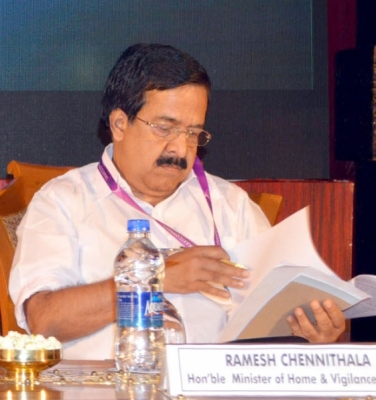
Thiruvananthapuram, March 27 – Senior Congress leader and CWC member Ramesh Chennithala alleged a "massive Rs 700-crore fraud" in Kerala’s Cooperative Department on Friday, claiming that irregularities are unfolding even as the state heads into a crucial election phase.
Kerala is set to go to the polls on April 9 to elect 140 members to the Legislative Assembly.
Addressing the media, Chennithala said the alleged scam – potentially the largest in the state’s cooperative sector – centres on a project to implement a common software platform across 4,415 primary cooperative societies.
He claimed the project was initially awarded to Tata Consultancy Services (TCS) for Rs 206 crore but was later scrapped under “mysterious circumstances” and re-tendered in a manner that allegedly favoured inexperienced entities at significantly inflated costs.
Tracing the background, Chennithala noted that since 2016, a unified core banking software system has been mandated across the country in line with the norms of the Reserve Bank of India (RBI) and the National Bank for Agriculture and Rural Development (NABARD), with full central funding support.
However, the Kerala government under Chief Minister Pinarayi Vijayan opted for a customised software solution, citing the advanced requirements of the state’s cooperative sector, he said.
A high-level committee chaired by the Chief Secretary had selected TCS as the sole qualified bidder in September 2023, following which a formal order was issued in April 2024, awarding the company a Rs 206-crore contract for implementation and maintenance.
“Despite adhering to all norms, the contract was abruptly cancelled due to political interference,” Chennithala alleged.
He further claimed that a fresh e-tender floated in April 2025 introduced “tailor-made conditions” that effectively excluded established IT firms. Criteria such as mandatory workforce presence in Kerala allegedly prevented companies like TCS from participating.
According to him, only two Kannur-based cooperative entities – Kerala Dinesh Beedi Workers Central Cooperative Society and Malabar Information Technology Cooperative Society – submitted bids under the revised tender.
The Dinesh Beedi Cooperative reportedly quoted Rs 58 crore for implementing the software in just 280 societies. “At this rate, scaling the project to all 4,415 societies would push the cost beyond Rs 900 crore, compared to Rs 206 crore quoted by TCS – implying a loss of over Rs 700 crore to the exchequer,” he said.
Chennithala termed the limited participation in such a large-scale project as “highly suspicious” and alleged that the move was not just financial misconduct but also a “backdoor attempt” to bring the cooperative sector under political control.
With the Model Code of Conduct in force, he alleged that the government is attempting to secure clearance from the Election Commission to fast-track the tender process. He urged the poll body to intervene immediately and stall the proceedings.
Stating that a formal complaint would be filed, Chennithala said a future United Democratic Front (UDF) government would scrap the deal if voted to power.