Ranchi, February 19 – The issue of elephant attacks dominated discussions in the Jharkhand Assembly on Thursday, as MLAs expressed concern over the rising number of deaths and called for urgent government intervention.
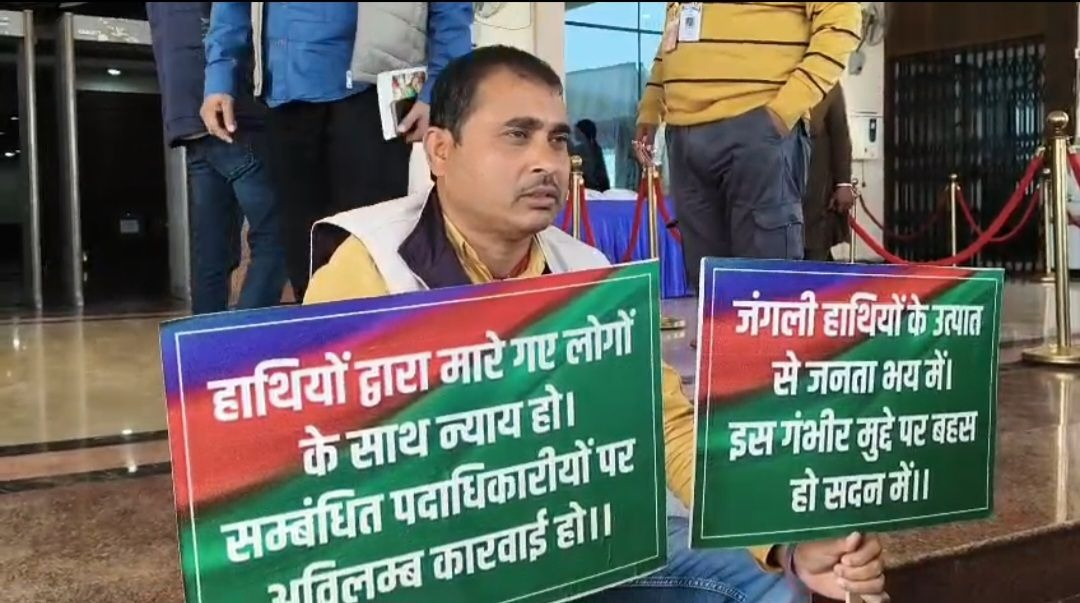
On the second day of the Budget Session, Nirmal Mahto, an MLA from Mandu representing the All Jharkhand Students Union (AJSU), staged a protest outside the Assembly, holding a banner and accusing the state government and the Forest Department of gross negligence in handling the escalating conflict between humans and animals.
He stated that more than 10 people have died in separate elephant attacks across the state, alleging that despite the rising casualties, the Forest Department has failed to establish an effective monitoring mechanism to track elephant movements.
He said that the elephants suddenly enter villages and even urban areas, causing loss of life and property, but the government is doing nothing.
The MLA linked the movement of elephants into human settlements to rampant illegal mining activities. He alleged that illegal extraction of coal and iron ore, along with blasting in mining zones at night, has severely disturbed the elephants' natural habitats.
"A government that claims to protect 'water, forest, and land' has failed to safeguard natural resources," he alleged.
Mahto also expressed strong dissatisfaction over the compensation being provided to the families of victims. Currently, the state government provides Rs 4 lakh as ex gratia assistance in cases of death due to elephant attacks. Calling the amount "grossly inadequate," he demanded that the compensation be increased to Rs 20 lakh or Rs 30 lakh.
In addition, he sought a government job for one member of each affected family and accused the government of failing to fulfill promises regarding the reconstruction of houses damaged by elephant incursions.
He alleged that instead of proper rehabilitation, only token assistance is being given. This is unjust to families who have lost their breadwinners and homes, he said.
The MLA demanded a comprehensive policy framework to address the human-elephant conflict, including scientific monitoring of elephant corridors, stricter action against illegal mining, and a time-bound rehabilitation plan for affected families.