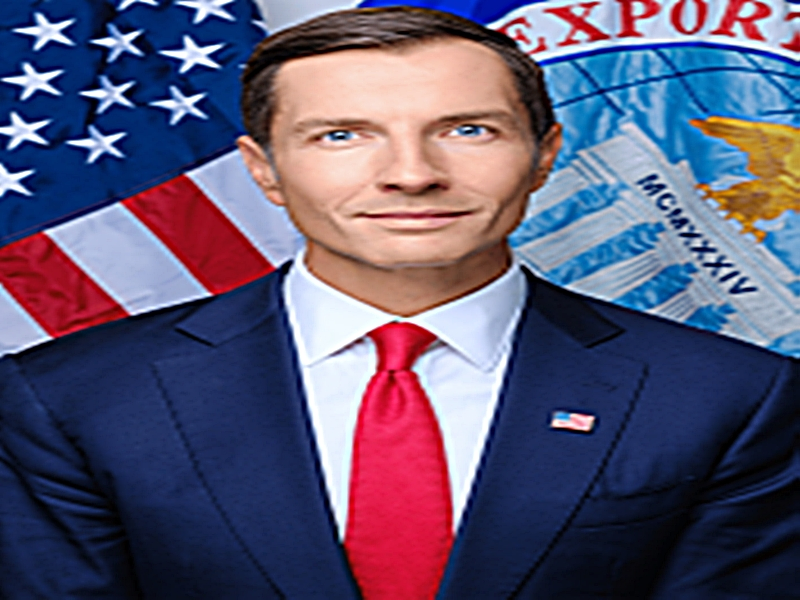
Washington, March 18 – The United States is repositioning the Export-Import Bank as a “frontline economic tool,” its chief told lawmakers, underscoring a sharper push to bolster American exporters and counter global competition led by China.
Testifying before a House subcommittee, EXIM President and Chairman Jovan Jovanovic said the bank is being aligned with efforts to reindustrialize the U.S., secure supply chains, and strengthen economic security.
“As many of you have noted, EXIM is one of America's frontline economic tools carrying out President Trump's vision for Reindustrializing America, securing our supply chains and ensuring our economy works for American workers and American companies large and small alike,” he said.
Subcommittee Chairman Warren Davidson said Beijing remains “the world's largest provider of export credit” and noted that China provided exporters with “over $23 billion in medium and long-term loans” in 2024, “quadruple what Exim provided to American firms.”
Jovanovic warned that U.S. companies are competing in markets where rivals deploy “massive state financing subsidies and industrial policy,” which has contributed to “weakened economic security” and job losses in the United States.
A central focus of the hearing was the China and Transformational Exports Program (CTEP), created by Congress to counter Beijing’s export financing. Jovanovic said the programme has now been integrated into the bank’s core operations.
“One out of every four transactions we do at the bank looks to the KTP program,” he said, calling it “mission critical” for achieving U.S. economic objectives.
Lawmakers stressed that reauthorizing and strengthening the programme would be essential to maintaining competitiveness. Representative Andy Barr said it has become a key tool in U.S. economic statecraft, while others warned that uncertainty over EXIM’s future could undermine confidence among global partners.
The hearing also highlighted “Project Vault,” a proposed public-private initiative to build a U.S. strategic reserve of critical minerals. Jovanovic said the project would combine “$10 billion of XM debt financing” with “nearly $2 billion of private sector capital” to address supply chain vulnerabilities.
He said the initiative is designed to ensure companies can “have what they need, when they need it most,” while reducing dependence on foreign sources of critical materials.
Small business support emerged as another key theme. Ranking Member Joyce Beatty said, “90 percent of EXIM authorizations directly benefit US small businesses,” calling the bank vital for enabling them to compete globally.
Jovanovic acknowledged gaps in outreach, saying he found only “two active relationships” in the community lender programme when he took office. He said efforts are underway to expand partnerships and improve access to export financing across all states.
The bank is also seeking to address internal inefficiencies and workforce challenges. Jovanovic said reforms include “clarifying priorities, streamlining internal processes,” and improving accountability to ensure faster deal execution.
On broader competition with China, lawmakers repeatedly pointed to Beijing’s use of state-backed financing to secure global influence. Jovanovic said the U.S. must respond without abandoning its standards.
“We don't pollute — we don't disregard the law,” he said, adding that the goal is to demonstrate the long-term value of partnering with the United States.
Jovanovic also emphasised that EXIM operates at a profit, noting it has “returned nearly $10 billion to the US Treasury” while maintaining a default rate lower than private sector lenders.
Congress must reauthorize EXIM before its mandate expires later this year. Lawmakers said a clear signal of bipartisan support would be critical to restoring confidence and ensuring U.S. exporters remain competitive in global markets.
Established in 1934 under President Franklin D. Roosevelt, EXIM was created to support American jobs by financing exports when private lenders are unwilling or unable to do so. Over time, it has become a key tool for promoting U.S. trade and industrial capacity abroad.
In recent years, the bank has taken on a more strategic role as Washington seeks to counter China’s expanding economic influence, particularly in infrastructure, energy, and emerging technologies, where state-backed financing has become a central feature of global competition.