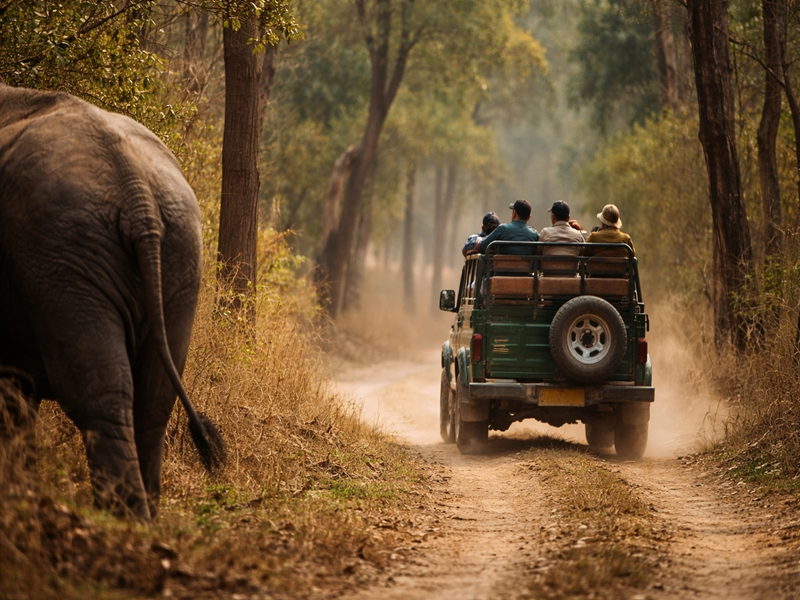
In Bengaluru, Karnataka, a debate arose in the Legislative Assembly regarding safari operations and trekking regulations in forest areas. Opposition leader R. Ashoka criticized the government for initially banning safaris and then re-opening them, while Forest and Ecology Minister Eshwar Khandre defended the decision, citing increased human-wildlife conflict.
Ashoka argued that safaris are conducted not only in Karnataka but also in other parts of India and globally. He pointed out that wildlife safaris are a major industry in countries like Kenya, providing livelihoods for thousands of people.
"Approximately 10,000 to 12,000 people in Karnataka depend on safaris for their livelihood. The safaris were abruptly stopped. While I understand the government's need to make decisions, a proper survey should have been conducted beforehand," he stated.
Ashoka alleged that the government made the ban on safaris without conducting a thorough study, resulting in the loss of livelihoods for thousands. He claimed that both workers and the government suffered financial losses due to the decision.
He argued that safaris were not recently introduced; they had been conducted for many years. He urged the government to protect farmers and safeguard the interests of those dependent on safari operations.
In response, Minister Khandre explained that the decision to halt safaris was not sudden but was prompted by increased human-wildlife conflict in forest regions, particularly around Bandipur. He mentioned several incidents of tiger attacks in the area during November and December.
Khandre said that three people were killed due to tiger attacks within 15 days in Bandipur and neighboring regions. He also mentioned another incident where one person was permanently disabled.
During his visit to Chamarajanagar district, representatives from farmer organizations and other groups submitted memoranda alleging that safari vehicles were operating even after permitted hours, and that various regulations were being violated. They warned that if safaris were not stopped, more human lives could be lost. Khandre said that officials were directed to verify the situation. Later, when he was in Bidar, another tiger attack occurred within a week. After that incident, he decided to stop safari operations.
Khandre acknowledged that the region attracts international tourists but emphasized that human life must be prioritized. He noted that approximately 314 kilometers of forest boundary exist in the region, of which nearly 100 kilometers have become major human-wildlife conflict zones.
Khandre stated that the department had established 25 anti-poaching camps and ordered round-the-clock patrolling along forest borders. Drones and other equipment were also deployed to prevent tragedies.
He added that farmer organizations had demanded a complete ban on safari operations, while some legislators and institutions pointed out that the decision had affected the livelihoods of thousands of people. The government also incurred an estimated revenue loss of Rs 6 crore to Rs 8 crore due to the suspension of safari activities.
Khandre said that after 31 months, the State Wildlife Board held a meeting and sought an interim report from a representative of the Central government. Based on the report and after introducing regulations, safari operations were reopened.
"Currently, there are no complaints," he stated.
Ashoka, however, criticized the government's approach, stating that such decisions should not be taken and reversed in a "Tughlaq-style" manner.
"If safaris are stopped, they should be stopped permanently. After banning them, did the human-wildlife conflict reduce? What is the tiger and elephant population now compared to earlier? The forest area remains the same but the number of wild animals is increasing. The minister must consider both human safety and wildlife protection," he said.
Khandre responded that the tiger population has grown significantly over the years.
"In 1972, there were only 12 tigers in the region. During the census period, the number rose to around 150, and now it has increased to 172," he said, adding that experts are studying the carrying capacity of forests as wildlife numbers continue to rise while forest area remains unchanged.
He also said that around 70 to 72 villages are located along the forest fringes, and that the department has been conducting outreach programs in these areas. With safari operations temporarily halted, personnel could be deployed for village patrols, and additional vehicles were made available.
In a separate discussion, Khandre also responded to a question from BJP MLA Bhagirathi Murulya regarding trekking regulations on the Subramanya–Kumaraparvatha route.
Khandre stated that the trekking distance from Subramanya to Kumaraparvatha is about 12 kilometers one way and 24 kilometers for a round trip. Earlier, trekkers required two days to complete the trek and had to stay overnight midway, where safety measures were limited and wild animals frequently roamed.
"Elephants and other wildlife move in the area. Considering safety concerns, the trekking schedule was revised on June 5, 2024," he said.
Khandre explained that the trek from Bidalli to Kumaraparvatha now takes about seven hours, while the Bidalli–Kumaraparvatha–Subramanya route takes around 10 to 12 hours. The overall trekking distance has also been reduced by about two kilometres from the earlier 22 kilometres.
He said the objective is to ensure that trekkers who begin their journey at 6 a.m. return by 6 p.m. to avoid risks from wildlife. The department has also established an anti-poaching camp in the area.
"I have seen 2,000 to 3,000 tourists gathering there at a time. Such large numbers can impact the ecosystem. Therefore, trekking has been regulated, and only 150 people are allowed per day," he said, adding that trekking is restricted during heavy rains and extreme summer conditions.
During the discussion, MLA Bhagirathi Murulya requested the minister to allow trekkers to begin their journey at 5.30 a.m. Khandre agreed to the suggestion and said he would direct officials to issue an order in this regard.