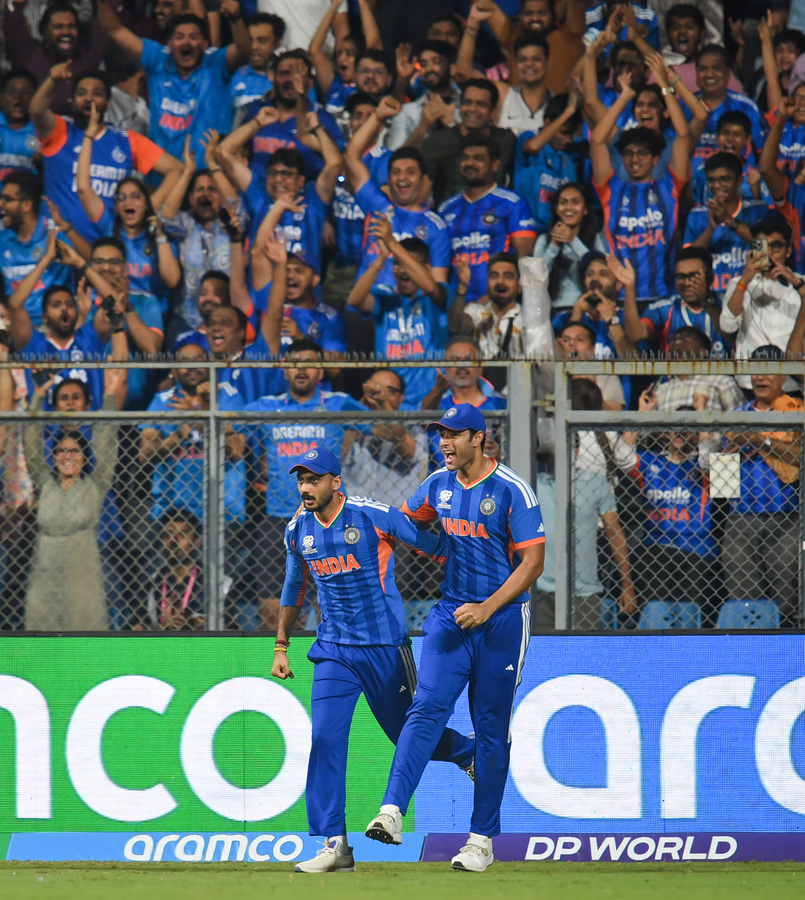
In Barbados, the focus was on breaking a curse, while in Ahmedabad, it was about building a kingdom. Simply put, India's current dominance in the shortest format of cricket is unprecedented in cricketing history.
India's 96-run victory over New Zealand in the final, securing their first-ever title defense, also signaled a new era of Indian supremacy in T20 cricket.
More importantly, the on-field brilliance also shifted the focus away from the diplomatic tensions that had overshadowed the tournament's buildup, stemming from Bangladesh's withdrawal due to "security concerns" and Pakistan's threat to boycott their crucial group stage match against India.
Given that India is the first team to win three T20 World Cups and achieve consecutive titles (2024, 2026), this claim of unparalleled strength is entirely justifiable.
Adding to this is the BCCI, cricket's financial powerhouse, and their impressive bench strength.
Beyond emerging as the standout team in this World Cup, this Indian squad may be the finest T20 side ever assembled internationally since the shortest format became popular over two decades ago.
India's dominance echoes the time when the West Indies and Australia dominated global cricket in the mid-1970s to 80s and the first decade of this millennium, winning numerous titles and series worldwide.
India's dominance has led the rest of the top teams to compete for second place, which is not ideal for the global game as it indicates a lack of competition.
While India's victory demonstrates their superiority in the shortest format, evaluating the true depth of their cricket will require considering players who didn't even make the squad for this tournament.
Even players like Sanju Samson, Ishan Kishan, Jasprit Bumrah, Axar Patel, Hardik Pandya, and Shivam Dube, who have achieved success, should be considered.
If we look at the records of players like Yashasvi Jaiswal, Shreyas Iyer, Shubman Gill, Ruturaj Gaikwad, and the young Vaibhav Sooryavanshi, we can see the incredible depth of Indian cricket at the moment.
Experts agree that India could easily field a "B" team and still win the World Cup, and this is based on facts.
Now, it's up to the other major teams to prevent India from dominating world cricket for years to come.
Several factors have contributed to India's success, including their strategy of high-risk, high-reward, prioritizing rapid scoring over wicket preservation, near-perfect execution of plans on the field, and clinching key moments of the game.
When a team is packed with talented players, including Bumrah, they can change the direction of matches in a matter of balls.
New Zealand's struggles:
New Zealand's recent failures in ICC white-ball tournaments mirror South Africa's struggles. The Kiwis have reached six finals in 13 ICC events since 2015, winning only the 2021 World Test Championship.
Some decisions made by captain Mitchell Santner in the final were questionable, including bowling first despite winning the toss, rather than putting pressure on the scoreboard.
Despite India's vulnerability to spin throughout the tournament, New Zealand left out specialist off-spinner Cole McConchie, who had taken two key wickets against South Africa in the semi-final, for pacer Jacob Duffy.
Furthermore, Glenn Phillips was only given one over early on, despite conceding only five runs, and was not brought back.
Pakistan's decline:
The tournament also saw Pakistan cricket continuing its prolonged slump caused by frequent captaincy shifts, lack of unity in the team, and a lack of player development program. The Pakistan Cricket Board, heavily influenced by the country's ruling establishment, also played a role in the team's decline in recent years.
Criticism of pre-seeding:
The ICC's pre-seeding system for the tournament, which locks Super 8 spots based on pre-tournament rankings rather than performance in the group stage, has drawn heavy criticism for favoring India and other top teams.
This structure, designed for commercial broadcasting benefits, resulted in imbalances as all four group winners (India, South Africa, West Indies, Zimbabwe) were placed in one group, while the runners-up got an easier path.
This process eliminated the traditional suspense and fairness one expects in a global event, prioritizing commercial gains over real action on the field.
Associate teams make a mark:
Associate teams made a mark in the tournament, although they are still far from closing the gap with full member nations. Highlights included the USA stretching India, the Netherlands nearly beating Pakistan, England's close shave against Nepal, and Canada's Yuvraj Samra scoring a century against New Zealand. Also, Zimbabwe beating Australia in the group stage.