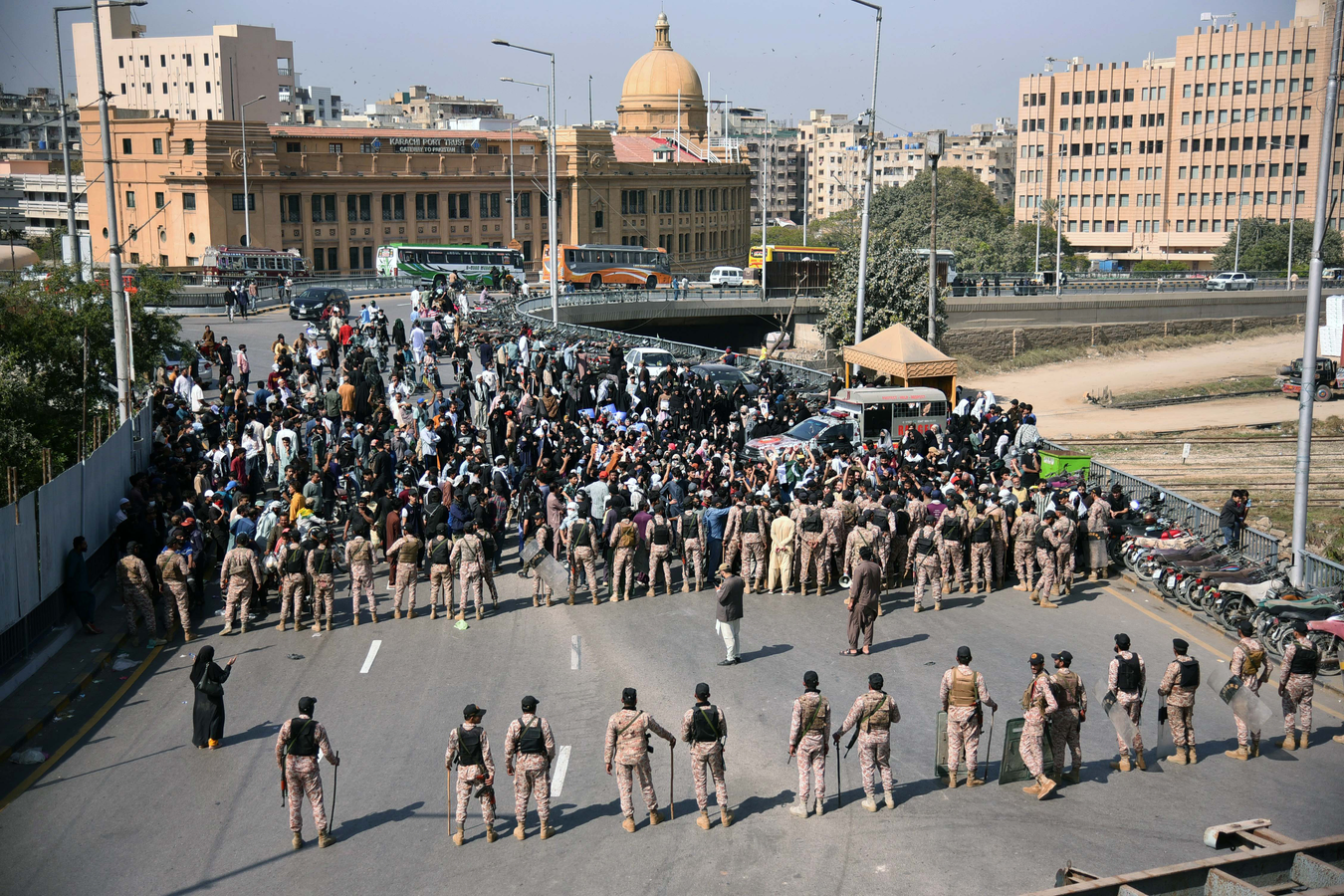
Islamabad, March 5 – The US and Israel’s strikes on Iran and Tehran’s subsequent response have also exposed divisions within Pakistani society, experts say. In particular, Shia communities have taken to the streets in protest after the death of Iran’s Supreme Leader, Ayatollah Khamenei, demanding solidarity and questioning Islamabad’s stance. These demonstrations were not just about Pakistan’s foreign policy; they were about national identity, belonging, and whether the government’s priorities align with the needs of its citizens.
The Pakistani government has attempted to navigate a delicate situation. It condemned the strikes, affirmed Islamabad’s support for Iran as a neighboring Muslim state, and deployed security forces to quell unrest. However, it has also quickly distanced itself from any notion that Pakistan would directly confront Israel or become a proxy in a larger regional conflict. Officials insist that this narrative does not reflect Islamabad’s position.
Pakistan is facing numerous challenges, both domestically and internationally. Domestically, it is struggling with internal conflicts, including those led by the Balochistan Liberation Army and Tehreek-e-Taliban Pakistan. The country's economy is also in a precarious state, and its most popular leader is currently in prison, facing charges that have compromised his fundamental human rights. Additionally, Pakistan is engaged in a conflict with Afghanistan along its western border, and tensions remain high after Operation Sindoor, which New Delhi has paused.
Currently, Pakistan is increasingly embroiled in the Middle East conflict, with its Shia population protesting the killing of its top religious leader. Just days ago, a violent mob attacked the US Consulate in Karachi, resulting in the deaths of at least 22 Pakistanis.
In this situation, Pakistan finds itself in a contradictory position, trying to uphold the idea of "Islamic unity" while also safeguarding its own interests. In reality, Pakistan's actions are often driven by the pursuit of power. To understand this situation, we need to look back at the 1970s, when India developed its nuclear capabilities and Pakistan was partitioned. Political elites, particularly Zulfikar Ali Bhutto, believed that possessing a nuclear weapon as a deterrent would help maintain the country's stability.
Obviously, Pakistan's nuclear ambitions were primarily aimed at India, but the country lacked the resources to fund such a program. This is where Middle Eastern countries came into play. In February 1974, shortly after the Arab-Israeli War of 1973, Zulfikar Ali Bhutto organized the second Organisation of Islamic Cooperation (OIC) Summit. Bhutto knew that the Middle Eastern countries had received significant financial support due to the 1973 oil embargo and the subsequent increase in oil prices. He aimed to use this money to fund his nuclear weapons program. The rhetoric of a "nuclear deterrent" proved effective. He argued that all civilizations in the world possess nuclear capabilities, except the Islamic world. Bhutto claimed that if Pakistan could develop nuclear capabilities, it would be able to assist the Islamic world in times of need. He also secured funding from Libya and Saudi Arabia.
Last year, Iranian Commander Mohsen Rezaei claimed that "Pakistan has assured us that if Israel uses a nuclear bomb on Iran, they will retaliate with a nuclear bomb."
However, Pakistan quickly refuted this claim, with Defence Minister Khawaja Muhammad Asif writing on X, "Our nuclear capability is for the benefit of our people and the defense of our country against the hostile designs of our enemies."
There are times when the rhetoric of deterrence can be perceived as overly assertive. Six months before the Iran crisis, Asif hinted at the possibility of Saudi Arabia having "nuclear coverage" under a defense pact with Islamabad, only to later clarify that nuclear weapons were "not on the radar." This ambiguity does little to reassure a population seeking clarity.
This is why the notion of Pakistan as a security guarantor in the Middle East – an "Islamic nuclear state" – falls apart. Nuclear weapons, for all their destructive potential, are not a guarantee of regional leadership. They are a last resort, intended to deter invasion, not to shape the destinies of distant conflict zones. If Islamabad now feels vulnerable, it is not because its arsenal has failed; it is because the very foundations of strategic deterrence have been shaken. When a country’s neighbors can be attacked and their leaders killed by foreign powers without immediate global repercussions, it forces a reevaluation of where true security lies.
The question Pakistan now faces is whether it can redefine what security means in an era where conventional and nuclear weapons are no longer inviolable shields, and where the threats are as much political and economic as they are military. Ultimately, the fear on the streets of Pakistan is that of isolation and entanglement. This fear, along with any missile or doctrine, will shape Pakistan’s choices in the near future.