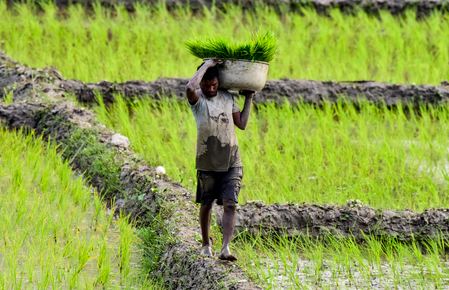
Chandigarh, March 30 – For decades, Punjab's agricultural landscape has followed a familiar pattern: wheat in the winter and rice in the summer. While this cycle once played a vital role in ensuring the nation's food security, it is now facing challenges.
Challenges such as shrinking landholdings, rising input costs, declining groundwater levels, and unpredictable weather have made monoculture increasingly unsustainable, especially for small and marginal farmers.
In response to these challenges, agricultural institutions, including the Punjab Agricultural University and its network of Krishi Vigyan Kendras (KVKs), are encouraging farmers to adopt diversified and integrated farming systems. Their approach emphasizes combining traditional crops with allied activities like dairy farming, poultry, goat rearing, fisheries, and beekeeping to create more stable and sustainable livelihoods.
According to a report by Khalsa Vox, a notable example of this shift can be seen in the village of Abalkhair in the Gurdaspur district, where farmer Gurnam Singh has transformed his modest two-acre ancestral farm into a thriving integrated model. Moving away from the conventional wheat-rice cycle, Singh has created a system that ensures multiple income streams and reduces dependence on fluctuating market conditions.
His journey began in 2016 when he received training at a local KVK, which inspired him to explore new possibilities. A year later, he ventured into dairy farming. Today, his farm supports 26 animals, including Murrah buffaloes, heifers, and calves, producing over a quintal of milk each day.
By selling milk directly to nearby households, he not only secures better profits but also builds lasting relationships with customers.
However, dairy farming is just one aspect of his diversified setup. Singh has also taken up poultry farming, raising around 150 indigenous chickens. The demand for their eggs and meat, particularly during winter, ensures a steady income. Expanding further, he introduced Beetal goats, which are valued for both milk and meat, adding another reliable source of earnings.
What truly distinguishes Singh's approach is the integration of all farm activities. Waste from one component is used in another, cattle feed is prepared on the farm itself, and animal welfare is prioritized through proper housing and clean water facilities. This interconnected system helps lower costs while improving overall productivity.
His innovative efforts earned him the Progressive Farmer Award at a Kisan Mela in 2023. However, beyond recognition, his model highlights a larger message: Diversification is no longer a choice but a necessity for the future of farming in Punjab.
Experts agree that his model holds lessons for Punjab's future. As small farmers grapple with uncertainty, integrated farming offers a practical roadmap, one that turns limited land into a source of diverse and dependable income.
In a state searching for its next agricultural chapter, farmers like Gurnam Singh are quietly writing it.