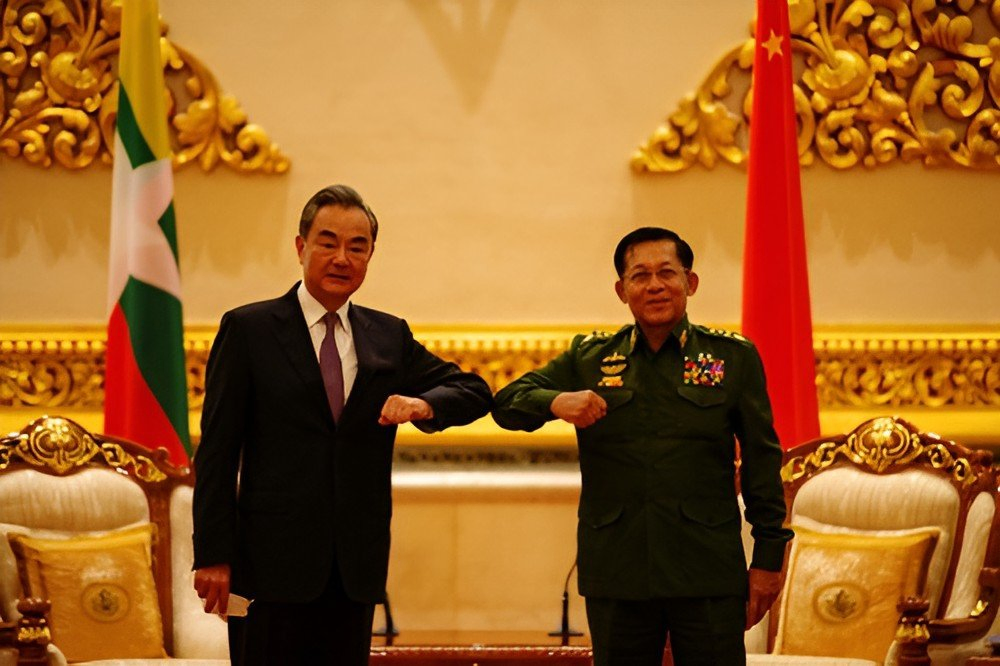
Naypyidaw, March 28 – As the conflict in the Middle East heightened maritime instability, Myanmar's long-term strategic significance has become increasingly important in China's security calculus. There are also other strategic chokepoints beyond the Strait of Hormuz, and it is in this context that the China-Myanmar Economic Corridor (CMEC) comes into focus – a look at the map shows how vital the outlet to the Indian Ocean through Myanmar is for China, according to a report.
"It began in the mid-1980s with a plan to open a trade route through Myanmar for China's landlocked inland provinces of Yunnan, Sichuan, and Guizhou, allowing them to trade with the outside world without having to rely on a long and underdeveloped network of roads and railroads to China's own ports. Eventually named the China-Myanmar Economic Corridor (CMEC), the projects may have always been about trade, but they were also an integral part of Beijing's drive to expand its political and military influence on the Bay of Bengal," Bertil Lintner, a Swedish journalist, author, and strategic consultant, wrote in Myanmar's leading media outlet, 'The Irrawaddy'.
"And now, as the wars in the Middle East have increased instability in that maritime region, long-term strategic goals for Myanmar rank even higher than before on the agenda of China's security planners," he added.
According to the expert, the wars in the Middle East and other recent developments in the region have likely renewed China's commitment to its long-term strategic interests in the Indian Ocean.
He added that Myanmar emerges as the only viable route to bypass critical chokepoints, including the Nicobar Gap, the Strait of Malacca, and the South China Sea.
"It is unlikely that the CMEC alone can replace present shipping lanes, but at least it provides China with an alternative to existing trade routes and gives it a platform from which it can expand its influence over the Indo-Pacific region. It would be naïve to believe that China, with its geostrategic interests, will not play an important role in shaping the future of Myanmar," Lintner stated.
Asserting that there is debate in Washington over whether isolation and sanctions are pushing Myanmar further into Beijing's orbit, the report said that some US analysts, including former Congressman and economist Dave Brat and prominent business consultant Adam Castillo, have begun advocating for "calibrated engagement" with the junta to secure rare earth elements and counter Beijing's influence.
"Although this has not yet translated into a formal softening of official policies," the report said, "it is a scenario that should not be ruled out."
It stressed that the wars in the Middle East, placing China and the US on opposite sides, have triggered a chain of geopolitical consequences across the region.
"And, Myanmar is right at the crossroads of superpower rivalries, caught up in games way beyond anything the military regime is able to handle," the report noted.