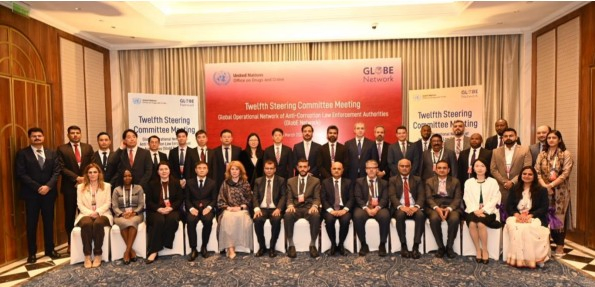
New Delhi, March 23 The director of the Enforcement Directorate (ED) said at a global anti-corruption meet on Monday that asset recovery is not an afterthought, but the truest measure of enforcement success.
At the same event in the national capital, the CBI director emphasized that corruption today has become transnational, sophisticated, and increasingly enabled by technology.
Addressing the opening session of the 12th Steering Committee Meeting of the GlobE Network, being hosted by India from March 23-25, the ED Director Rahul Navin highlighted the agency's mandate "to trace, restrain, confiscate, and restitue proceeds of crime" under the Prevention of Money Laundering Act, an official statement said.
He stressed that under the modern anti-corruption framework enshrined in the United Nations Convention Against Corruption (UNCAC), asset recovery is central to enforcement outcomes and "the truest measure of enforcement success."
Sharing India's performance, he said the ED has "restituted assets worth approximately USD 5.6 billion, including in corruption cases," with a significant portion achieved in recent years.
The ED director also underlined the "complementary roles of India's two member agencies," describing the CBI as the primary anti-corruption investigation and prosecution body, and the ED as the agency focused on financial tracing and recovery.
Highlighting international cooperation, he cited "the assistance extended by Spain in a case where information shared through the (GlobE) Network led directly to the restraining of assets through formal channels."
He further pointed to the "utility of the Directory of Open Source Registries in accelerating the early stages of investigations."
In his keynote address, the Director of the Central Bureau of Investigation (CBI) Praveen Sood said international cooperation is "not a matter of choice but an absolute necessity" in tackling modern corruption.
He highlighted the GlobE Network's Secure Communication Platform (SCP) as "a highly effective tool for encrypted, real-time information exchange among member authorities," and urged agencies to "share actionable intelligence, and make full use of available cooperation mechanisms."
Emphasising coordinated efforts, he said "timely and coordinated action can make a decisive difference in ensuring that offenders are brought to justice and illicit assets are recovered," adding that the platform enables more "real-time connect and collaboration as compared to other platforms."
The three-day meeting has brought together representatives from 15 member nations of the GlobE Network's Steering Committee to deliberate on strategic priorities and strengthen global anti-corruption cooperation.
The GlobE Network, operating under UNCAC, enables "direct, practitioner-level cooperation among member agencies for the investigation, prosecution, and recovery of proceeds of corruption," and currently includes 135 countries and 250 authorities.
According to the statement, the meeting will focus on reviewing guiding principles, strengthening cooperation tools and enhancing mechanisms for real-time information sharing among member states.