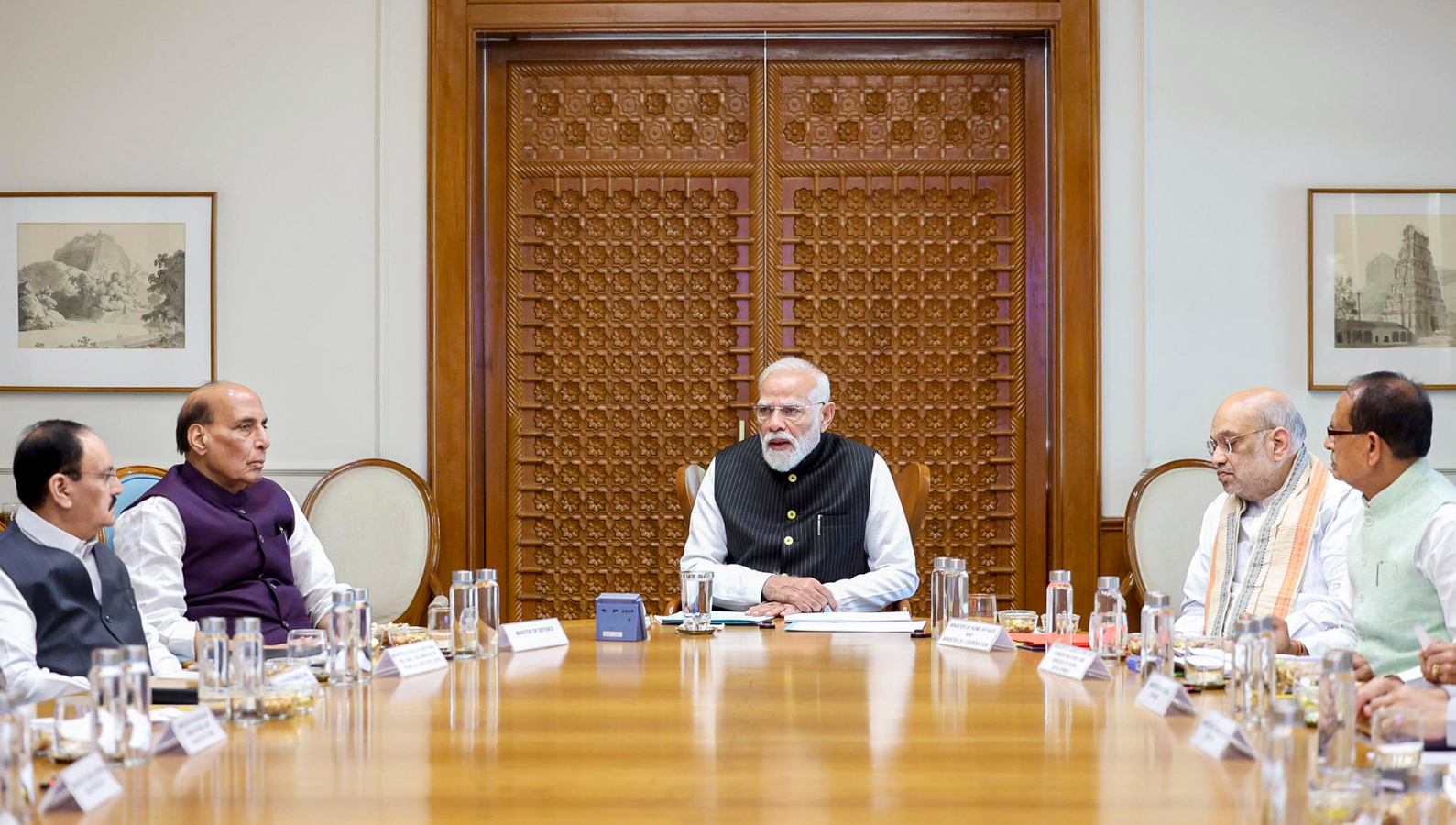
New Delhi, March 22 The Cabinet Committee on Security (CCS) on Sunday reviewed the situation arising from the conflict in West Asia and carried out a detailed assessment on the availability of essential needs for the common people, including food, energy, and fuel security.
Prime Minister Narendra Modi, who chaired the meeting, directed the creation of a group of ministers and secretaries to work collaboratively on a comprehensive approach to address the effects of the West Asia conflict, according to a statement issued after the CCS meeting.
The prime minister stated that the conflict is an evolving situation, and it is impacting the entire world.
He emphasized that all efforts must be made to protect citizens from the impact of this conflict.
Modi instructed that all government agencies should work together to minimize any inconvenience to citizens.
The meeting focused on detailed discussions on medium and long-term measures to ensure the continued availability of essential goods.
"The ongoing conflict in West Asia will have significant short, medium, and long-term impacts on the global economy, and its effect on India was assessed, along with discussions on counter-measures, both immediate and long-term," the statement said.
The CCS, the highest decision-making body on security and strategic matters, carried out a comprehensive assessment of the availability of essential needs for the common people, including food, energy, and fuel security.
The expected impact and measures to address it across sectors such as agriculture, fertilizers, food security, petroleum, power, MSMEs, exporters, shipping, trade, finance, supply chains, and all affected sectors were discussed, the statement said.
The overall macro-economic scenario in the country and further measures to be taken were also discussed.
"Chaired a meeting of the CCS to review mitigating measures in the wake of the ongoing conflict in West Asia," Modi said in a post on X.
He stated that the meeting involved extensive discussions on short, medium, and long-term measures, including ensuring continued fertilizer availability for farmers, diversifying import sources for key sectors, promoting exports to new destinations, and more.
"We are committed to safeguarding our citizens from the impact of this conflict," he said.
The impact on farmers and their fertilizer requirements for the Kharif season was assessed during the CCS meeting.
Measures taken in recent years to maintain adequate fertilizer stocks will ensure timely availability and food security.
Alternative sources of fertilizer were also discussed to ensure continued availability in the future.
It was also determined that an adequate supply of coal stocks at all power plants would ensure no electricity shortage in India.
Several measures were discussed to diversify import sources for chemicals, pharmaceuticals, petrochemicals, and other industrial sectors.
Similarly, new export destinations for Indian goods will be developed in the near future, the statement said.
Cabinet Secretary T V Somanathan gave a detailed presentation on the global situation and mitigating measures taken so far and being planned by all concerned ministries and departments of the Indian government.
Several proposals from different ministries will be prepared and implemented in the coming days after consultation with all stakeholders.
The PM also asked for proper coordination with state governments to ensure no black marketing and hoarding of essential commodities.
Sources said the situation related to crude, gas, and other petroleum products, as well as power and fertilizer sectors, was reviewed in view of the evolving West Asia situation.
The focus of the meeting was on ensuring uninterrupted supply, stable logistics, and efficient distribution across the country, they said.
Defence Minister Rajnath Singh, Home Minister Amit Shah, Finance Minister Nirmala Sitharaman, and External Affairs Minister S Jaishankar are members of the CCS, which is headed by the PM.
However, for Sunday's meeting, a number of senior ministers with responsibilities for key ministries were invited to attend.
These ministers included Shivraj Singh Chouhan (Agriculture), J P Nadda (Health), Piyush Goyal (Commerce and Industry), and Ashwini Vaishnaw (Railways), Sarbananda Sonowal (Ports and Shipping), Manohar Lal Khattar (Power), Pralhad Joshi (Food and Consumer Affairs), Kinjarapu Rammohan Naidu (Civil Aviation), and Hardeep Singh Puri (Petroleum).
National Security Advisor (NSA) Ajit Doval and the prime minister's two principal secretaries, P K Mishra and Shaktikanta Das, were also present.
On March 12, PM Modi had said that the war in West Asia has triggered a worldwide energy crisis, posing a critical test of national character that requires dealing with circumstances through peace, patience, and increased public awareness.
The prime minister had emphasized that his government was working relentlessly to address disruptions that had emerged in international supply chains.
"Continuous efforts are also underway to determine how we can overcome the disruptions that have occurred in the supply chain," Modi had said.
The prime minister has spoken to many global leaders since the West Asia conflict started on February 28, when the US and Israel attacked Iran. Iran has retaliated by targeting Israel and several of its Gulf neighbours hosting US military bases.
Iran controls the Strait of Hormuz, a key shipping route through which 20 per cent of the world's energy is transported. Since the conflict, very few ships have been allowed by Iran to cross it.
The blockade has resulted in severe disruptions in energy supply to many countries, including India.
Since the conflict, Modi has had telephonic conversations with leaders of Saudi Arabia, the UAE, Qatar, Bahrain, Kuwait, Jordan, France, Malaysia, Israel, and Iran.