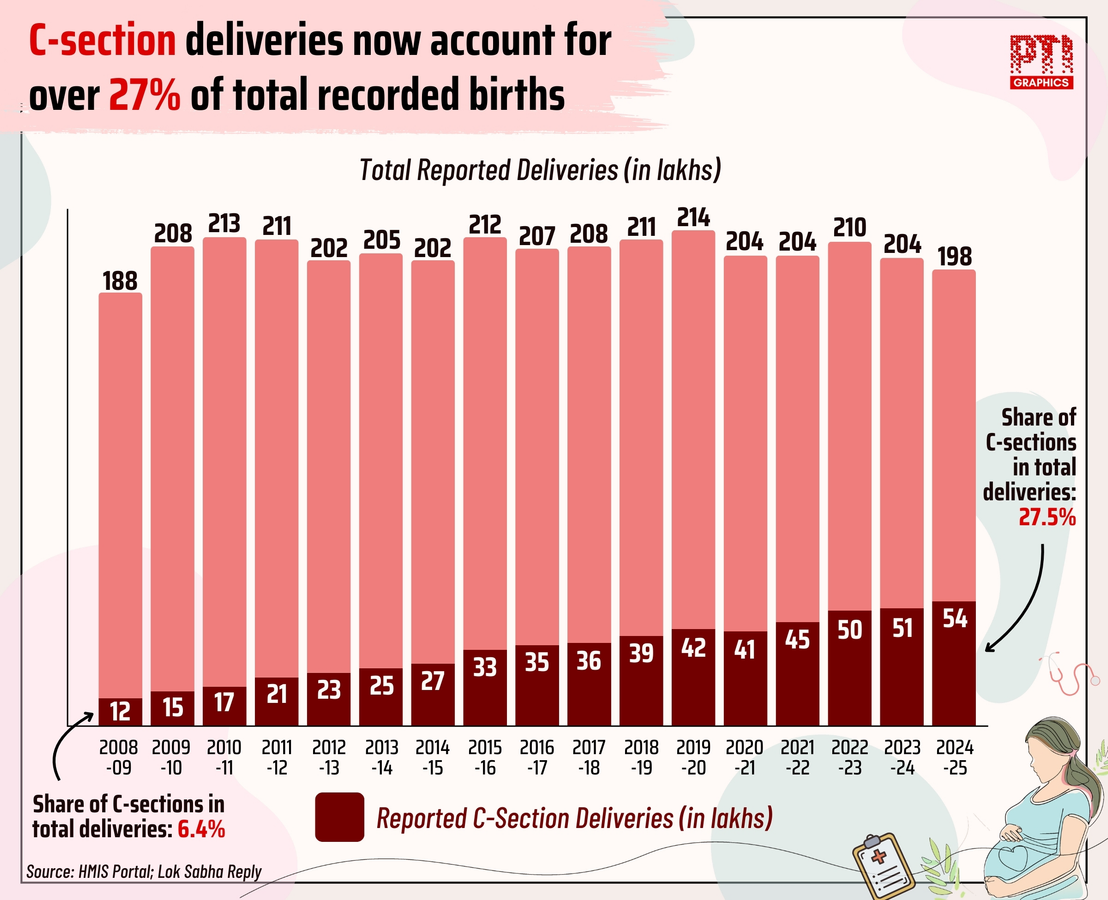
New Delhi, March 12 Caesarean section deliveries in India have increased by more than four times over the last 16 years, now accounting for more than 27 per cent of all reported childbirths in 2024-25, the government has informed Parliament.
In a written reply to the Lok Sabha, Minister of State for Health Prataprao Jadhav said that while the total number of reported deliveries remained largely stable, increasing marginally from 1.88 crore to 1.98 crore between 2008-09 and 2024-25, C-sections jumped from 12.03 lakh to over 54.35 lakh during the period.
The data shows that the figure has consistently increased year-on-year. The share of C-section deliveries in total reported deliveries first crossed the double-digit mark in 2012-13 at 11.47 per cent. It subsequently moved past the 20 per cent mark in 2020-21. By 2023-24, one in every four reported deliveries (25.27 per cent) was a C-section, a figure that further rose to 27.46 per cent in 2024-25.
The minister, citing a 2022 study by the Population Research Centre (PRC), Dharwad, attributed the rise in C-sections to a combination of doctors' clinical decision-making and changing patient preferences.
The study, titled 'Understanding the Context of Caesarean Delivery from the Providers’ and Receivers’ Perspectives', listed clinical indications such as advanced maternal age, multiple pregnancies, fetal distress, previous C-sections, prolonged labour, and maternal complications as factors increasing the likelihood of caesarean deliveries.
On steps taken to regulate unnecessary C-sections, Jadhav in his reply on February 6 stated that CGHS-empanelled hospitals are required to prominently display information on the ratio of Caesarean section deliveries to normal deliveries.
Additionally, under the 'LaQshya' initiative, a dedicated C-section audit component has been incorporated into the assessment checklist for maternity operation theatres across all government hospitals.
The minister also noted that training programmes such as 'Daksh', 'Dakshta', and 'Skilled Birth Attendant' (SBA) have been instituted to ensure the availability of well-trained human resources to promote normal deliveries.
In parallel with the rise in surgical deliveries, the government data showed a consistent decline in mortality rates, with the Maternal Mortality Ratio (MMR) dropping from 212 per 1 lakh live births in the 2007-09 period to 88 in 2021-23.
Similarly, the Infant Mortality Rate (IMR) declined significantly from 57 per 1,000 live births in 2006 to 25 per 1,000 live births in 2023, according to the SRS Statistical Report cited in the reply.