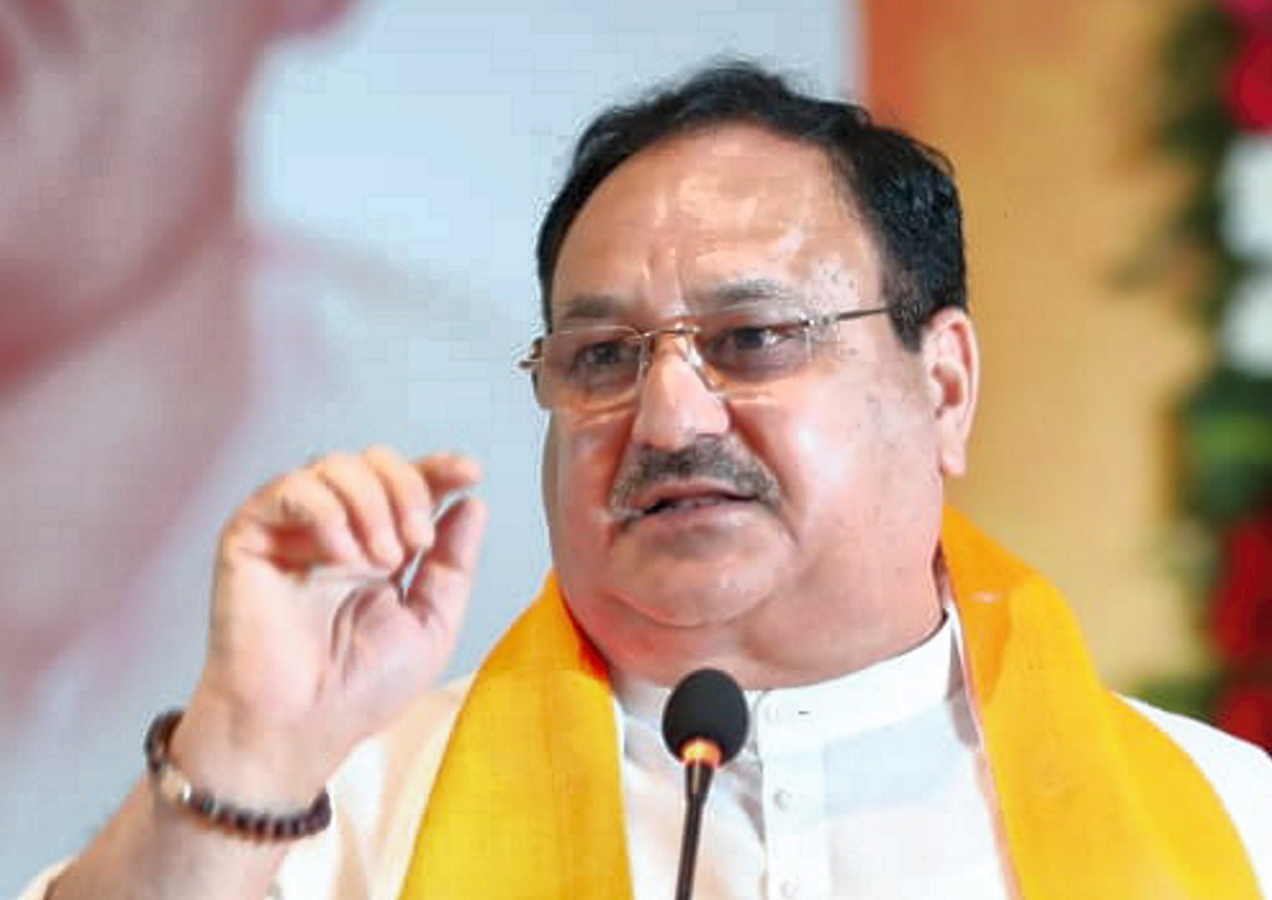
New Delhi, February 17 Interoperable systems have been enabled across platforms, and large-scale, consent-based health-data frameworks are being developed to empower citizens while ensuring data privacy and security, Union Health Minister J P Nadda said on Tuesday.
He made the remarks while launching two pioneering digital-health initiatives -- SAHI (Secure AI for Health Initiative) and BODH (Benchmarking Open Data Platform for Health AI) -- during the India AI Impact Summit 2026 here.
The launch marks a significant milestone in advancing the safe, ethical, and evidence-based deployment of artificial intelligence (AI) in India's healthcare ecosystem.
Describing the summit as both timely and necessary, Nadda emphasised that AI does not operate in isolation, but thrives on strong digital infrastructure and high-quality data.
Recognising this early, India began laying its digital foundations more than 10 years ago. Under Prime Minister Narendra Modi's leadership, the government launched the Digital India programme in 2015 to transform the country into a digitally-empowered society and knowledge economy, Nadda said.
He noted that the health sector has aligned itself decisively with this national vision.
The National Health Policy, 2017, envisages the creation of a comprehensive digital-health ecosystem that would be interoperable, inclusive, and scalable, Nadda said. Building on this vision, the government launched the Ayushman Bharat Digital Mission (ABDM) in 2020 to establish a robust digital public architecture for healthcare, he noted.
Highlighting the progress achieved, the minister said sustained efforts have led to the creation of a strong digital public infrastructure in health.
Interoperable systems have been enabled across platforms, and large-scale, consent-based health-data frameworks are being developed to empower citizens while ensuring data privacy and security, he said.
In this context, the minister referred to the launch of SAHI, describing it as not merely a technology strategy but a governance framework, policy compass, and national roadmap for the responsible use of AI in healthcare. He said SAHI will guide India in leveraging AI in a manner that is ethical, transparent, accountable, and people-centric.
Nadda also emphasised that SAHI provides a structured framework for collaboration, ensuring that innovation flourishes while public interest remains paramount.
He also underlined the transformative potential of AI in pharmaceuticals and life sciences.
AI-driven tools can accelerate drug discovery, shorten research timelines, enhance clinical-trial precision, and make research processes more cost-effective, thereby strengthening affordable healthcare delivery, he noted.
Nadda further highlighted the critical role of academic institutions in developing a future-ready healthcare AI workforce.
The collaboration between the government and academia has led to the development of BODH, which provides a structured mechanism for testing and validating AI solutions before deployment at scale, the health minister said.
He reiterated that AI solutions must be rigorously evaluated for performance, reliability, and real-world readiness. Together, SAHI and BODH represent India's commitment to building a trustworthy, inclusive, and globally-competitive health-AI ecosystem grounded in innovation, responsibility, and public trust, he stressed.
Addressing the gathering, Union Health Secretary Punya Salila Srivastava said under Modi's visionary leadership, India has made tremendous strides in leveraging technology to make governance more inclusive, transparent, and efficient.
She emphasised that the launch of SAHI and BODH marks an important step in advancing the application of AI in healthcare.
SAHI, she said, represents a long-term policy commitment of the Centre and provides a common framework for the Union and state governments, as well as private partners, to guide AI evaluation, adoption, and integration within the healthcare ecosystem.
Srivastava further highlighted that BODH will play a critical role in ensuring that the AI tools used by clinicians are safe, reliable, and validated against real-world parameters before deployment.
She stressed that trust, safety, and accountability must remain central to India's health-AI journey.