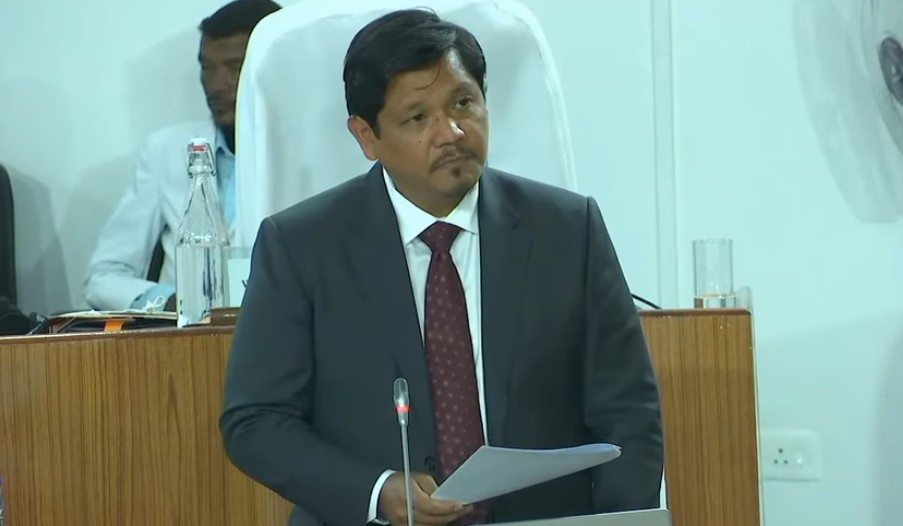
Shillong, February 18 – Meghalaya Chief Minister Conrad K. Sangma adopted a cautious yet politically astute stance in the Assembly on Wednesday regarding the proposal to carve out the Shillong Urban Agglomeration from the East Khasi Hills district, signaling that the government is not opposed to administrative restructuring but will not rush into a decision without thorough scrutiny.
Responding to a short-duration discussion under Rule 50 initiated by United Democratic Party (UDP) MLA Paul Lyngdoh during the Budget Session, the Chief Minister acknowledged that the issue of creating a separate Shillong district is of “serious public importance,” given the rapid urban expansion and mounting pressure on governance mechanisms in the State capital.
Sangma emphasized that Shillong is no longer a conventional town but a complex urban agglomeration comprising the Shillong Municipal Board, the Shillong Cantonment Board, and 10 census towns, along with dozens of peri-urban villages spread across East Khasi Hills and parts of the Ri-Bhoi district.
This growth, he noted, has stretched civic administration, infrastructure, policing, and service delivery. However, the Chief Minister was careful to stress that district creation cannot be driven by political sentiment alone.
He reminded the House that strict criteria – including population, area, public convenience, communication, availability of funds, and socio-economic indicators – govern such decisions. Any proposal, he said, must be examined by a high-level committee headed by the Chief Secretary, with representation from key departments including Home, Finance, Planning, and Rural Development.
In a subtle political message, Sangma highlighted Shillong’s “unique administrative ecosystem,” where institutions like the Khasi Hills Autonomous District Council, traditional bodies such as Syiemships and Dorbar Shnongs, and multiple government agencies operate simultaneously.
He hinted that poor coordination, rather than administrative boundaries alone, remains a core governance challenge. By committing only to “detailed examination,” the Chief Minister effectively kept the issue open, balancing urban aspirations with rural sensitivities – a move seen as politically prudent ahead of future electoral battles in Khasi Hills.
He concluded by thanking Lyngdoh for raising the issue, framing the debate as part of a larger conversation on governance reform, not merely redistricting. The reply made it clear: while Shillong’s demand for focused administration is gaining political traction, the government will move only on its own terms, and at its own pace.