New Delhi, March 25 Prime Minister Narendra Modi has informed US President Donald Trump that the conflict in West Asia must end soon, as it is affecting everyone, according to the government, which addressed the concerns of the opposition at a meeting on Wednesday. The government also dismissed Pakistan's reported mediation efforts, stating that India is not a "broker" nation.
There is no new development in Pakistan's mediation efforts, as the country has been "used" by the US since 1981, according to sources quoting External Affairs Minister S Jaishankar.
Jaishankar reportedly told the attendees of the meeting convened at the Parliament complex, "We are not a broker nation."
The government refuted the opposition's claim that New Delhi was silent on the situation, asserting that "we are commenting and responding."
In response to the opposition's charge that India displayed moral weakness by not condoling the death of the Iranian Supreme Leader sooner, the government told the parties that the opening of the Iranian embassy was followed by the foreign secretary's immediate visit and signing of the condolence book.
The government also informed the parties that its primary concern is ensuring the security of the Indian diaspora living in the Gulf region and fulfilling domestic energy needs.
The government stated that it has been successful in this regard.
However, the opposition said that the answers provided at the meeting were "unsatisfactory" and demanded that a debate be held on the West Asia situation in both Lok Sabha and Rajya Sabha.
Congress leader Tariq Anwar said that Pakistan is playing the role of a mediator while "we are still passive observers."
He suggested that a debate should be held in Lok Sabha under rule 193 and in Rajya Sabha under rule 176.
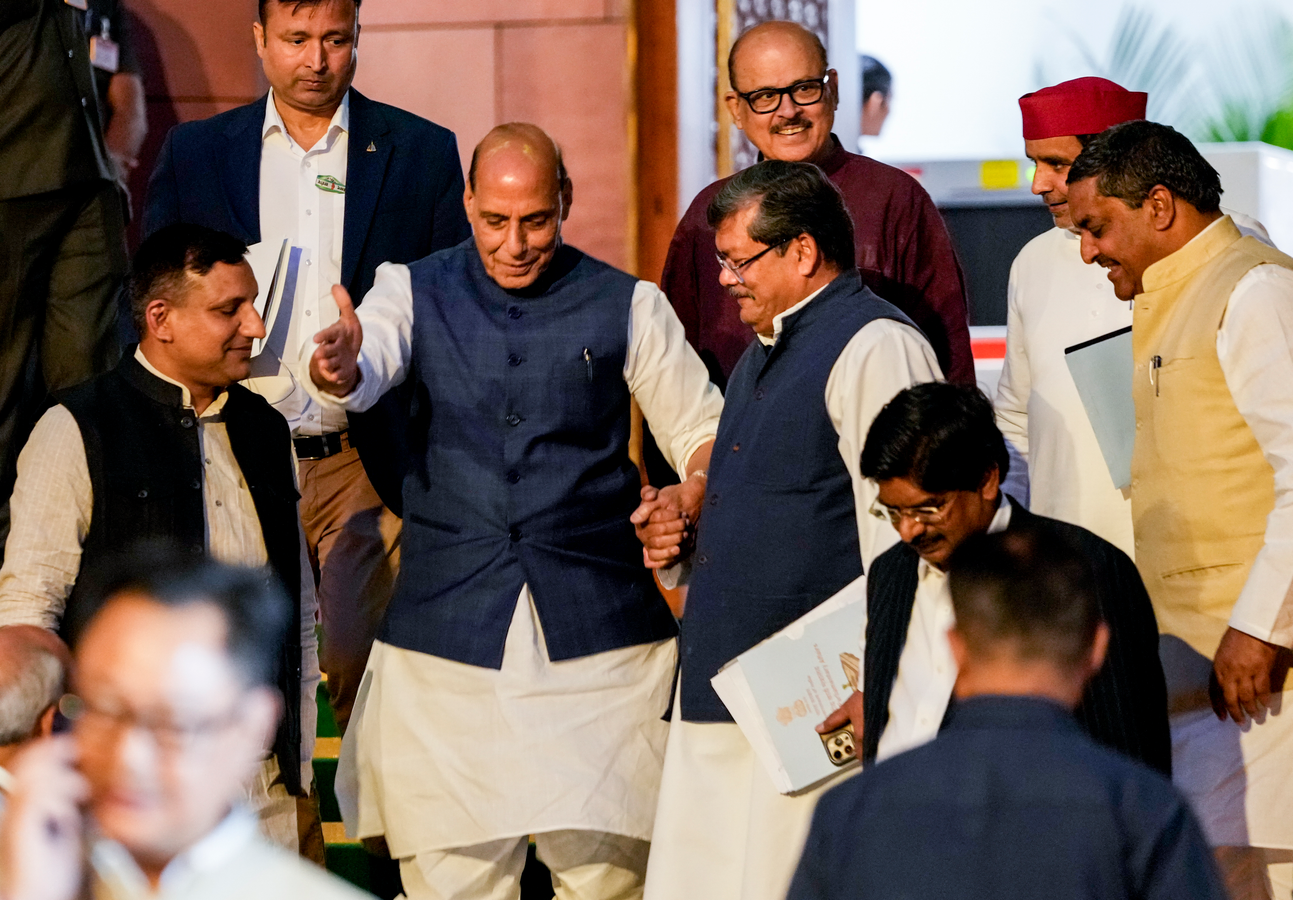
All Union ministers, including Defence Minister Rajnath Singh, Home Minister Amit Shah, External Affairs Minister Jaishankar, and Finance Minister Nirmala Sitharaman, represented the government.
Union Health Minister JP Nadda and Parliamentary Affairs Minister Kiren Rijiju also attended. Foreign Secretary Vikram Misri presented a briefing.
Opposition leaders who attended the meeting, including Tariq Anwar and Mukul Wasnik of the Congress, Dharmendra Yadav of the Samajwadi Party, Sasmit Patra of the Biju Janata Dal (BJD), Sanjay Jha of JD-U, Srikant Shinde of Shiv Sena, Sanjay Singh of Aam Aadmi Party, John Brittas of CPI-M, Supriya Sule of NCP (SP), Arvind Sawant of Shiv Sena (UBT), and Asaduddin Owaisi of AIMIM, were present.
The government conveyed that there is no need to panic, as India has enough stock and more crude oil and gas are expected to arrive.
The government told the meeting that it has already placed advance orders and diversified sources of oil and gas, and is currently procuring from 41 countries.
The government also highlighted the diplomatic success of four India-bound ships carrying petroleum products having already crossed the Strait of Hormuz, with five more expected soon. It was also informed that 18 India-bound ships were stranded around the Strait of Hormuz.
Regarding the US attack and sinking of an Iranian ship, the government stated that if the ship had been in Indian waters, it would have been saved, but unfortunately, it was near Sri Lankan waters.
The government told the meeting that Iran expressed gratitude for India's protection of other ships and sailors.
The government also stated that India has good relations with the US, Israel, and Iran.
Defence Minister Singh and Petroleum Minister Hardeep Singh Puri made opening remarks during the meeting.
Jaishankar primarily replied to the opposition's queries and concerns during the question-and-answer session. Home Minister Shah also intervened on a few occasions.
Rijiju said the meeting was convened at the Prime Minister's request, and information was shared about the crisis in West Asia.
"Several questions were raised by opposition friends regarding the situation arising from the conflict in West Asia involving Iran, Israel, and the United States, specifically about how it would impact India and what steps the government has taken for Indian citizens," Rijiju said.
Comprehensive and detailed responses were provided on behalf of the government, he added.
"I feel satisfied to inform you that all the questions asked by the opposition and the information they sought were fully addressed by the government," Rijiju asserted.
In the end, all opposition members stated that they would stand united and support the government's decisions and steps taken in this time of crisis.
Anwar said that while an attempt was made to seek clarification from the government, the meeting was "unsatisfactory."
"We have consistently demanded that this issue be debated in both Rajya Sabha and Lok Sabha under Rules 193 and 176. Only then will people feel satisfied... The government says it (we don't want war), but what difference does merely saying that make? The reality is that a conflict is already underway. Pakistan, which is smaller than us and weaker in every respect, is today acting as a mediator and playing that role, while we remain mute spectators," Anwar said.
Brittas said that the opposition parties expressed their disapproval of the government's silence.
"All the opposition leaders who spoke said that the government should have taken a position with regard to the unilateral attack against a sovereign independent country Iran by the United States. And there have been questions raised with regard to the visit of our Prime Minister to Tel Aviv, and also there were certain questions about the proactive role of Pakistan," Brittas said.
Union minister Pralhad Joshi expressed concern over the absence of Leader of Opposition in Lok Sabha Rahul Gandhi and TMC members from the all-party meet on West Asia situation.
"The statements that Rahul Gandhi is making raise serious questions about whether he is genuinely interested in India's interests or in spreading rumours within the country. This has created significant doubt in people's minds. Today, in a way, he has even appeared to appreciate Pakistan. At a time when Pakistan is making statements against India, he seems to be lending credibility to them. He should first clarify whether he stands with India or with Pakistan," Joshi said.