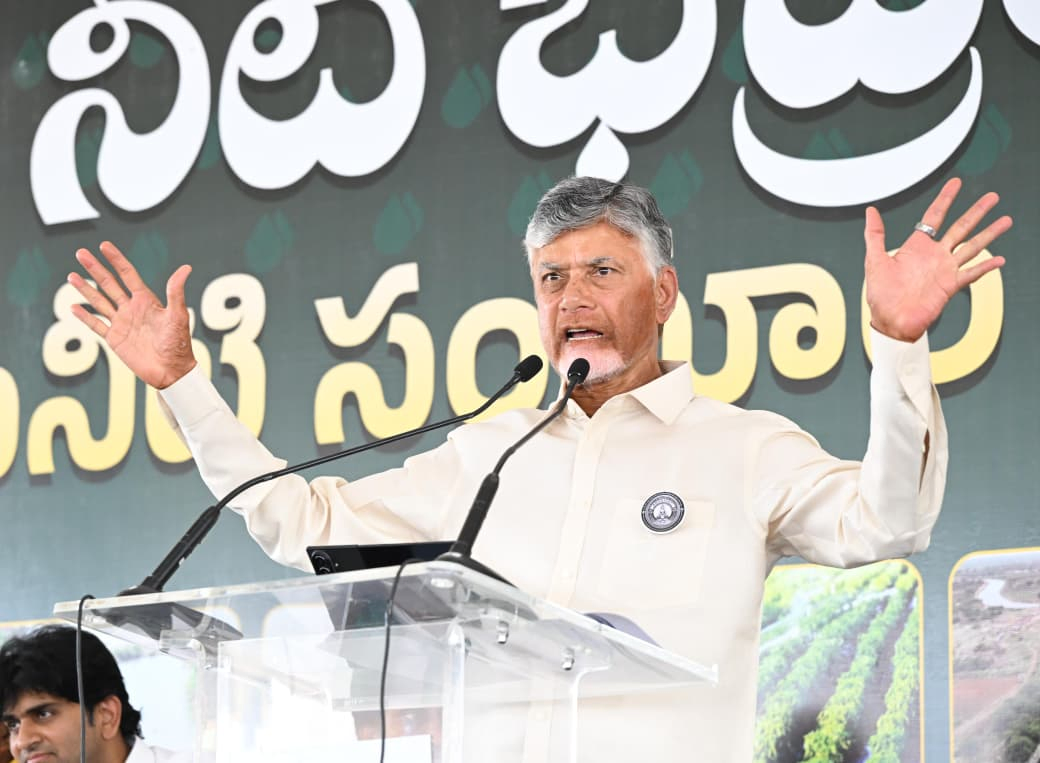
Amaravati, April 6 – Andhra Pradesh Chief Minister N. Chandrababu Naidu launched the ‘Jaladhara’ programme on Monday, a 100-day action plan implemented across the state for water security.
With the goals of desilting tanks, repairing canals, recharging groundwater, and conserving water, the government has designed the Jaladhara programme to ensure water for every acre and confidence for every farmer.
The Chief Minister launched the programme in Yadiki in Anantapur district, in the drought-prone Rayalaseema region.
Speaking on the occasion, the Chief Minister stated that the government has initiated a public movement for water conservation. He said that in this programme, led by 60,000 members of water user associations, every citizen should become a stakeholder.
The Chief Minister stated that by utilising the earth itself as a natural reservoir for storage, we can achieve more effective water management.
He called upon the people, government officials, and water user associations to join hands and increase groundwater levels.
“We must ensure that groundwater is available at a depth of 6 meters before the monsoon season, and at less than 3 meters after it. If we can achieve this, the state will no longer face any water scarcity,” he said.
He emphasised the need to fill the reservoirs to their capacity so that the state can have the opportunity to utilise the water whenever necessary.
CM Naidu stressed the need to arrest the flow of running water, store the water that has settled, and strive to fill reservoirs.
He claimed that the state made significant strides by implementing various initiatives such as percolation pits, check dams, sprinkler irrigation, and micro-irrigation.
He claimed that thanks to water conservation measures, the government successfully raised groundwater levels by an additional 1.92 meters.
In 2024, the groundwater levels in Anantapur district were at a depth of 13.36 meters. The water level has now risen by 2.11 meters through effective water management and reached 11.25 meters.
“Only with water can we have development, industries, welfare, and wealth. The united Anantapur district, which everyone once feared would turn into a desert, is today leading in the horticulture sector solely through water management and conservation efforts,” he said.
Stating that regions like Anantapur went without water for several years, he said it was the TDP government that provided input subsidies to support and rescue the farmers.
“To ensure the efficient utilisation of water in the Anantapur district, we introduced the drip irrigation programme. It was our government, in the past, that provided drip irrigation equipment with a subsidy of up to 90 per cent,” he said.
He recalled that the report submitted on micro-irrigation in the past became a benchmark. It set a standard that is now being adopted and utilised across the entire country, he said.
“Currently, we rank number one in the nation in the field of micro-irrigation, with an expenditure of Rs 1,031 crore. It is precisely because of drip irrigation that the Rayalaseema region has transformed into a horticultural hub. We hold the top position in the country in the field of horticulture,” he said.
Statewide, the water requirement stands at 547 TMCs for the Kharif season, 343 TMCs for the Rabi season, 28 TMCs for industrial use, and 158 TMCs for drinking water purposes. In total, the state requires approximately 1,300 TMCs of water.
Even after the completion of the Rabi and Kharif crop seasons, our reservoirs currently retain a water storage level of 65 per cent, he added.