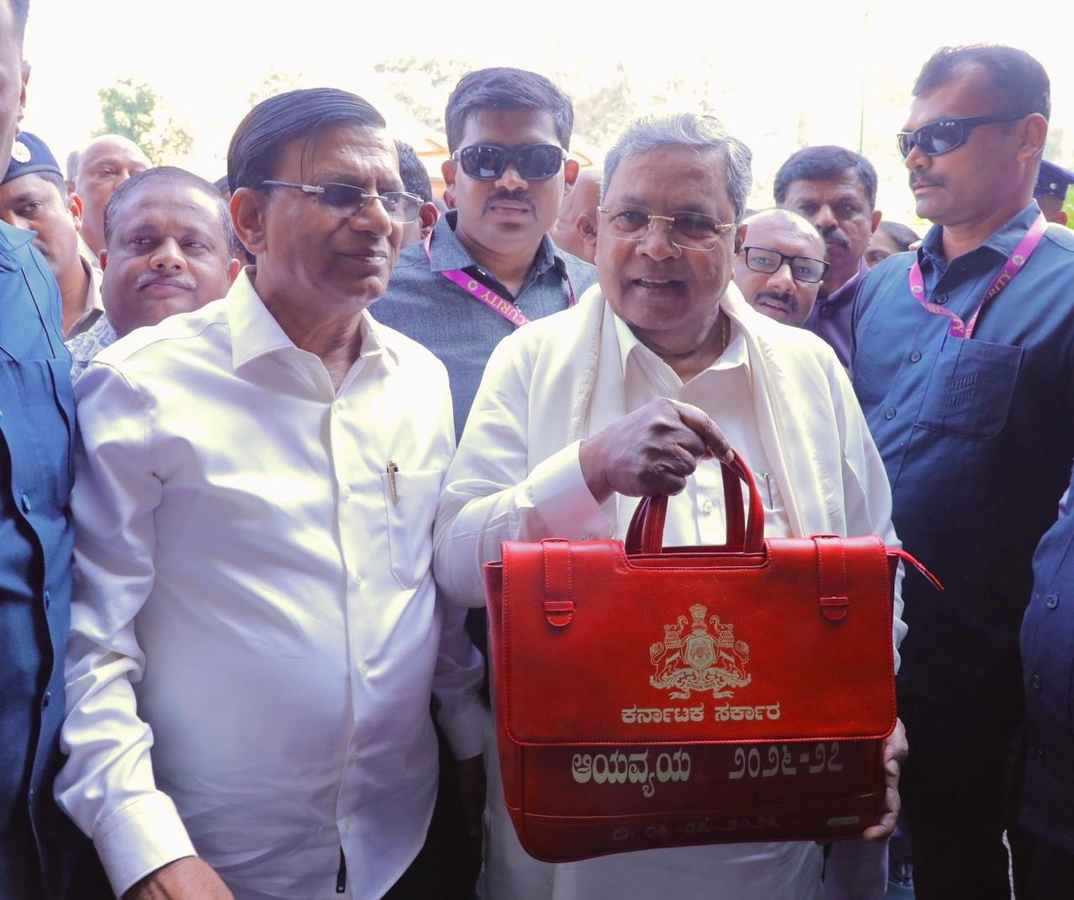
Bengaluru, March 6 – Karnataka Chief Minister Siddaramaiah stated on Friday that the Central Government’s rationalization of Goods and Services Tax (GST) rates has negatively impacted the state’s revenue collection, leading to a significant shortfall in the current fiscal year.
Presenting the state’s budget for 2026-27, Siddaramaiah said the changes in rates are expected to result in an estimated revenue shortfall of approximately Rs 10,000 crore for the state in the current fiscal year, while a shortfall of Rs 15,000 crore is projected for the next year.
According to the Chief Minister, GST remains the primary source of tax revenue for Karnataka, accounting for 43 per cent of the state’s own tax revenue. He noted that Karnataka ranks second in the country in GST revenue collection.
The Chief Minister said that the state’s revenue collection had declined after the Centre unexpectedly rationalized GST rates in the middle of the fiscal year. Prior to the rationalization in 2025-26, the state’s average monthly GST revenue growth (net of refunds) stood at 10 per cent. However, following the rate revision, the monthly growth in GST collections has dropped to 4 per cent.
Siddaramaiah also pointed out that GST revenue collection has been disappointing at the national level.
"Compared to the Union Government’s budget estimates for 2025-26, GST collections have declined by 11 per cent in the revised estimates and by 13.4 per cent in the budget estimates for 2026-27. These figures are even lower than the actual collections recorded in 2024-25," he said.
He added that overall GST collections across the country are expected to fall short by Rs 1.3 lakh crore in the current year and by Rs 2 lakh crore in the next year. As a result, the share of taxes devolved to states will also decline.
The Chief Minister said the fall in GST collections has placed significant financial pressure on states. Changes in the tax structure and rate rationalisation have had a more direct impact on the revenue of states than on that of the Centre.
At the same time, the Centre continues to raise revenue through cess and other levies on products such as tobacco and luxury goods, with the entire proceeds going to the Union government’s exchequer.
Siddaramaiah said the state government supports GST rate rationalisation in principle but stressed the need to protect the financial interests of states. Karnataka, along with seven other states, has submitted a joint memorandum to the GST Council seeking measures to safeguard state revenues and compensate for losses arising from the rate revisions.
He said the state would continue to urge the Centre to provide necessary compensation to offset the revenue loss caused by GST rationalisation.
Referring to tax devolution, Siddaramaiah said the share of central taxes received by states has become even more crucial in view of the constraints on the state’s own tax revenues. The Fourteenth Finance Commission had recommended a tax devolution share of 4.713 per cent for Karnataka, but this was reduced to 3.647 per cent during the tenure of the Fifteenth Finance Commission, representing a 23 per cent decline.
He said the state had suffered an overall loss of about Rs 65,000 crore over the six-year period of the Fifteenth Finance Commission. In addition, the Centre has not released the special grant of Rs 5,495 crore and the state-specific grant of Rs 6,000 crore recommended by the commission.
The Chief Minister said the state had urged the Sixteenth Finance Commission to adopt a tax devolution formula that balances equity with growth and recognises the fiscal performance and economic contribution of states.
He noted that the Sixteenth Finance Commission has recommended a tax share of 4.131 per cent for Karnataka for the period 2026-31, representing a 13 per cent increase compared to the share recommended by the Fifteenth Finance Commission. Although the state had hoped for the restoration of the 4.713 per cent share recommended earlier, the new recommendation partially addresses the imbalance in tax devolution, he said.
Siddaramaiah also welcomed the commission’s decision to consider a state’s contribution to the national GDP as a criterion in determining the tax devolution formula, describing it as an important development that recognises the economic performance and growth potential of states.
Despite constraints on revenue mobilisation, the Chief Minister said the state government has prioritised prudent expenditure management to maintain a balance between economic growth, welfare programmes and fiscal discipline.
He said that since the implementation of the government's guarantee schemes, the state has spent a total of Rs 1,21,598 crore up to February 2026. The government has honoured its commitments to the people while maintaining fiscal discipline, he added.
Siddaramaiah further said that despite declining revenues due to GST rationalisation and reduced tax devolution from the Centre, the government has maintained fiscal discipline over the past three years. In accordance with the provisions of the Karnataka Fiscal Responsibility Act, the state has kept the fiscal deficit within 3 percent of Gross State Domestic Product (GSDP) and total public liabilities within 25 percent of GSDP.
He reiterated the state’s commitment to maintaining fiscal discipline and ensuring long-term financial sustainability.