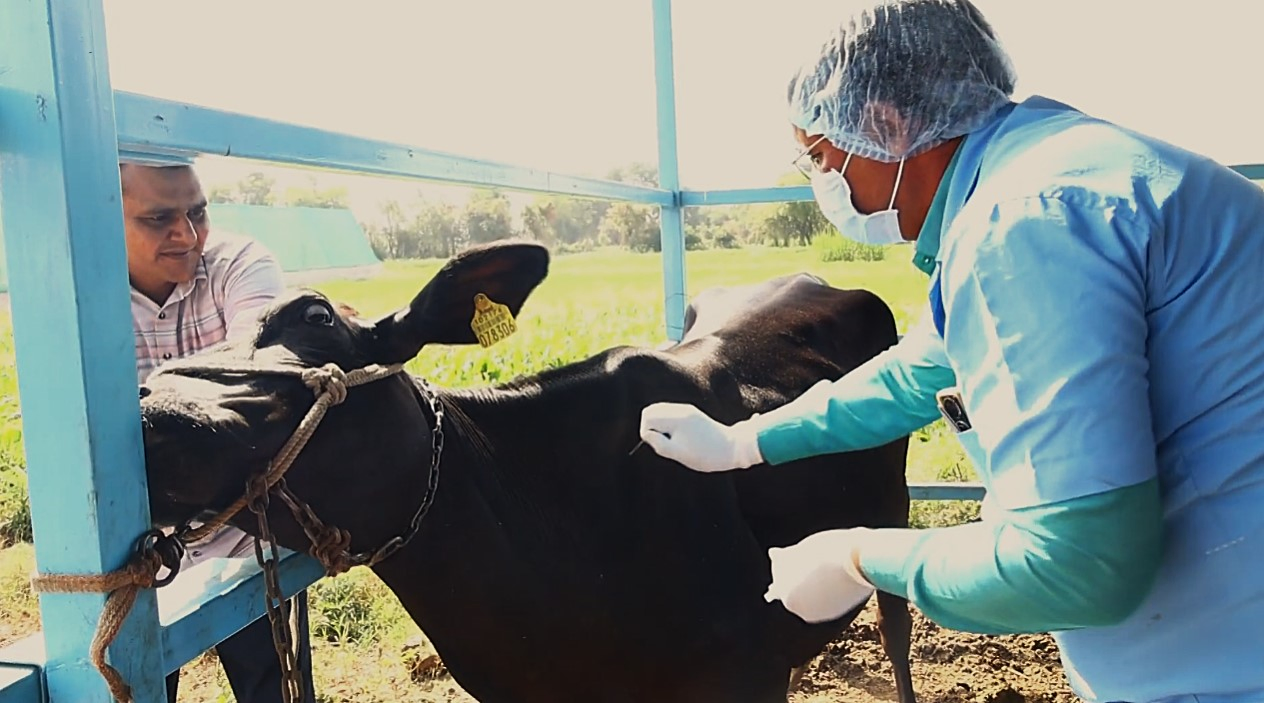
Gandhinagar, March 18 – Gujarat has reduced the spread of Foot and Mouth Disease (FMD) in livestock to 3 per cent, while aiming for herd immunity of around 80 per cent by 2025, state officials said, attributing this progress to sustained mass vaccination drives.
This development comes as India strives to achieve FMD-free status by 2030 under a nationwide vaccination programme led by Prime Minister Narendra Modi.
In Gujarat, the campaign is being implemented under Chief Minister Bhupendra Patel, with a focus on improving animal health and strengthening farmers' incomes.
Officials said the state's strong performance in milk production is linked to sustained veterinary care and disease control efforts. Farmers say regular vaccination has become central to their livelihoods.
Jigar Patel, a 42-year-old farmer from Lodra village in Mansa taluka of Gandhinagar district, said he relies on the biannual visits of Animal Husbandry Department teams to vaccinate his livestock.
"I have 32 animals, and it is very important to keep them disease-free, as my income depends on milk production. Foot and Mouth Disease reduces milk production in animals. Fortunately, every six months, the Animal Husbandry Department team comes to my cattle shed and vaccinates them free of cost," he said.
According to Mahendra Patel, secretary of the Lodra village milk producers' cooperative society, vaccination coverage in the village is progressing steadily.
"There are more than 1,700 animals in Lodra village, and vaccination against FMD is currently underway. Around 50 per cent of the animals have already been vaccinated," he said.
Across the state, thousands of personnel from the Animal Husbandry Department and dairy cooperatives are carrying out vaccinations in villages, farms, and cattle shelters.
This effort is part of the Central Government's Livestock Health and Disease Control Programme, which aims to control and eradicate major animal diseases.
The National Animal Disease Control Programme, launched on September 11, 2019, is fully funded by the central government and implemented with technical support from states.
Dr Falguni Thakar, Director of the Gujarat Animal Husbandry Department, said a fresh vaccination campaign began on March 1 this year.
"This vaccination is carried out twice every year. The effectiveness of this campaign can be measured through the declining incidence of outbreaks and reduced virus spread, which is evident from decreasing NSP antibody levels," she said.
She added that cases in the state have remained limited in recent years.
"In the past few years, only sporadic cases have been reported in the state, and those too have generally been less severe. As a result of vaccination, the virus spread remained only 3 per cent in 2025, while herd immunity reached up to 80 per cent. This clearly reflects the impact of vaccination and biosecurity measures," she said.
FMD is a highly contagious viral disease that causes fever and blisters in the mouth and feet of animals, leading to reduced appetite, weight loss, and a fall in milk production, often resulting in financial losses for farmers.
Gujarat has an estimated livestock population of around 2 crore cows and buffaloes, of which 1.71 crore are eligible for vaccination against the disease.
In the 2025–26 financial year, the state is carrying out two rounds of vaccination covering a total of 337.52 lakh animals.
Officials said disease control measures are also being supported by digital tracking.
Under the National Digital Livestock Mission, animals are being assigned a unique identity through 12-digit ear tags and registered on the Bharat Pashudhan portal, allowing authorities to monitor health records and vaccination status.
Animal husbandry remains a key component of the rural economy, and officials noted that reducing the incidence of FMD could also improve India's prospects in the global dairy export market.
The disease is estimated to cause annual economic losses of about Rs 24,000 crore nationwide.
Authorities said continued vaccination and biosecurity measures are expected to further reduce outbreaks, improve milk yields, and strengthen rural incomes while supporting the broader goal of disease eradication.