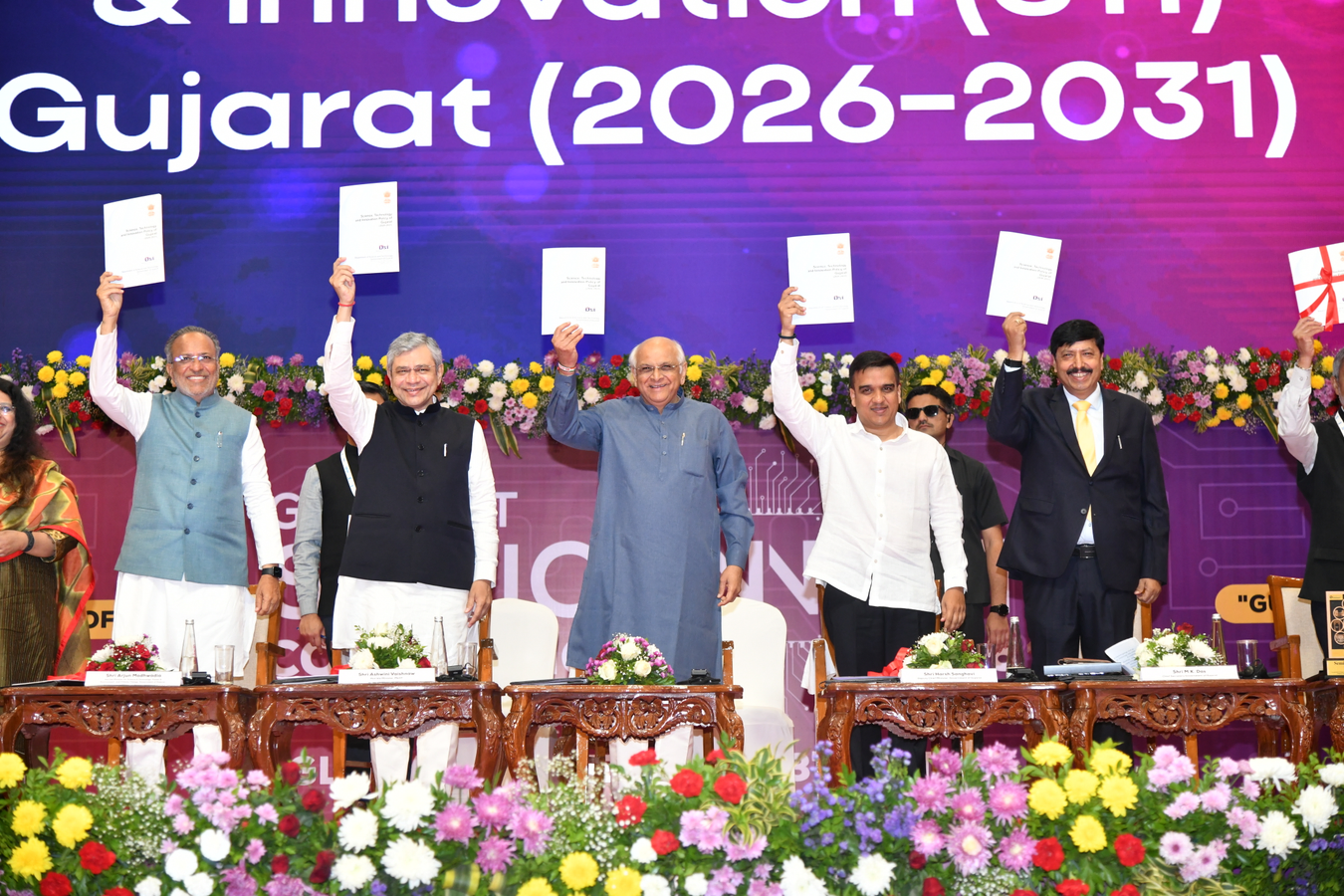
Gandhinagar, March 1 – The Gujarat government on Sunday unveiled its Science, Technology and Innovation (STI) Policy 2026-31, with Chief Minister Bhupendra Patel inaugurating the Gujarat SemiConnect Conference-2026 in Gandhinagar. He outlined the state's plans to expand semiconductor manufacturing, design, and research.
The conference, organized by Gujarat's Department of Science and Technology under the theme "Gujarat: India's Silicon Gateway", was attended by Union Electronics and IT Minister Ashwini Vaishnaw, Deputy Chief Minister Harsh Sanghavi, State Science and Technology Minister Arjun Modhwadia, senior officials, and representatives from domestic and international semiconductor companies.
In his address, Chief Minister Patel stated that the conference marked a significant shift in the state's economic trajectory.
"This conference signifies the transformation of Gujarat from a national growth engine into a technology-driven hub," he added.
"With stable policies, transparency, ease of doing business, and a commitment to development, Gujarat is emerging as a leading player in semiconductor and chip manufacturing," the Chief Minister said.
Referring to the national goals of "Viksit Bharat @ 2047" and "Aatmanirbhar Bharat," Chief Minister Patel emphasized that Gujarat was committed to achieving Prime Minister Narendra Modi's vision through "a journey from chip to champion."
He further stated, "Under the leadership of Prime Minister Narendra Modi, India is strengthening its presence in the hardware sector and building confidence in India's readiness, reliability, and ability to deliver."
Chief Minister Patel highlighted that the Dholera Special Investment Region (DSIR) is "no longer just a blueprint but is transforming into the country's Semicon City."
He added that quality infrastructure, plug-and-play facilities, and modern logistics systems have been developed in Dholera and Sanand to meet the future needs of the semiconductor sector.
"We are developing the necessary infrastructure and logistics, along with a skilled workforce," the Chief Minister said, adding that a nano-fabrication laboratory is being established at IIT Gandhinagar to support advanced research and training.
He also noted that with global industries facing concerns about carbon footprint and carbon taxes, Gujarat, with its power-surplus status and strong renewable energy base, prioritizes green growth.
On Saturday, Union Minister Vaishnaw marked a milestone in India's semiconductor journey with Prime Minister Modi inaugurating Micron's first plant in Sanand.
"With the launch of Micron's plant, India has secured a prominent position on the global semiconductor map," he said.
Announcing the next phase, he stated, "We will launch Semicon 2.0 with the objective of making India not only a manufacturing hub but also a global center for design, machinery, and talent."
Recalling the early stages of the programme, Union Minister Vaishnaw noted, "When the first presentation on semiconductors was made in 2021, the Prime Minister spent three hours reviewing every detail instead of the scheduled 45 minutes. This reflects the seriousness of this mission."
He said that under Semicon 2.0, India would promote deep-tech startups, enabling companies like Qualcomm, Broadcom, and Nvidia to establish a presence domestically.
"India will develop not only semiconductor chips but also the machinery, materials, and testing ecosystems required for chip manufacturing, with a long-term vision," he added.
Regarding workforce development, Union Minister Vaishnaw said, "A global shortage of two million semiconductor professionals is expected, and India will help address this gap."
He added that the target of training 85,000 engineers within 10 years has already been achieved in four years.
"Students in 35 universities are already designing real chips. We will expand this network to 500 universities, allowing young people across the country to participate in this high-technology sector," Union Minister Vaishnaw said.
He also referred to infrastructure and financial commitments, stating, "At the infrastructure level, commitments of $250 billion have been made, along with $17 billion in deep-tech venture funding."
Tax incentives have been assured until 2047 to ensure policy stability, the Union Minister stated.
"With surplus power and clean energy, Gujarat has a strong opportunity to establish data centers and contribute to India's ambition of becoming a global data hub."
Deputy Chief Minister Sanghavi said that Gujarat has become the preferred destination for investors across the country.
"Gujarat offers the highest return on investment in the country," he said, adding, "It provides not only investment opportunities but also a secure future."
Presenting the economic data, the Deputy Chief Minister stated, "With only five per cent of the country's population and six per cent of its geographical area, Gujarat contributes more than 18 per cent to India's manufacturing output, over 8 per cent to GDP, over 30 per cent to exports, and more than 40 per cent to total cargo handling."
He added that long-standing political and policy stability is among the state's key strengths, and the state government works to address investors' concerns.
State Minister Modhwadia said that the Covid-19 pandemic had exposed vulnerabilities in semiconductor supply chains.
"When supply chains were disrupted, industries worldwide were affected because semiconductors are critical components. Viewing this challenge as an opportunity, India decided to become a semiconductor hub," he added.
Referring to the Micron Assembly, Test, and Packaging plant in Sanand, the Minister said, "This is an important step, but significant progress remains ahead."