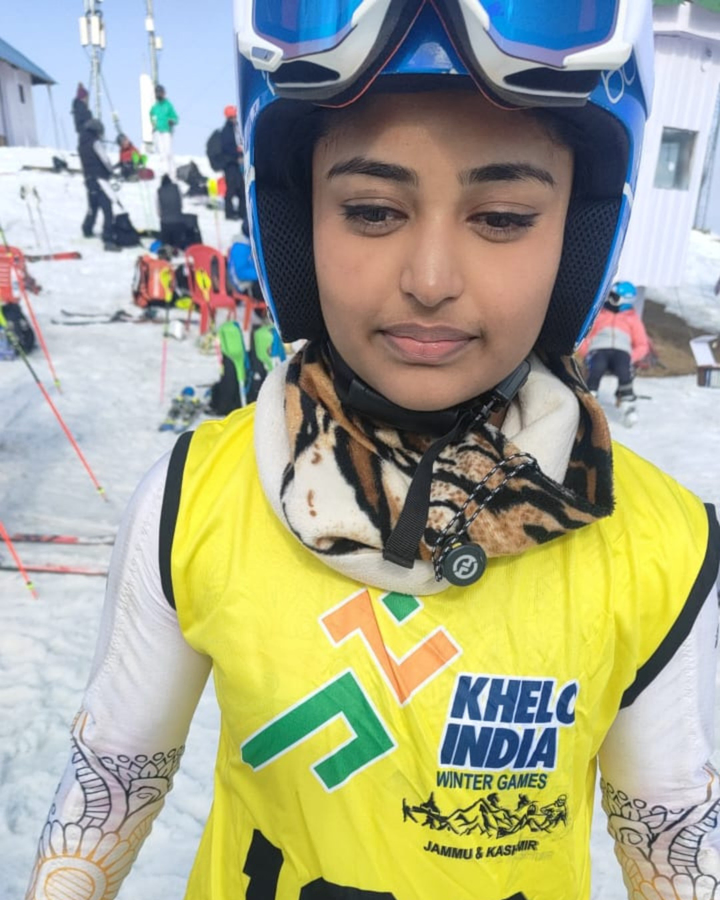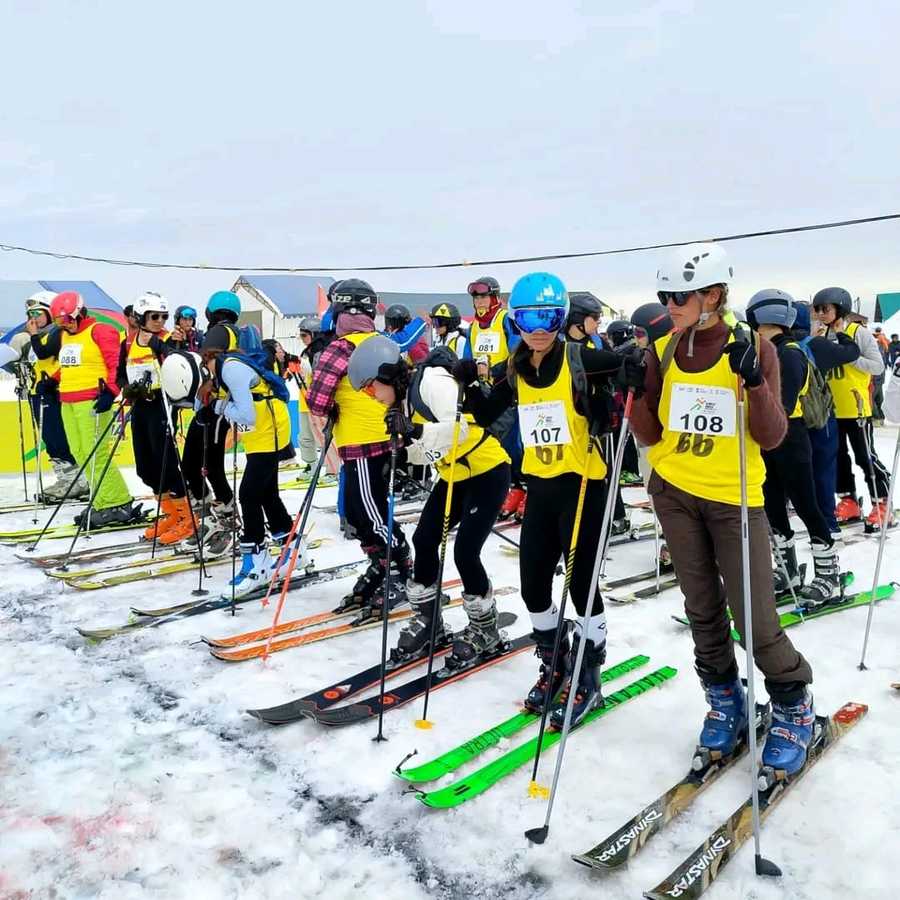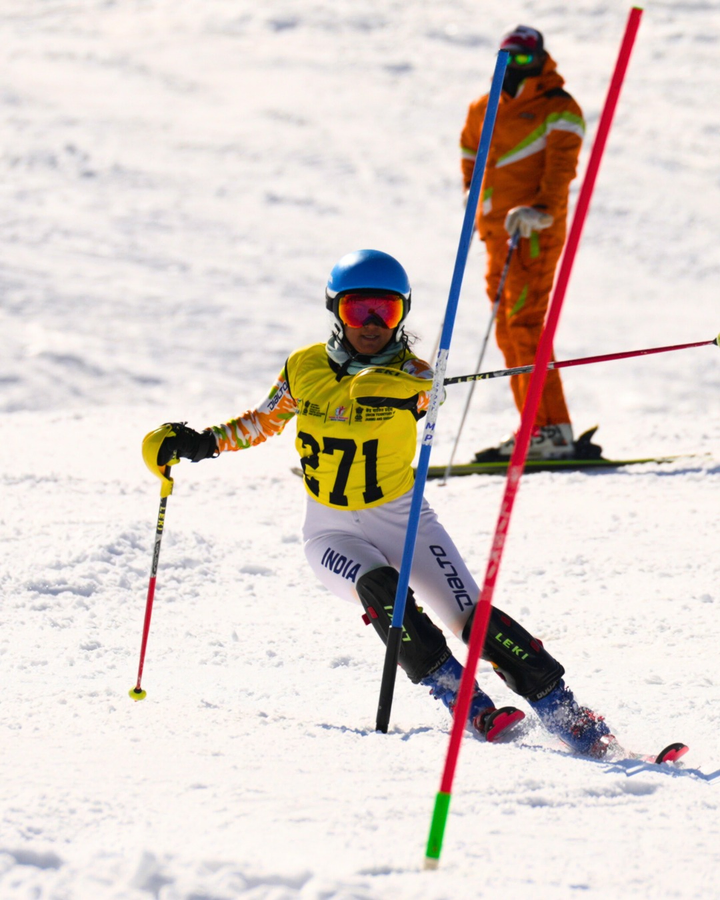
From February 23 to 26, the meadow-turned-arena in Gulmarg hosted the 6th edition of the Khelo India Winter Games. While experienced athletes excelled, a new generation was emerging.
They arrived with borrowed skis, southern accents, and a determination to succeed, driven by dreams that extended beyond Kashmir's tranquil landscapes. One such athlete was Jiah Aryan, a 17-year-old from Bengaluru who skis with the skill of someone who grew up in the Alps, not under palm trees. Jiah achieved two bronze medals in the Alpine events – one in Slalom and the other in Giant Slalom. Her success was not just about winning, but about her composure and technique. She approached the course with confidence and determination.
"I've been involved in winter sports since I was 10," she said, her voice steady and analytical. Her journey began at the Jawahar Institute of Mountaineering and Winter Sports (JIM&WS), where she first learned to trust her skills on the snow. Soon after, her parents made a decision that few in tropical India would have considered – they sent her to train abroad at the Kron Platz Racing Centre in Italy, a renowned center for European ski excellence.
Being from Bengaluru, Jiah was drawn to winter sports because "the grass is greener on the other side." But in her case, the grass was snow, and it was calling to her.
The country's talent scouts have already identified Jiah as one of India's top winter prospects. This recognition led to a sponsorship from the Reliance Foundation, providing her with support in the form of a physiotherapist, a sports psychologist, and a nutritionist, along with equipment and financial assistance.
In elite sports, infrastructure is crucial. For the first time, Indian winter athletes are benefiting from proper facilities and support. Jiah is currently a 12th-grade student at the National Institute of Open Schooling (NIOS) Regional Centre Bengaluru, balancing her studies with intensive training.
She is the only child of Aryan I C and Janvi Aryan, who run an old-age home and an IBM professional, respectively.
Jiah's mother says they have simply done what parents are supposed to do – encourage her. Jiah's ambition is equally ambitious.
"I want to be the first Indian female winter sports athlete to win a gold medal," she says. "I will train hard and do whatever it takes."
This is not just teenage ambition; it's a blueprint for success. If Jiah represents long-term grooming, Renu Danu represents speed and intensity.
The CRPF athlete, Renu Danu, saw snow for the first time just two years ago. This week, she stood on the podium three times, winning silver medals in the Nordic 15-km, Nordic 1.5-km Sprint, and the Ski Mountaineering Relay. Her performances in the endurance-heavy Nordic disciplines were impressive, demonstrating composure and surgical precision. Progress in winter sports is typically measured in Olympic cycles. Renu achieved her goals in just 24 months.
Then came Kaamya Karthikeyan, 19, who delivered a performance that resonated far beyond her own success. The Maharashtra athlete won gold in Ski Mountaineering, marking a historic first for her state in the discipline at the Khelo India Winter Games.
Winter sports in India have long been limited to specific geographic regions – Himachal Pradesh, Jammu and Kashmir, and Ladakh. However, Kaamya's success signals a broader democratization of snow sports. Talent is no longer restricted to specific altitudes.
The CRPF's Kajal Kumari Rai, 25, from Meghalaya, turned Nordic tracks into a personal showcase, winning two gold medals in the women's 15-km and 10-km sprint events, showcasing power and pacing.
Veteran Aanchal Thakur, 29, from Himachal Pradesh, also achieved a significant milestone, winning her first gold in Giant Slalom in Alpine Skiing, a victory that blended experience with a burning desire to succeed.
And for the host region, Zubair Ahmad Lone delivered Jammu and Kashmir its solitary gold of the edition, topping the podium in Snowboarding Giant Slalom. This achievement felt particularly significant on home snow.
Minister of Youth Affairs and Sports, Dr Mansukh Mandaviya, framed the games within a larger national context. He emphasized that by 2047, India aims to become a ‘Viksit Bharat’ – a developed nation – and sports will play a vital role in achieving this goal.
"The young athletes competing here will carry this mission forward," Dr Mandaviya said.
Prime Minister Narendra Modi has expressed his commitment to bringing the Olympic Games to India in 2036. Under the proposed “Khelo Bharat Niti,” sports infrastructure and athlete development are being prioritized as strategic investments, not just seasonal indulgences.
Winter sports, which were once niche and underfunded, are now gaining legitimacy. In countries like Norway and Austria, winter sports are deeply ingrained in the culture. In India, they are still emerging. That is why the Khelo India Winter Games are important. They are not just a stepping stone to the Olympics; they are a proving ground, a chance for young athletes to develop their skills and potential.
For four days in Gulmarg, youth from Bengaluru raced alongside soldiers who discovered snow as adults. Athletes from Meghalaya, Maharashtra, and Kashmir stood on the same podium. Physiotherapists and sports psychologists replaced guesswork and grit-alone survival. And somewhere between the Slalom gates and the Nordic tracks, a new pattern emerged: India is no longer just participating in winter sports; it is preparing for the future.