Chandigarh, Feb 17 – Asserting that the BJP government's budget is the people's budget, shaped by public suggestions, Chief Minister Nayab Singh Saini on Tuesday stated that the upcoming state budget will fulfill the aspirations and expectations of the people.
Referring to Haryana's economic position, he said that according to figures released by the Planning Department on January 29, 2026, the state's Gross Domestic Product (GDP) for 2025-26 (advance estimates) stands at Rs 13,67,769 crore, compared to Rs 12,13,951 crore in 2024-25, reflecting a growth rate of 12.67 per cent.
He added that the state's per capita income for 2024-25 is Rs 3,58,171, significantly higher than the national average of Rs. 2,19,575, placing Haryana among the top five states in the country.
Saini said that the upcoming state budget will provide a strong foundation for the state's development roadmap, welfare priorities, and future planning. The budget session of the Haryana Assembly will begin here on February 20.
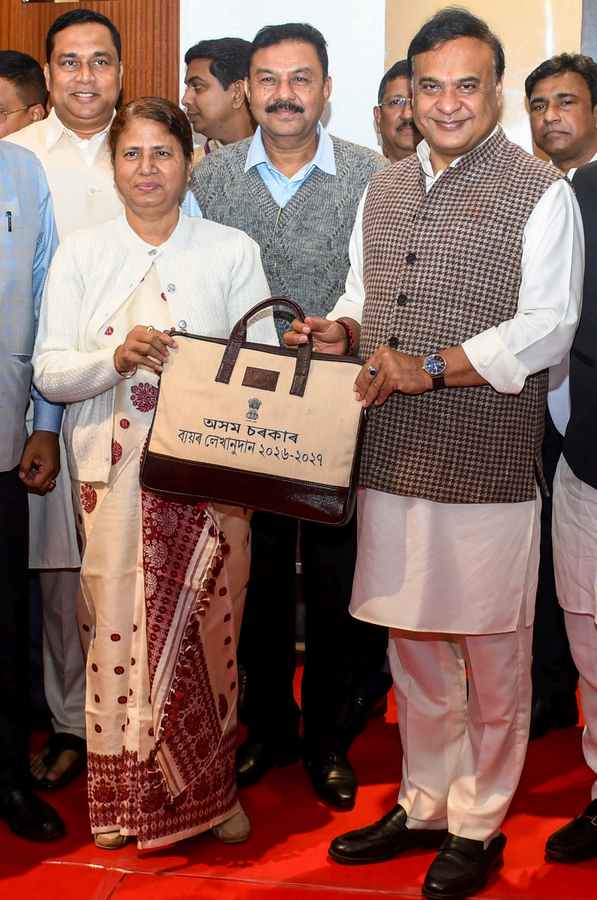
The Chief Minister said that on March 17, 2025, he had presented his first budget as Finance Minister in the Vidhan Sabha. He described it as a people's budget shaped by public suggestions rather than merely a government document.
He said that 248 announcements were made in that budget, out of which 77 have already been fully implemented, while work on 165 announcements is in the final stages. Saini said the upcoming Budget for 2026-27 will fulfil the aspirations and expectations of the people.
"We had sought suggestions from people regarding the budget and 12,400 suggestions have been received... Nearly 4,000 to 5,000 suggestions will be incorporated in the budget for 2026-27," he told reporters here.
He said that over the past 10 years, Haryana's per capita income has consistently increased, rising from Rs. 1,47,382 in 2014-15 to the current level, reflecting nearly two-and-a-half-fold growth.
The actual expenditure of all state departments was Rs. 1,75,801 crore in 2024-25, compared to Rs. 61,904 crore in 2014-15. In the current financial year, the actual expenditure till February 16, 2026, stands at Rs. 1,59,747 crore and is expected to reach around Rs. 2 lakh crore by March 31, 2026, which would be nearly 98 per cent of the Budget estimate.
He further said this would be the first time in history that such a high proportion of the Budget is utilised. Responding to opposition criticism, the Chief Minister said actual expenditure on the economy during the BJP government's tenure has been nearly three times that of previous governments.
He added that more than 80 per cent of the allocated expenditure for 2025-26 has already been incurred by around 11 departments, including Police, Transport, Revenue and Medical Education and Research. Around 21 departments have recorded over 70 per cent expenditure and about 18 departments over 60 per cent.
Taking a dig at the opposition, he said those under whose tenure the system was weak are now questioning financial management. He said the fiscal deficit is the best indicator of financial management.
The state's fiscal deficit for 2024-25 stood at 2.83 per cent of GDP, compared to 2.88 per cent in 2014-15, both within the FRBM limit of 3 per cent, indicating improved fiscal discipline..
Saini said that as per the recommendations of the 16th Finance Commission (2026-31), Haryana's share in central taxes has increased from 1.093 per cent to 1.361 per cent, marking an increase of 24.52 per cent over the 15th Finance Commission period.
He said this increased share reflects the state government's strong financial credibility and effective policy framework..
Referring to employment, he cited a NITI Aayog working paper published, stating that while about 90.61 lakh people were employed in government and private sectors in 2004-05, the number declined to 86.93 lakh in 2014-15.
However, by 2023-24, employment had risen to 1.10 crore across sectors. This indicates that while nearly 3.68 lakh people lost employment between 2004 and 2014, about 27 lakh new employment opportunities have been created by 2023-24, he said.
On education, he said the Gross Enrolment Ratio (GER) in higher education has increased from about 27 per cent during 2004-14 to 34 per cent during 2015-25. The number of universities in the state, which was around 45 between 2005 and 2014, has increased significantly with the establishment of 60 new universities between 2015 and 2025.
He questioned critics who claim a decline in education standards, asking whether these figures do not reflect progress in the education sector. He said that according to the white paper issued by the Finance Department, the state's own revenue stood at Rs 25,567 crore in 2013-14. By 2024-25, this had increased to Rs 77,943 crore.
Between 2004 and 2014, MSME activity remained limited, with around 33,000 units registered. However, between 2015 and 2025, more than 20 lakh MSMEs were registered on the Udyam and Udyam Registration portals, bringing a large number of small enterprises into the formal system.
Between April 2024 and March 2025, Haryana's total exports stood at 19.10 billion US dollars, reflecting the state's growing strength in both investment and exports. From 2015 to 2024, Haryana's total exports were USD 132.13 billion, whereas from 2004 to 2014, that is, the previous 10 years, they were only USD 61.60 billion, he said.