April 9, Thiruvananthapuram/Guwahati/Puducherry – Voting in the Thursday assembly elections in Assam, Kerala, and Puducherry saw record voter turnout, with women participating in greater numbers than men.
The election process was largely peaceful, despite heavy security deployment, with only isolated incidents reported.
Assam and Puducherry recorded the highest voter participation ever, with 85.38% and 89.83% turnout, respectively. Previously, Assam's highest turnout was 84.67% in the 2016 assembly elections, and for Puducherry, it was 86.19% in 2011. Kerala recorded 78.03%.
Chief Election Commissioner Gyanesh Kumar welcomed the high turnout in the first phase of the elections, which may be the highest in five decades, highlighting that the impressive turnout reflects the people's trust in democracy.
Notably, women voters outnumbered men in all three states and the Union Territory. In Assam, women constituted 85.96% of voters, compared to 84.80% for men, while in Kerala, it was 80.86% and 75.01% for men, and in Puducherry, 91.33% and 88.09% for men. Puducherry also recorded the highest turnout of electors representing the third gender at 91.81%, compared to Assam's 36.84% and 91.81% in Kerala.
A total of 296 assembly constituencies in the two states and the Union Territory of Puducherry went to the polls, with over 5.31 crore electors. Simultaneously, by-elections were also held in Karnataka's Bagalkot and Davanagere South, Nagaland's Koridang, and Tripura's Dharmanagar.
Several initiatives to encourage voting, such as candidate photos on EVM ballot papers, Mobile Deposit Facility (MDF), newly-designed Voter Information Slips (VIS) for easy readability, and a limit of 1,200 electors per polling station, were implemented.
Voters lined up steadily throughout the day, even with specially-abled individuals exercising their right to vote.
In Kalamasseri, Ernakulam, Kerala, a newly married couple cast their votes at the HMT School polling station.
In Thiruvananthapuram, first-time voters received halwa from CEO, Dr. Rathan U. Kelkkar, as part of the Vote Sweetened Kerala campaign.
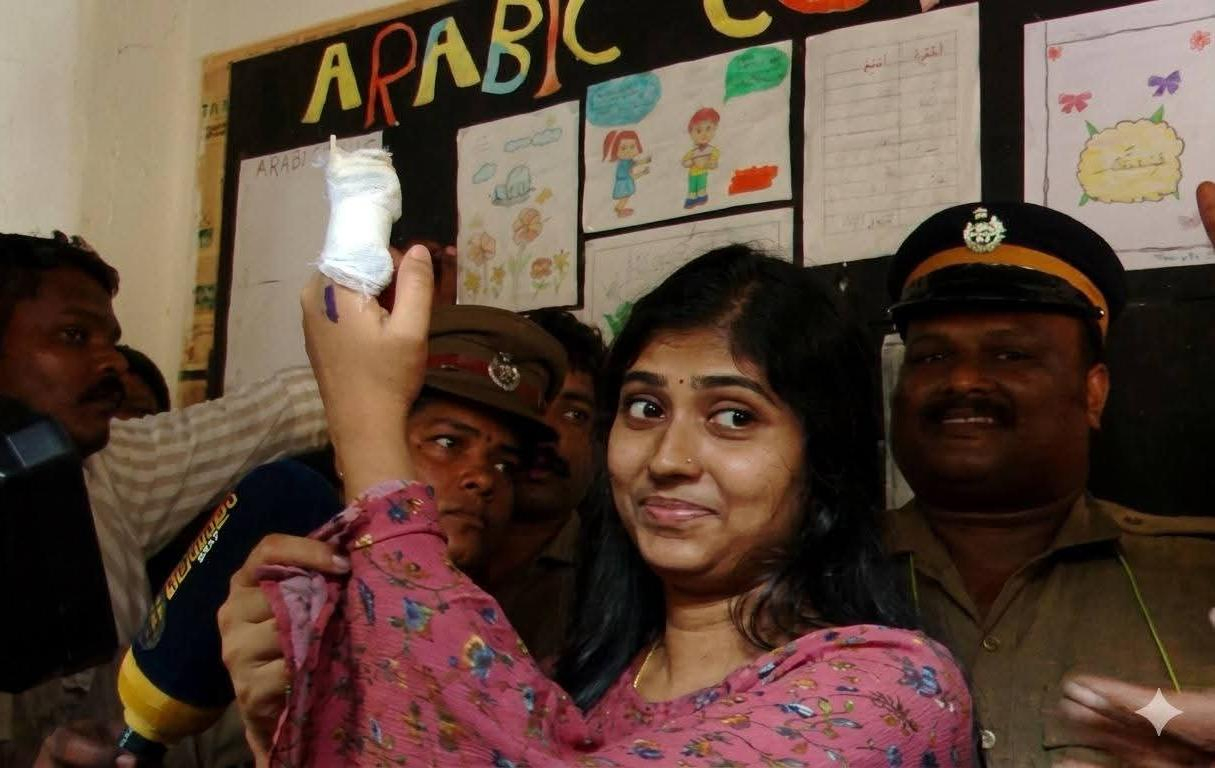
In Thrissur, woman voter Akshaya was initially stopped because her left index finger was bandaged due to an injury. The Presiding Officer refused to allow her to vote as the election ink could not be applied to that finger. However, the Chief Electoral Officer intervened and gave a written order, allowing her to cast her vote.
Meanwhile, a robot was seen welcoming voters at the VOC Government School Higher Secondary School in Puducherry's Raj Bhavan constituency. The white robot was seen moving along a corridor, carrying a tray full of petals, greeting people, and encouraging them to exercise their franchise.
Thursday's election covered 140 seats in Kerala, 126 in Assam, and 30 in Puducherry. Tamil Nadu will go to the polls on April 23, and West Bengal on April 23 and 29. Voting counting is slated for May 4.
Election authorities and state governments deployed large security forces – paramilitary units and local police reinforcements – and model polling booths to ensure orderly voting across urban and remote booths.
The emphasis was on preventing booth capture, intimidation, and illegal campaigning near polling stations. Only a few, isolated incidents were reported during the day.
Most reports highlighted the routine seizure of illicit materials, complaints of EVM malfunction or queue disruptions, followed by rapid police responses; no major law and order incidents were reported by evening.
Election officials emphasized strict enforcement of the model code of conduct and quick redressal mechanisms, as special teams monitored sensitive constituencies in Assam and urban pockets in Kerala.
Assam saw high rural and tribal turnout, with long queues at many booths and visible enthusiasm among first-time voters.
The polls came after the mandatory silent period, before which the campaign was dominated by flags and banners, rallies of political parties, and local issues such as migration, land rights, and development shaped voter conversations.
Polling in Kerala combined disciplined turnout, where the day remained largely peaceful and orderly, while Puducherry recorded the highest reported turnout, with strong voter mobilization in both urban and rural areas.
Polling continued from 7 a.m. to 5 p.m., though those electors who had joined the queues before closing time were allowed to cast their vote.
High-stakes narratives, such as regional identity in Assam, development vs anti-incumbency in Kerala, and local issues in Puducherry, targeted voter outreach and strong ground organisation by parties contributed to elevated participation. Weather and weekend scheduling also aided turnout in many districts.
While the National Democratic Alliance governments in both Assam and Puducherry are looking for another term, the contest in Kerala is between two blocs, where the incumbent Left Democratic Front, led by the Communist Party of India-Marxist, is again facing a challenge from the Congress-led United Democratic Front alliance.