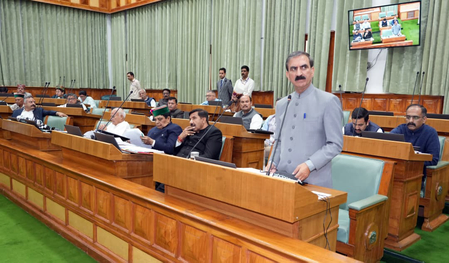
Shimla, February 24 Himachal Pradesh Chief Minister Sukhvinder Singh Sukhu oversaw the signing of two agreements on Tuesday to expand the cultivation of medicinal plants across the state.
Sukhu also released a report, "Scientific Assessment of Tackling Non-CO2 Emissions: Pathways for Himachal Pradesh," which outlines strategies to address greenhouse gases beyond carbon dioxide as part of the state's climate action agenda.
The Memorandums of Agreement (MoAs) were signed with Dabur India and Karan Singh Vaidh—a renowned Ayurvedic practitioner and researcher based in Solan—to promote the cultivation and conservation of medicinal plants in the state, a statement issued here said.
Under the agreement, Dabur will supply 12 lakh saplings annually—1.20 crore over 10 years—suited to the different agro-climatic zones of the state, it said.
In the low and mid-hill regions of Una, Bilaspur, Hamirpur, Kangra, and Sirmaur, Amla, Harad, Bahera, Kakadshingi, and Lodhra will be distributed. In the mid to high-hill areas of Kullu, Chamba, Mandi, and Kinnaur, Jatamansi, Kutaki, Sugandhbala (herbs), Padam Kasht (tree), and Pushkarmool (herb) will be distributed.
Alpine species such as Atich and Vish (herbs) will be made available to farmers in the higher reaches of Kinnaur, Lahaul-Spiti, and Chamba districts.
The second agreement with Karan Singh Vaidh, for a period of five years, envisages promoting the cultivation, conservation, and value-chain development of selected medicinal plants in the Solan district.
The chief minister said that his government was committed to making Himachal Pradesh the first Green Energy State in the country and has initiated various steps in this direction.
Environmental conservation has been accorded top priority, and several initiatives have been undertaken to preserve the state's pristine environment, he said, adding that the government has set a target of harnessing 200 MW of solar power during the current year.
A one-megawatt Green Hydrogen plant is also being established at Nalagarh in collaboration with Oil India Limited, and the state government is also promoting electric mobility, he said.
Around 300 new e-buses will be inducted into the fleet of Himachal Roadways Transport Corporation (HRTC) by April this year. Moreover, electric vehicles are being deployed across government departments, and a 40 per cent subsidy is being provided to convert 38,000 taxis into e-taxis, he added.
Sukhu said that climate change has posed serious challenges, resulting in unprecedented cloudbursts, flash floods, landslides, and shrinking glaciers in the state. He termed these developments as warning signals that demand urgent remedial measures.
He said that Himachal Pradesh was not merely a geographical entity but the soul of the Himalayas. Its glaciers, rivers, forests, and mountains define its identity and sustain millions beyond its borders. Any disturbance to the Himalayas would have worse consequences not only for the State but for the entire nation, he said.