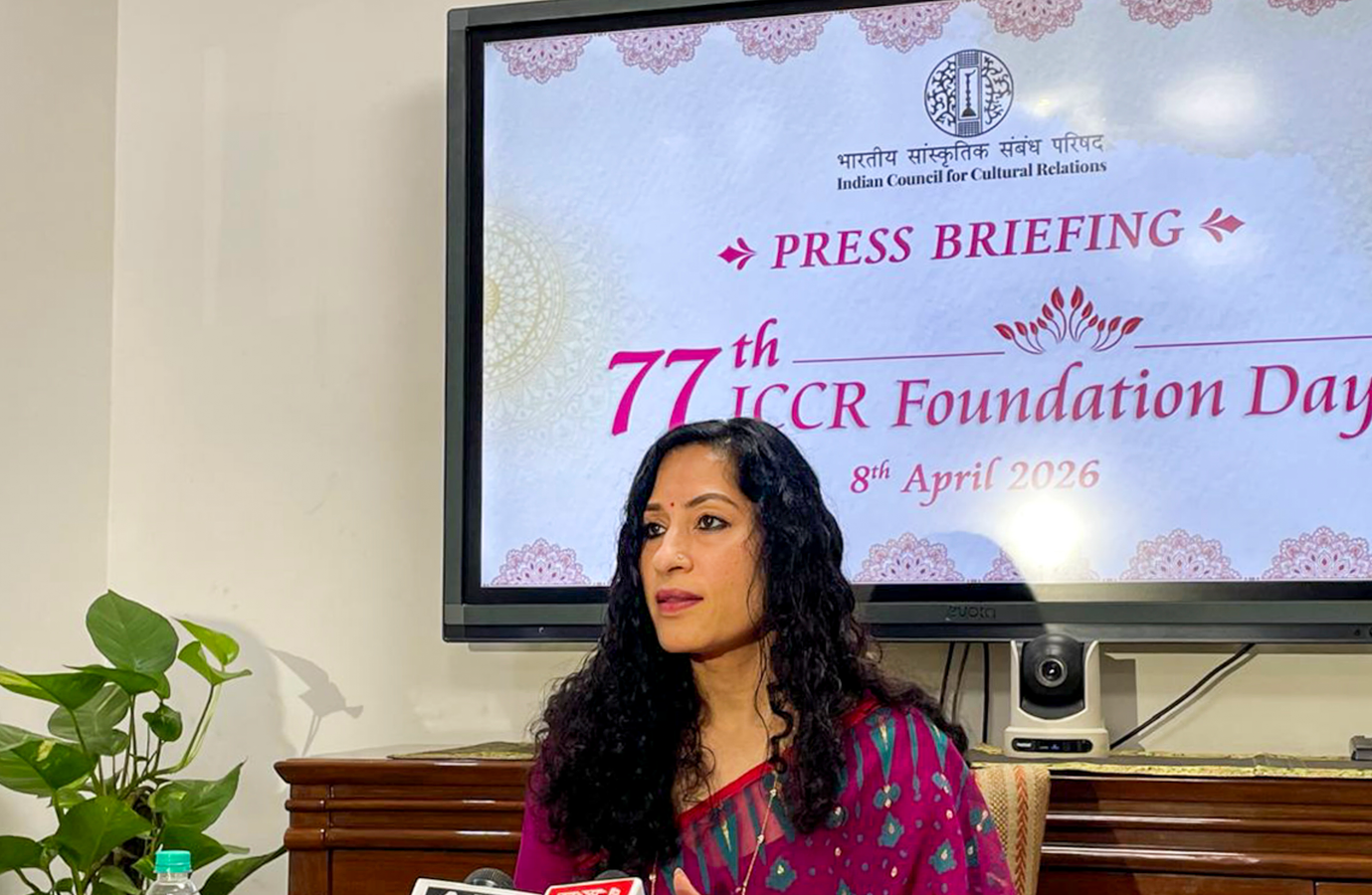
New Delhi, April 8 India stands for peace, harmony, and universal brotherhood, K Nandini Singla, Director General of the Indian Council for Cultural Relations (ICCR), said on Wednesday, asserting that in times of wars, conflicts, and growing anxiety, Indian values and its ideas as a civilization are becoming increasingly relevant.
At a press conference held at Azad Bhawan on the eve of the 77th foundation day of the ICCR, she also said that the world needs to be reminded of the ancient Indian ethos of Vasudhaiva Kutumbakam.
"This is not just a cliché. The feeling of 'Vasudhaiva Kutumbakam' is something that every person in the world appreciates – the idea that we are all interconnected, and that we cannot thrive at someone else's expense," Singla said.
In her remarks, the Director General of the ICCR – the cultural arm of the Ministry of External Affairs (MEA) – also referred to the multiple conflicts taking place in the world, including the ongoing Russia-Ukraine War and the West Asia conflict.
The conflict in West Asia has reached a critical juncture as Iran and the US agreed on a conditional ceasefire that includes the opening of the Strait of Hormuz, a strategically important waterway between the Persian Gulf and the Gulf of Oman, which handles approximately 20 per cent of global oil and LNG (Liquefied Natural Gas).
Earlier in the day, India welcomed the two-week ceasefire and called for unimpeded freedom of navigation and commerce through the Strait of Hormuz, while hoping for lasting peace in West Asia.
New Delhi on Wednesday reiterated its continuous advocacy for dialogue and diplomacy to bring an early end to hostilities.
The conflict was triggered by US-Israeli strikes against Iran on February 28 and has had ramifications on the global economy and energy sourcing by a large number of countries, including India.
Singla welcomed the ceasefire and said she hoped the West Asia conflict will soon end, leading to lasting peace in the region, taking note of the large Indian diaspora that lives in the region.
Asked if any of the cultural centres run by the ICCR in Israel, Iran, and the Gulf countries have suffered any damage during the course of the conflict, she said, "No, none of our properties have suffered any damage."
The DG said as the ICCR completes 76 years since its inception on April 9, 1950, "We recommit ourselves to connecting India with the world, and to projecting the richness and diversity of India's culture, and to disseminating to the world the timeless and eternal values that India represents."
"And, I believe that in today's world of wars, conflicts and growing anxiety, these values of India are becoming more and more relevant. The world needs to be reminded of Vasudhaiva Kutumbakam," she said, adding that humanity is interconnected, which can "prosper or perish together."
This is India's message to the world, what the Indian prime minister has been saying, and what the external affairs minister has also been advocating, the DG said.
"This is what India stands for – peace, harmony and universal brotherhood," Singla asserted.
She underlined that in times of conflict, the role of ICCR has become "more and more important, and not just relevant."
"Because at a time of war, when normal channels of communication break down, it is culture that continues to connect. Even when countries have difficult relationships with one another, there are dancers, musicians, poets, actors, painters who continue to connect people at a human level. So, culture transcends borders, languages, and I would say, even conflicts," she emphasised.
Singla said, "Politics changes, power equations change, geopolitics evolves, but cultural exchanges continue despite everything."
"So, when a relationship is troubled, we continue to connect with the people of that country, so that when the relationship gets normalised, the two countries take off from where they had left off," she added.
The ICCR DG said the Indian values and its ideas as a civilisation "find resonance, especially in times of conflict".
She shared that during the peak of the Russia-Ukraine war, representatives of "some of our yoga and meditation...organisations" in conflict zones went to schools when children were developing anxiety or stress, and started teaching them yoga, breathing and relaxation exercises, which helped them.
Singla said Delhi Lieutenant Governor and former diplomat Taranjit Singh Sandhu will be the chief guest at the ICCR's 77th foundation day ceremony on Thursday, which will be hosted in the Delhi University's North Campus area.
Foreign students who are currently in India on ICCR scholarships, including those studying at the DU, will take part in cultural performances on the occasion, depicting Indian dance forms, she said.