JAMMU, April 8: The Jammu and Kashmir Government has begun identifying eligible beneficiaries under the Antyodaya Anna Yojana (AAY) category to provide 200 units of free electricity per month, aiming to support economically weaker sections across the Union Territory.
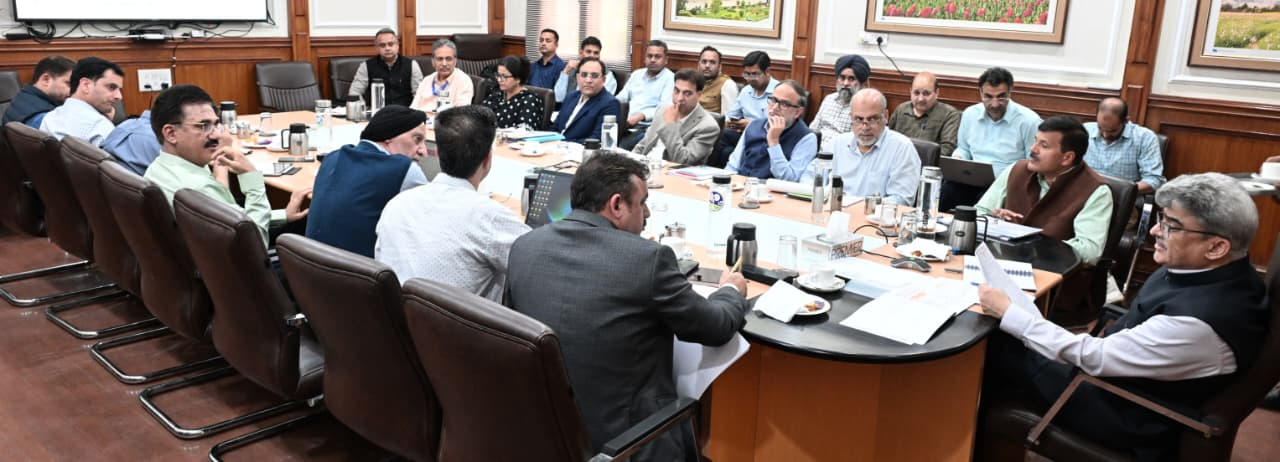
The progress of this initiative was reviewed during a high-level meeting chaired by Chief Secretary Atal Dulloo. The meeting focused on accelerating power sector reforms while balancing social welfare, sustainability, and efficiency. It also evaluated the implementation of the Revamped Distribution Sector Scheme (RDSS) and the expansion of rooftop solar installations under the PM Surya Ghar: Muft Bijli Yojana.
The free electricity scheme is expected to benefit over 2.22 lakh AAY households across all districts, including those in remote and hard-to-reach areas. Identification of beneficiaries is being carried out in coordination with district administrations, with ongoing efforts to ensure accurate targeting.
Additional Chief Secretary of the Power Development Department, Ashwani Kumar, stated that extensive field verification and data validation are underway to ensure that only genuine beneficiaries are included. Authorities are addressing issues such as mismatches between ration card and electricity records, migration cases, inaccessible households, and a lack of awareness or participation.
Special attention is being given to remote and mountainous regions, where scattered settlements and challenging terrain complicate outreach and power distribution.
Alongside the welfare initiative, significant progress has been made in promoting rooftop solar energy under the PM Surya Ghar scheme. In the Jammu Division, over 28,600 applications have been received, with more than 11,000 installations completed—around 67% progress. In the Kashmir Division, more than 73,000 applications have been submitted, and over 17,700 installations completed, with several districts exceeding targets.
The scheme is largely being implemented under the RESCO (Renewable Energy Service Company) model, allowing private developers to install and maintain solar systems without requiring upfront payments from consumers.
The meeting also reviewed progress under RDSS, a major reform programme aimed at strengthening power distribution infrastructure. Projects worth ₹5,762 crore are underway, including ₹1,053 crore for smart metering and ₹4,709 crore for reducing transmission and commercial losses.
Over 7.10 lakh smart meters have already been installed across Jammu and Kashmir, including nearly 3 lakh in the last six months. Improvements have also been noted in operational performance, with the ACS-ARR gap reduced to 0.3 by FY 2025–26, billing efficiency rising to 77%, collection efficiency to 94%, and AT&C losses brought down to 30%.
The Chief Secretary emphasized that combining direct financial relief with long-term reforms like solar energy adoption and infrastructure upgrades will enhance power reliability, reduce losses, and promote sustainable development across the Union Territory.